 Back
Chapter 14: The Molecular Basis of Inheritance – DNA Structure, Replication, and Chromatin
Study Guide - Smart Notes
 Tailored notes based on your materials, expanded with key definitions, examples, and context.
DNA as the Genetic Material
Historical Evidence and Discovery
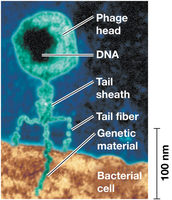
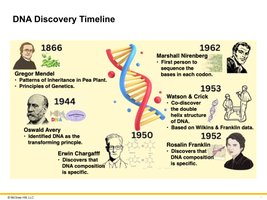
DNA is the hereditary material found in the nucleus of cells, encoding all information necessary for organismal development and function. Early researchers believed proteins, due to their complexity, were the genetic material, but experiments with bacteria and viruses demonstrated that DNA is responsible for heredity.
Key Point: DNA was shown to be the genetic material through studies of bacteriophages (viruses that infect bacteria).
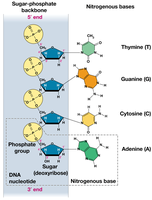
Key Point: DNA is a polymer of nucleotides, each consisting of a nitrogenous base, a sugar, and a phosphate group.
Example: The Hershey-Chase experiment used radioactive labeling to show that DNA, not protein, enters bacterial cells during infection.
Structure of DNA
Nucleotide Composition and Chargaff’s Rules
DNA is composed of four types of nucleotides: adenine (A), thymine (T), guanine (G), and cytosine (C). Erwin Chargaff discovered that DNA composition varies between species and that the amount of A equals T, and G equals C in any given species.
Key Point: Chargaff’s rules provided evidence for base pairing in DNA.
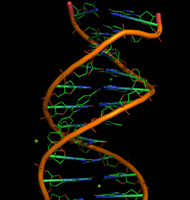
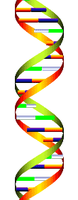
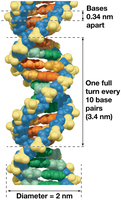
Key Point: DNA is a double helix with antiparallel strands.
Example: The Watson-Crick model explains that A pairs with T and G pairs with C, maintaining uniform width in the helix.
DNA and RNA Structure
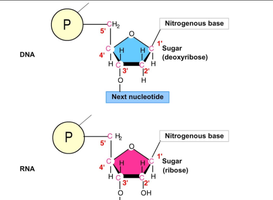
DNA and RNA are both nucleic acids, but DNA contains deoxyribose sugar and thymine, while RNA contains ribose sugar and uracil.
Key Point: DNA is typically double-stranded, while RNA is single-stranded.
Key Point: The sugar-phosphate backbone provides structural stability.
Building the Structural Model of DNA
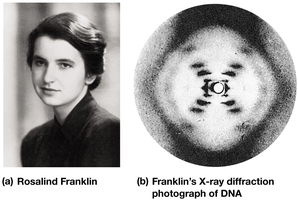
X-ray crystallography, performed by Rosalind Franklin, provided critical evidence for the helical structure of DNA. Watson and Crick used this data to build the double helix model, showing antiparallel sugar-phosphate backbones and interior base pairing.
Key Point: Purines (A, G) pair with pyrimidines (C, T) to maintain uniform helix width.
Key Point: The double helix is stabilized by hydrogen bonds between complementary bases.
DNA Replication
Semiconservative Model and Meselson-Stahl Experiment
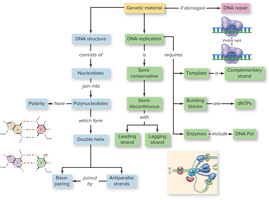
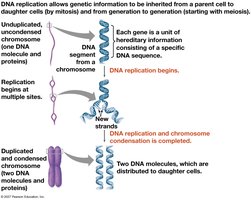
DNA replication is the process by which DNA is copied before cell division. The semiconservative model states that each new DNA molecule consists of one old strand and one newly synthesized strand. The Meselson-Stahl experiment confirmed this model using isotopic labeling.
Key Point: Replication ensures accurate transmission of genetic information.
Key Point: Competing models included conservative and dispersive, but only semiconservative was supported by evidence.
Mechanism of DNA Replication
Replication begins at origins of replication, forming replication bubbles and forks. Enzymes such as helicase, primase, DNA polymerase, and ligase coordinate the process.
Key Point: DNA polymerase adds nucleotides only to the 3' end, synthesizing in the 5' to 3' direction.
Key Point: The leading strand is synthesized continuously, while the lagging strand is synthesized discontinuously as Okazaki fragments.
Key Point: DNA ligase joins Okazaki fragments; primase synthesizes RNA primers; helicase unwinds DNA; topoisomerase relieves strain.
Example: Okazaki fragments are short DNA segments on the lagging strand, joined by ligase.
Proofreading and Repair
DNA polymerases proofread newly synthesized DNA, correcting errors. Additional repair mechanisms include mismatch repair and nucleotide excision repair, involving enzymes such as nuclease.
Key Point: Mutations arise when errors escape repair, contributing to genetic variation.
Replicating Chromosome Ends: Telomeres and Telomerase
Eukaryotic chromosomes have telomeres at their ends, which protect genes from erosion during replication. Telomerase extends telomeres in germ cells and is active in some cancer cells.
Key Point: Telomere shortening is associated with aging and cell division limits.
Key Point: Telomerase activity allows cells to maintain chromosome length.
Chromatin Structure and Chromosome Organization
Levels of Chromatin Packing
Chromatin is the complex of DNA and proteins (mainly histones) that forms chromosomes. Packing levels range from nucleosomes (DNA wrapped around histone octamers) to higher-order structures.
Key Point: Nucleosomes resemble "beads on a string" in 10-nm fibers.
Key Point: Chromatin packing changes during the cell cycle, condensing into metaphase chromosomes for mitosis.
Euchromatin vs. Heterochromatin
Key Point: Euchromatin is loosely packed and transcriptionally active.
Key Point: Heterochromatin is highly condensed and transcriptionally inactive, found at centromeres and telomeres.
Prokaryotic vs. Eukaryotic Chromosomes
Key Point: Bacterial chromosomes are circular and supercoiled, found in the nucleoid.
Key Point: Eukaryotic chromosomes are linear and associated with large amounts of protein.
Histone Modification and Gene Expression
Chemical modifications of histones affect chromatin condensation and gene expression, playing a role in epigenetic regulation.
Key Point: Histone tails can be modified to regulate access to DNA.
Table: Bacterial DNA Replication Proteins and Their Functions
Protein | Function |
|---|---|
Helicase | Unwinds DNA at replication forks |
Single-strand binding protein | Stabilizes single-stranded DNA |
Topoisomerase | Relieves strain ahead of replication fork |
Primase | Synthesizes RNA primer |
DNA polymerase III | Main enzyme for DNA synthesis |
DNA polymerase I | Removes RNA primer and replaces with DNA |
DNA ligase | Joins Okazaki fragments |
Key Equations and Concepts
DNA Polymerization: Each nucleotide added is a nucleoside triphosphate, releasing pyrophosphate:
Semiconservative Replication:
Summary
The molecular basis of inheritance centers on DNA, its structure, replication, and packaging into chromatin. Accurate DNA replication and repair are essential for genetic continuity, while chromatin structure regulates gene expression and chromosome organization. Additional info: Chromatin modifications and telomere dynamics are active areas of research in genetics and cell biology.
