 Back
Chapter 14: The Molecular Basis of Inheritance – DNA Structure, Replication, and Chromatin
Study Guide - Smart Notes
 Tailored notes based on your materials, expanded with key definitions, examples, and context.
DNA as the Genetic Material
Historical Evidence and Discovery
The identification of DNA as the genetic material was a pivotal moment in biology, supported by experiments with bacteria and viruses. Early researchers believed proteins were the genetic material due to their complexity, but evidence from bacteriophage studies and DNA composition led to the acceptance of DNA's role in heredity.
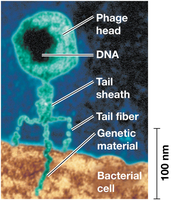
Bacteriophages (phages) are viruses that infect bacteria, demonstrating that DNA can program cells.
DNA is a polymer of nucleotides, each consisting of a nitrogenous base, a sugar, and a phosphate group.
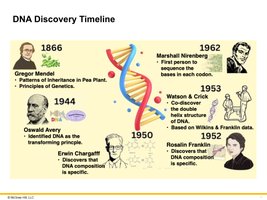
Erwin Chargaff showed that DNA composition varies between species, supporting its role as genetic material.
Chargaff’s Rules
Chargaff’s rules state that in any species, the number of adenine (A) and thymine (T) bases is equal, as is the number of guanine (G) and cytosine (C) bases. This was explained by the discovery of the double helix structure.
Base composition varies between species.
A = T and G = C in any organism.
Structure of DNA
Nucleotide Composition and Double Helix
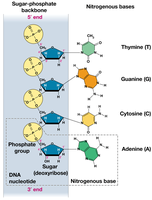
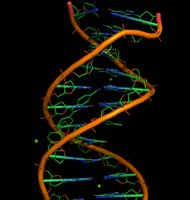
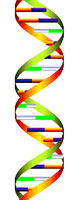
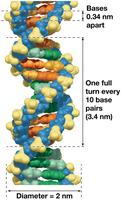
DNA is composed of nucleotides, each containing a phosphate group, a deoxyribose sugar, and a nitrogenous base (A, T, G, or C). The double helix structure, discovered by Watson and Crick, consists of two antiparallel strands with complementary base pairing.
Purines (A, G) pair with pyrimidines (C, T) to maintain uniform width.
Backbones are antiparallel, running in opposite directions.
Hydrogen bonds between bases stabilize the helix.
DNA vs. RNA Structure
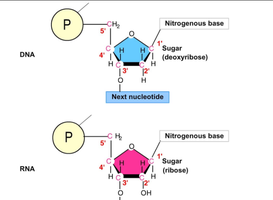
DNA and RNA are both nucleic acids, but differ in their sugars and bases. DNA contains deoxyribose and thymine, while RNA contains ribose and uracil.
DNA: deoxyribose sugar, bases A, T, G, C.
RNA: ribose sugar, bases A, U, G, C.
Experimental Evidence for DNA Structure
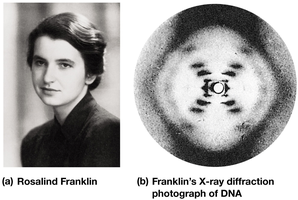
X-ray crystallography, performed by Rosalind Franklin, provided key evidence for the helical structure of DNA. Watson and Crick used these images to deduce the double helix model.
Franklin’s X-ray diffraction images revealed the helical nature and dimensions of DNA.
Watson and Crick built models based on these findings.
DNA Replication
Semiconservative Model and Meselson-Stahl Experiment
DNA replication is the process by which genetic information is copied for cell division. The semiconservative model, supported by the Meselson-Stahl experiment, states that each new DNA molecule contains one old strand and one new strand.
Replication ensures faithful transmission of genetic information.
Competing models: conservative (parent strands rejoin), dispersive (mix of old and new).
Meselson-Stahl experiment confirmed semiconservative replication.
Mechanism of DNA Replication
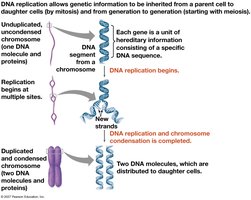
Replication begins at origins of replication, forming replication bubbles and forks. Multiple enzymes and proteins coordinate the process.
Helicase: unwinds the double helix.
Single-strand binding proteins: stabilize unwound DNA.
Topoisomerase: relieves strain from unwinding.
Primase: synthesizes RNA primer.
DNA polymerase: adds nucleotides to the 3' end.
DNA ligase: joins Okazaki fragments on the lagging strand.
Antiparallel Elongation: Leading and Lagging Strands
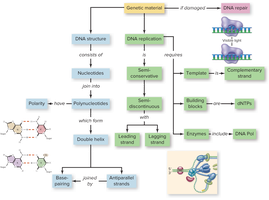
Due to the antiparallel nature of DNA, replication occurs differently on each strand. The leading strand is synthesized continuously, while the lagging strand is synthesized in fragments (Okazaki fragments).
DNA polymerase can only add nucleotides to the 3' end.
Lagging strand synthesis requires multiple primers and DNA ligase to join fragments.
Proofreading and DNA Repair
DNA polymerases proofread newly synthesized DNA, correcting errors. Additional repair mechanisms include mismatch repair and nucleotide excision repair, involving enzymes such as nuclease.
Low error rate after proofreading and repair.
Mutations can become permanent and contribute to genetic variation.
Telomeres and Telomerase
Structure and Function of Telomeres
Telomeres are repetitive nucleotide sequences at the ends of eukaryotic chromosomes, protecting genes from erosion during replication. Telomerase extends telomeres in germ cells and is active in some cancer cells.
Telomeres postpone gene erosion but do not prevent shortening.
Telomerase activity is linked to cell longevity and cancer.
Chromatin Structure and Chromosome Packing
Levels of Chromatin Packing
Chromatin is the complex of DNA and proteins in eukaryotic cells. Packing levels range from nucleosomes to highly condensed metaphase chromosomes.
Nucleosome: DNA wrapped around histone proteins.
Chromatin can be loosely packed (euchromatin) or highly condensed (heterochromatin).
Histone modifications affect chromatin structure and gene expression.
Bacterial vs. Eukaryotic Chromosomes
Bacterial chromosomes are circular and associated with fewer proteins, while eukaryotic chromosomes are linear and highly protein-associated.
Bacterial DNA is supercoiled in the nucleoid region.
Eukaryotic chromosomes undergo complex packing and condensation during the cell cycle.
DNA Discovery Timeline
Key Historical Milestones
The discovery of DNA as the genetic material involved contributions from many scientists, including Mendel, Avery, Chargaff, Franklin, Watson, and Crick.
Summary Table: DNA Replication Proteins and Functions
Protein | Function |
|---|---|
Helicase | Unwinds the DNA double helix |
Single-strand binding protein | Stabilizes single-stranded DNA |
Topoisomerase | Relieves strain from unwinding |
Primase | Synthesizes RNA primer |
DNA polymerase | Adds nucleotides to the growing DNA strand |
DNA ligase | Joins Okazaki fragments |
Nuclease | Removes damaged DNA |
Key Equations and Concepts
Base pairing: ,
Antiparallel strands: 5' → 3' and 3' → 5'
Semiconservative replication: Each new DNA molecule contains one old strand and one new strand
Additional info:
Mutations arising from replication errors are a source of genetic diversity and evolution.
Histone tail modifications can regulate gene expression by altering chromatin structure.
