 Back
Chapter 14: The Molecular Basis of Inheritance – DNA Structure, Replication, and Chromatin
Study Guide - Smart Notes
 Tailored notes based on your materials, expanded with key definitions, examples, and context.
DNA: The Genetic Material
Historical Evidence and Discovery
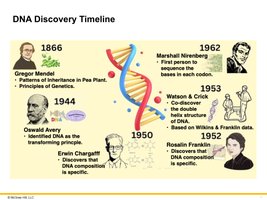
DNA is the hereditary material found in the nucleus of cells, encoding all information necessary for organismal development. Early researchers believed proteins were the genetic material due to their complexity, but experiments with bacteria and viruses revealed DNA's central role.
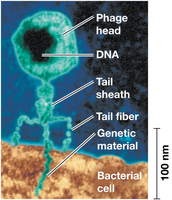
Key Point: DNA was identified as the genetic material through studies of bacterial transformation and viral infection.
Example: The Hershey-Chase experiment showed that viral DNA, not protein, enters bacterial cells and directs viral reproduction.
Structure of DNA
DNA Composition and Chargaff's Rules
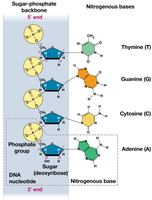
DNA is a polymer of nucleotides, each consisting of a nitrogenous base, a sugar (deoxyribose), and a phosphate group. The four bases are adenine (A), thymine (T), guanine (G), and cytosine (C). Chargaff's rules state that in any species, the amount of A equals T, and G equals C.
Key Point: DNA composition varies between species, supporting its role as genetic material.
Key Point: Chargaff’s rules are explained by the base pairing in the double helix.
Double Helix Structure
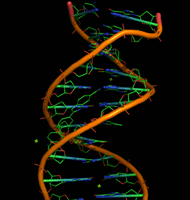
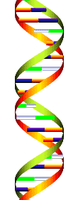
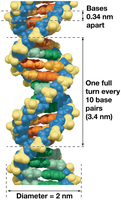
The double helix model, proposed by Watson and Crick, describes DNA as two antiparallel strands twisted around each other. The sugar-phosphate backbones are on the outside, and the bases pair in the interior: A with T, G with C. The uniform width of the helix is due to pairing a purine with a pyrimidine.
Key Point: The antiparallel arrangement means one strand runs 5' to 3', the other 3' to 5'.
Key Point: Hydrogen bonds between complementary bases stabilize the helix.
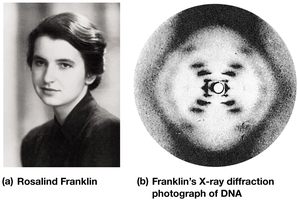
Example: X-ray crystallography images by Rosalind Franklin provided evidence for the helical structure.
DNA Replication
Semiconservative Model and Meselson-Stahl Experiment
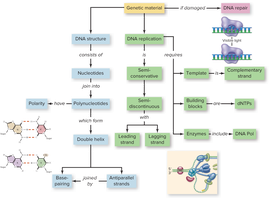
DNA replication is the process by which DNA is copied before cell division. The semiconservative model states that each new DNA molecule consists of one old strand and one new strand. The Meselson-Stahl experiment confirmed this model by demonstrating the distribution of old and new DNA strands after replication.
Key Point: Accurate replication ensures genetic information is transmitted to offspring.
Key Point: Competing models (conservative, dispersive) were disproven by experimental evidence.
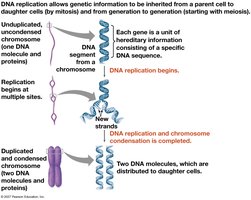
Mechanism of DNA Replication
Replication begins at origins of replication, forming replication bubbles. Enzymes unwind the DNA and synthesize new strands. The process involves several proteins:
Helicase: Unwinds the double helix.
Single-strand binding proteins: Stabilize unwound DNA.
Topoisomerase: Relieves strain from unwinding.
Primase: Synthesizes RNA primers.
DNA polymerase: Adds nucleotides to the 3' end of the primer.
DNA ligase: Joins Okazaki fragments on the lagging strand.
Leading and Lagging Strands
Due to the antiparallel nature of DNA, replication occurs differently on each strand:
Leading strand: Synthesized continuously toward the replication fork.
Lagging strand: Synthesized discontinuously away from the fork in short segments called Okazaki fragments.
Energy for DNA Polymerization
Each nucleotide added is a nucleoside triphosphate. The energy for polymerization comes from the hydrolysis of the two terminal phosphates, releasing pyrophosphate.
Proofreading and Repair
DNA polymerases proofread newly synthesized DNA, correcting errors. Additional repair mechanisms include mismatch repair and nucleotide excision repair, involving enzymes such as nuclease.
Telomeres and Telomerase
Structure and Function of Telomeres
Telomeres are repetitive nucleotide sequences at the ends of eukaryotic chromosomes. They protect genes from erosion during replication but shorten with each cell division.
Key Point: Telomerase extends telomeres in germ cells and some cancer cells, allowing continued division.
Example: Telomere shortening is associated with aging; telomerase activity is linked to cancer cell immortality.
Chromatin Structure and Chromosome Organization
Levels of Chromatin Packing
Chromatin is DNA combined with proteins, mainly histones, to fit into the nucleus. Packing levels include:
Nucleosome: DNA wrapped around histone octamers, forming "beads on a string".
30-nm fiber: Nucleosomes coil into a thicker fiber.
Looped domains: Fibers loop and attach to a scaffold.
Metaphase chromosome: Highly condensed chromatin during mitosis.
Euchromatin vs. Heterochromatin
Euchromatin is loosely packed and accessible for transcription, while heterochromatin is densely packed and generally inactive.
Key Point: Chromatin packing changes during the cell cycle, affecting gene expression.
Bacterial vs. Eukaryotic Chromosomes
Bacterial chromosomes are circular and supercoiled, found in the nucleoid. Eukaryotic chromosomes are linear and associated with large amounts of protein.
Feature | Bacterial Chromosome | Eukaryotic Chromosome |
|---|---|---|
Shape | Circular | Linear |
Protein Association | Small amount | Large amount (histones) |
Location | Nucleoid | Nucleus |
Summary Table: Key Proteins in DNA Replication
Protein | Function |
|---|---|
Helicase | Unwinds DNA |
Single-strand binding protein | Stabilizes single-stranded DNA |
Topoisomerase | Relieves strain from unwinding |
Primase | Synthesizes RNA primer |
DNA polymerase | Synthesizes new DNA |
DNA ligase | Joins Okazaki fragments |
Key Equations
DNA Polymerization Reaction:
Chargaff's Rule:
Additional info:
DNA replication is essential for both mitosis and meiosis, ensuring genetic continuity.
Mutations arising from replication errors are a source of genetic variation and evolution.
