 Back
Chapter 15: The Chromosomal Basis of Inheritance – Study Notes
Study Guide - Smart Notes
 Tailored notes based on your materials, expanded with key definitions, examples, and context.
Big Idea: Chromosomes are made of genes that determine heredity
Structure of Chromosomes and Genes
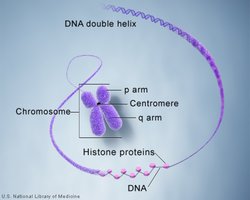
Chromosomes are thread-like structures found in the nucleus of eukaryotic cells, composed of DNA and associated proteins. Genes are specific sequences of DNA located on chromosomes, and they determine hereditary traits by encoding proteins.
Chromosome: A structure consisting of DNA tightly coiled around histone proteins.
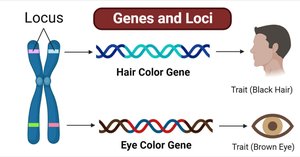
Gene: A segment of DNA that codes for a specific protein or trait.
Locus: The specific physical location of a gene on a chromosome.
Centromere: The region where sister chromatids are joined.
p arm/q arm: The short (p) and long (q) arms of a chromosome.
Trait: A characteristic determined by a gene, such as eye color or hair color.
Chapter 15: The Chromosomal Basis of Inheritance
Concept 15.1: Mendelian Inheritance and Chromosome Behavior
Mendel’s hereditary units were theoretical until parallels between chromosome behavior and inheritance were observed. The chromosome theory of inheritance was developed in the early 1900s, with Thomas Hunt Morgan providing the first solid evidence linking genes to chromosomes.
Mendelian inheritance: The principles of heredity proposed by Gregor Mendel, including the law of segregation and independent assortment.
Chromosome theory of inheritance: States that genes are located on chromosomes, and the behavior of chromosomes during meiosis accounts for inheritance patterns.
Thomas Hunt Morgan: Used fruit flies (Drosophila melanogaster) to demonstrate the chromosomal location of genes.
Morgan’s Choice of Experimental Organism
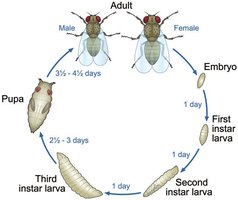
Morgan chose Drosophila melanogaster (fruit fly) for genetic studies due to its rapid life cycle, high offspring number, and simple chromosome structure.
Fruit fly characteristics: Four pairs of chromosomes, short generation time, many offspring.
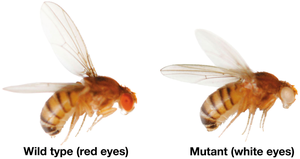
Wild type: The normal phenotype commonly found in nature (e.g., red eyes).
Mutant phenotype: Traits that differ from the wild type (e.g., white eyes).
Correlating Gene Alleles with Chromosome Behavior
Morgan’s experiments with fruit flies demonstrated that the white-eyed allele was located on the X chromosome, supporting the chromosome theory of inheritance.
Sex-linked inheritance: Traits associated with genes located on sex chromosomes.
X chromosome: Females have two (XX), males have one (XY).
Scientific inquiry: Crosses between mutant and wild-type flies revealed inheritance patterns.
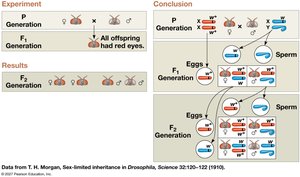
The Chromosomal Basis of Mendel’s Laws
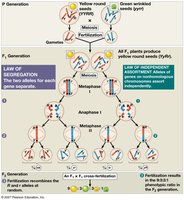
Mendel’s laws of segregation and independent assortment are explained by the behavior of chromosomes during meiosis.
Law of segregation: Each parent passes one allele for each gene to offspring.
Law of independent assortment: Alleles of different genes assort independently during gamete formation.
Concept 15.2: Sex-linked Genes and Patterns of Inheritance
Sex-linked Genes
Genes located on sex chromosomes (X or Y) exhibit unique inheritance patterns. Morgan’s discovery of sex-linked traits in fruit flies was pivotal for understanding chromosomal inheritance.
Sex-linked gene: A gene located on either the X or Y chromosome.
X-linked gene: Found on the X chromosome; human X chromosome contains about 900 genes.
Y-linked gene: Found on the Y chromosome; human Y chromosome contains about 700 genes.
The Chromosomal Basis of Sex
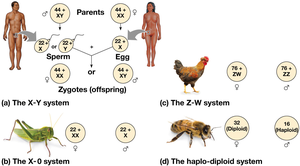
Sex determination systems vary among organisms. In humans and mammals, the X-Y system determines sex, but other systems exist in insects, birds, and bees.
X-Y system: XX = female, XY = male.
X-0 system: Found in insects; XX = female, X0 = male.
Z-W system: Found in birds; ZW = female, ZZ = male.
Haplo-diploid system: Found in bees; females are diploid, males are haploid.
SRY Gene and Sex Determination
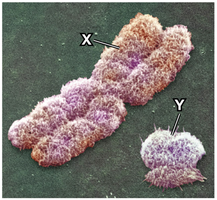
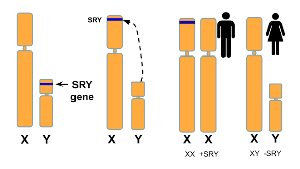
The SRY gene on the Y chromosome is responsible for male development in mammals. Short homologous segments at the ends of X and Y chromosomes allow pairing during meiosis.
SRY gene: Sex-determining region on the Y chromosome; triggers development of testes.
Homologous segments: Allow X and Y chromosomes to behave as homologs during meiosis.
Inheritance of X-Linked Genes
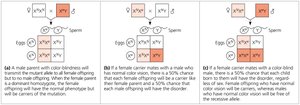
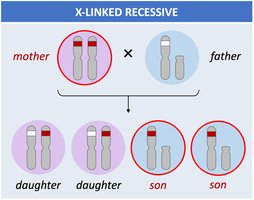
X-linked genes follow specific inheritance patterns. Recessive X-linked traits are more common in males, who only need one copy of the allele to express the trait, while females need two.
Hemizygous: Males have only one X chromosome, so a single recessive allele causes the trait.
Homozygous: Females must have two recessive alleles to express the trait.
X-linked recessive disorders: More frequent in males (e.g., colorblindness).
X Inactivation in Female Mammals
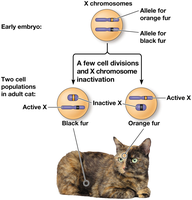
In female mammals, one X chromosome in each cell is randomly inactivated, forming a Barr body. Heterozygous females are mosaics for X-linked traits.
Barr body: Inactive X chromosome condensed in the nucleus.
Mosaic: Females heterozygous for X-linked genes express both alleles in different cells.
Concept 15.3: Linked Genes and Genetic Recombination
Linked Genes
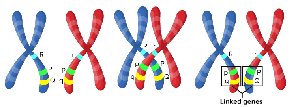
Genes located near each other on the same chromosome tend to be inherited together. These are called linked genes.
Linked genes: Genes located close together on the same chromosome.
Genetic recombination: Production of offspring with combinations of traits different from either parent.
Recombination of Unlinked Genes: Independent Assortment
Genes on different chromosomes assort independently, producing parental and recombinant types. A 50% recombination frequency is observed for genes on different chromosomes.
Parental type: Offspring with phenotype matching one parent.
Recombinant type: Offspring with new combinations of traits.
Recombination of Linked Genes: Crossing Over
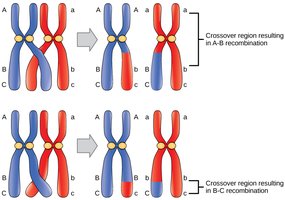
Linked genes can be separated by crossing over during meiosis, resulting in recombination. Morgan observed nonparental allele combinations, indicating crossing over breaks the physical connection between genes.
Crossing over: Exchange of genetic material between homologous chromosomes during meiosis.
Recombination frequency: Used to map gene locations on chromosomes.
Abnormalities in Chromosome Number and Structure
Nondisjunction and Aneuploidy
Nondisjunction occurs when homologous chromosomes fail to separate during meiosis, resulting in gametes with abnormal chromosome numbers. Aneuploidy is the condition of having an abnormal number of chromosomes.
Nondisjunction: Failure of chromosome pairs to separate properly during meiosis.
Aneuploidy: Fertilization of gametes with abnormal chromosome numbers.
Monosomic: Zygote with one copy of a chromosome.
Trisomic: Zygote with three copies of a chromosome.
Alterations of Chromosome Structure
Chromosome breakage can lead to structural changes: deletion, duplication, inversion, and translocation.
Deletion: Removal of a chromosomal fragment.
Duplication: Repetition of a segment.
Inversion: Reversal of a segment's orientation.
Translocation: Movement of a segment to another chromosome.
Human Conditions Due to Chromosomal Alterations
Alterations in chromosome number and structure cause various human syndromes. Some types of aneuploidy are less disruptive, allowing survival to birth and beyond.
Down syndrome (Trisomy 21): Three copies of chromosome 21; frequency increases with maternal age.
Klinefelter syndrome: Extra X chromosome in males (XXY).
Turner syndrome: Monosomy X (XO) in females; only viable monosomy in humans.
XXX females: Usually healthy, but at risk for learning disabilities.
XYY males: Typically normal, no syndrome.
