 Back
Chapter 15: The Chromosomal Basis of Inheritance – Study Notes
Study Guide - Smart Notes
 Tailored notes based on your materials, expanded with key definitions, examples, and context.
Big Idea: Chromosomes are made of genes that determine heredity
Introduction to Chromosomes and Genes
Chromosomes are structures within cells that contain DNA, the molecular basis of heredity. Genes are specific sequences of DNA that encode instructions for traits. The physical arrangement of genes on chromosomes forms the foundation for inheritance patterns observed in organisms.
Chromosome Structure: Chromosomes consist of DNA wrapped around histone proteins, forming a compact structure with distinct regions such as the p arm, q arm, and centromere.
Gene Location: Genes are positioned at specific loci on chromosomes, and their arrangement influences inheritance.
Example: The relationship between DNA, histones, and chromosome structure is fundamental to understanding genetic inheritance.
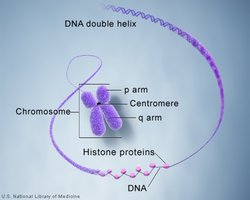
Chapter 15: The Chromosomal Basis of Inheritance
Concept 15.1: Mendelian Inheritance and Chromosome Behavior
Mendel’s principles of inheritance were theoretical until biologists observed parallels between chromosome behavior and Mendel’s proposed hereditary units. The chromosome theory of inheritance, developed by Sutton, Boveri, and others, states that genes are located on chromosomes and their behavior during meiosis explains Mendelian inheritance.
Chromosome Theory of Inheritance: Genes are carried on chromosomes, which segregate and assort independently during meiosis.
Historical Evidence: Thomas Hunt Morgan’s experiments with fruit flies provided the first solid evidence linking specific genes to specific chromosomes.
Example: Morgan’s work with Drosophila melanogaster demonstrated the physical basis of Mendelian inheritance.
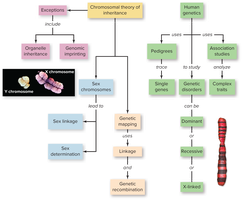
Relationship Between Genes and Chromosomes
Genes are located on chromosomes, and their behavior during cell division explains inheritance patterns. Chromosomes duplicate before cell division, and homologous chromosomes segregate during meiosis, ensuring each gamete receives one version of each gene.
Meiosis: Homologous chromosomes separate, distributing alleles to gametes.
Fertilization: Offspring inherit chromosomes (and genes) from each parent.
Example: Each chromosome carries one version of a gene, and homologous chromosomes have genes at the same locus.
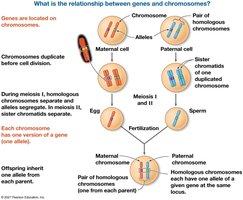
Morgan’s Choice of Experimental Organism
Thomas Hunt Morgan chose Drosophila melanogaster (fruit fly) for genetic studies due to its rapid life cycle, high offspring number, and simple chromosome structure. He distinguished between wild type (normal) and mutant phenotypes, with the first mutant being a white-eyed fly.
Wild Type: The common phenotype in a population (e.g., red eyes in fruit flies).
Mutant Phenotype: Traits that differ from the wild type (e.g., white eyes).
Application: Fruit flies are ideal for studying inheritance due to their genetic simplicity.
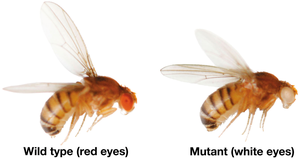
Correlating Gene Alleles with Chromosome Behavior
Morgan’s experiments involved crossing wild-type females with mutant males, observing inheritance patterns. The results supported the chromosome theory of inheritance, showing that the white-eyed allele was located on the X chromosome.
Sex Chromosomes: Female flies have two X chromosomes; males have one X and one Y.
Inheritance Pattern: Only males exhibited the white-eyed trait, indicating X-linked inheritance.
Example: The F2 generation showed a 3:1 ratio, but only males had white eyes.
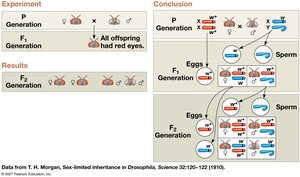
The Chromosomal Basis of Mendel’s Laws
Mendel’s laws of segregation and independent assortment are explained by the behavior of chromosomes during meiosis. The separation of homologous chromosomes and the random assortment of alleles account for genetic variation.
Law of Segregation: Each parent contributes one allele for each gene.
Law of Independent Assortment: Alleles of different genes assort independently during gamete formation.
Example: Dihybrid crosses illustrate these laws in action.
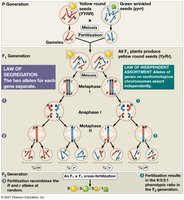
Concept 15.2: Sex-Linked Genes and Patterns of Inheritance
Sex Chromosomes and Sex Determination
Sex chromosomes determine the biological sex of an organism. Humans and other mammals use the X-Y system, but other systems exist in different species. The SRY gene on the Y chromosome triggers male development.
X-Y System: Two X chromosomes result in female development; one X and one Y result in male development.
Other Systems: X-0, Z-W, and haplo-diploid systems are found in insects, birds, and bees.
SRY Gene: Responsible for testis development in mammals.
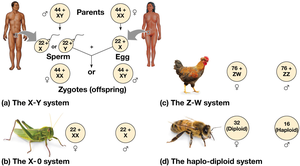
Sex-Linked Genes
Genes located on sex chromosomes are called sex-linked genes. X-linked genes are found on the X chromosome, while Y-linked genes are found on the Y chromosome. X-linked recessive disorders are more common in males due to their single X chromosome.
X-Linked Genes: Require two copies for expression in females, one in males.
Y-Linked Genes: Only affect males; fewer genes are present on the Y chromosome.
Example: Transmission of X-linked recessive traits can be illustrated with Punnett squares.
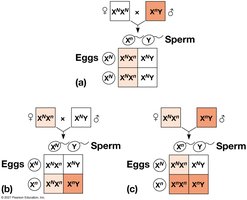
X Inactivation in Female Mammals
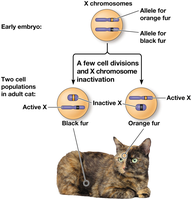
In female mammals, one X chromosome in each cell is randomly inactivated, forming a Barr body. This results in mosaicism for X-linked traits, as seen in calico cats.
Barr Body: The condensed, inactive X chromosome.
Mosaicism: Heterozygous females express different alleles in different cells.
Example: Calico cats display mosaic fur coloration due to X inactivation.
Concept 15.3: Linked Genes and Genetic Recombination
Linked Genes
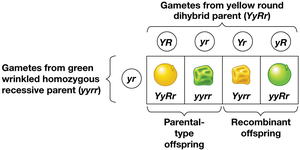
Genes located near each other on the same chromosome tend to be inherited together, known as linked genes. However, genetic recombination can produce new combinations of traits.
Linkage: Linked genes do not assort independently.
Genetic Recombination: Crossing over during meiosis can separate linked genes, creating recombinant offspring.
Example: Parental-type and recombinant-type offspring can be distinguished in dihybrid crosses.
Abnormalities in Chromosome Number and Structure
Nondisjunction and Aneuploidy
Nondisjunction occurs when homologous chromosomes fail to separate during meiosis, resulting in gametes with abnormal chromosome numbers. Aneuploidy is the presence of an abnormal number of chromosomes in a cell.
Monosomy: Only one copy of a chromosome is present.
Trisomy: Three copies of a chromosome are present.
Example: Down syndrome is caused by trisomy 21.
Alterations of Chromosome Structure
Chromosome breakage can lead to structural changes such as deletion, duplication, inversion, and translocation. These alterations can cause genetic disorders and syndromes.
Deletion: Loss of a chromosomal segment.
Duplication: Repetition of a segment.
Inversion: Reversal of a segment’s orientation.
Translocation: Movement of a segment to another chromosome.
Human Conditions Due to Chromosomal Alterations
Alterations in chromosome number and structure are associated with various human conditions. Some types of aneuploidy are less disruptive, allowing individuals to survive with characteristic syndromes.
Down Syndrome: Trisomy 21; frequency increases with maternal age.
Klinefelter Syndrome: XXY males; extra X chromosome.
Turner Syndrome: XO females; only viable monosomy in humans.
XXX Females: Healthy, but at risk for learning disabilities.
Summary Table: Types of Chromosomal Alterations
Type | Description | Example |
|---|---|---|
Monosomy | One copy of a chromosome | Turner syndrome (XO) |
Trisomy | Three copies of a chromosome | Down syndrome (Trisomy 21) |
Deletion | Loss of a segment | Cri du chat syndrome |
Duplication | Repeated segment | Charcot-Marie-Tooth disease |
Inversion | Reversed segment | Some forms of hemophilia |
Translocation | Segment moved to another chromosome | Chronic myelogenous leukemia |
Additional info: The study notes expand on brief points from the original materials, providing academic context, definitions, and examples for clarity and completeness.
