 Back
Chapter 15: The Chromosomal Basis of Inheritance – Study Notes
Study Guide - Smart Notes
 Tailored notes based on your materials, expanded with key definitions, examples, and context.
Chromosomal Basis of Inheritance
Locating Genes Along Chromosomes
The concept of genes as "hereditary factors" was first proposed by Mendel, but their physical location was unknown. Modern techniques allow us to visualize genes on chromosomes using fluorescent dyes, confirming that genes are located on chromosomes.
Genes are segments of DNA found on chromosomes.
Fluorescent tagging helps identify the location of specific genes.
Chromosomes are the vehicles of genetic inheritance.
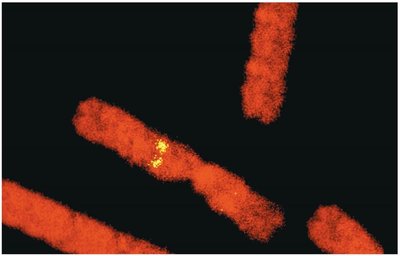
Mendelian Laws and Chromosome Theory
Mendel’s laws of segregation and independent assortment are explained by the behavior of chromosomes during meiosis. Cytologists observed parallels between Mendel’s hereditary factors and chromosome behavior, leading to the chromosome theory of inheritance.
Law of Segregation: Two alleles for each gene separate during gamete formation.
Law of Independent Assortment: Alleles of genes on nonhomologous chromosomes assort independently.
Meiosis and fertilization recombine alleles, producing characteristic phenotypic ratios.
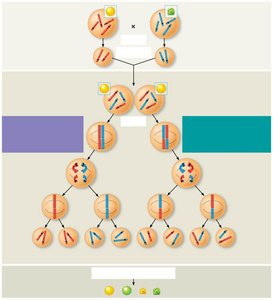
Chromosome Theory of Inheritance
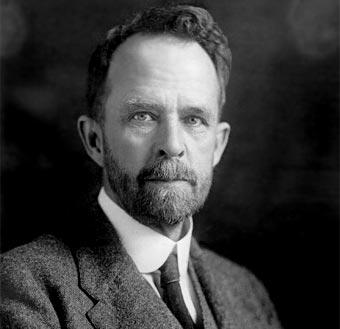
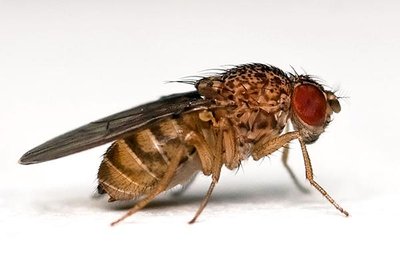
Early 20th-century experiments by Thomas Hunt Morgan provided evidence that chromosomes are the location of Mendel’s heritable factors. Morgan used Drosophila melanogaster (fruit fly) for genetic studies due to its practical advantages.
Drosophila melanogaster is easy to breed, has a short generation time, and only four pairs of chromosomes.
Morgan’s work established the physical basis of inheritance.
Sex Chromosomes and Sex-Linked Genes
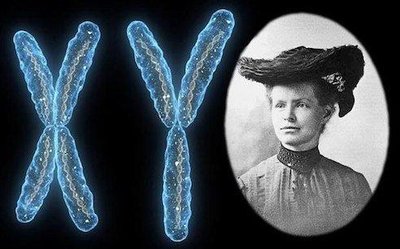
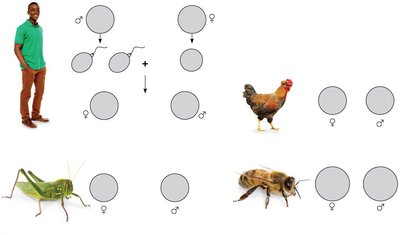
Sex chromosomes determine the sex of an organism. In humans, females have two X chromosomes, and males have one X and one Y chromosome. The SRY gene on the Y chromosome triggers male development.
X chromosome: Contains many genes unrelated to sex.
Y chromosome: Contains genes mostly related to sex determination.
SRY gene: Initiates testis development.
Sex-linked genes exhibit unique inheritance patterns.
Patterns of Inheritance: Sex-Linked Traits
Sex-linked genes, especially those on the X chromosome, follow specific inheritance patterns. X-linked recessive disorders are more common in males because they have only one X chromosome.
Hemizygous: Males need only one copy of the allele for expression.
Homozygous: Females need two copies for expression.
Examples: Color blindness, Duchenne muscular dystrophy, hemophilia.
X Inactivation in Female Mammals
In female mammals, one X chromosome in each cell is randomly inactivated during embryonic development, forming a Barr body. Heterozygous females are mosaics for X-linked traits.
Barr body: Inactive X chromosome.
Mosaicism results in varied expression of X-linked traits.
Linked Genes and Genetic Recombination
Genes located close together on the same chromosome tend to be inherited together (linked genes). However, crossing over during meiosis can produce recombinant phenotypes.
Linked genes: Tend to be inherited together.
Genetic recombination: Crossing over creates new allele combinations.
Recombination frequency is used to map gene locations.
Linkage Maps and Genetic Mapping
Linkage maps are constructed using recombination frequencies. Map units (centimorgans) represent the distance between genes, with one map unit equaling 1% recombination frequency.
Linkage map: Ordered list of genetic loci on a chromosome.
Genes farther apart have higher recombination frequencies.
Four linkage groups in Drosophila correspond to its four chromosomes.
Alterations of Chromosome Number and Structure
Abnormal chromosome number or structure can cause genetic disorders. Nondisjunction leads to aneuploidy (extra or missing chromosomes), while structural changes include deletions, duplications, inversions, and translocations.
Nondisjunction: Failure of chromosome pairs to separate properly.
Aneuploidy: Monosomic (one copy) or trisomic (three copies) zygotes.
Polyploidy: More than two complete sets of chromosomes (common in plants).
Chromosome structure changes: Deletion, duplication, inversion, translocation.
Examples: Down syndrome (trisomy 21), Edward syndrome (trisomy 18), Patau syndrome (trisomy 13), Klinefelter’s syndrome (XXY), Turner syndrome (X0).
Inheritance of Organelle Genes
Extranuclear genes are found in mitochondria and chloroplasts. These genes are inherited maternally, as the zygote’s cytoplasm comes from the egg. Mutations in mitochondrial DNA can cause diseases affecting the muscular and nervous systems.
Mitochondrial inheritance: Only from the mother.
Examples: Mitochondrial myopathy, Leber’s hereditary optic neuropathy.
Additional info: Mitochondrial DNA is circular and encodes essential proteins for cellular respiration.
