 Back
BackChapter 16: How Genes Work – Study Notes
Study Guide - Smart Notes
 Tailored notes based on your materials, expanded with key definitions, examples, and context.
How Genes Work
Introduction to Gene Function
Genes are fundamental units of heredity, encoding instructions for the synthesis of proteins and functional RNAs. Understanding how genes work at the molecular level is essential for linking genotype to phenotype and for comprehending biological processes. - DNA is often referred to as the blueprint of life, storing genetic information. - Gene expression is the process by which information in DNA is converted into functioning molecules within the cell. - The study of gene function involves examining how genetic information flows from DNA to RNA to proteins. 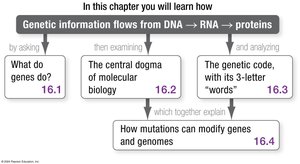
What Do Genes Do?
Early experiments by Beadle and Tatum revealed that genes direct the synthesis of specific enzymes. By creating defective genes and observing the resulting phenotypes, they established the concept that each gene encodes a particular enzyme. - Null or loss-of-function alleles: Mutated genes that do not produce functional products. - The one-gene, one-enzyme hypothesis states that each gene contains information to make one enzyme. - This hypothesis evolved into the one-gene, one-polypeptide hypothesis as biologists recognized that not all proteins are enzymes and some proteins are composed of multiple polypeptides. 
The Central Dogma of Molecular Biology
The central dogma describes the directional flow of genetic information in cells: DNA → RNA → Protein. - DNA acts as an information storage molecule. - RNA serves as the intermediary, carrying instructions from DNA to the site of protein synthesis. - Messenger RNA (mRNA) is synthesized by RNA polymerase using DNA as a template. - Transcription is the process of making a complementary RNA copy from a DNA template. - Translation is the process of synthesizing proteins from the information in mRNA. 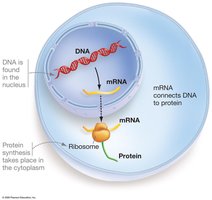
Linking Genotype to Phenotype
The genotype of an organism is determined by the sequence of bases in its DNA, while the phenotype is the product of the proteins it produces. - Alleles of the same gene differ in DNA sequence, leading to differences in protein structure and function. - Changes in genotype can result in observable differences in phenotype. 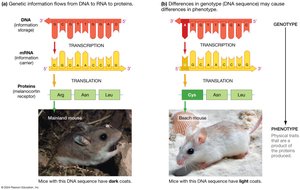
Modifications to the Central Dogma
The central dogma has exceptions and extensions: - Some genes code for RNAs that are not translated into proteins but have important cellular functions. - In certain viruses, information can flow from RNA back to DNA via the enzyme reverse transcriptase. 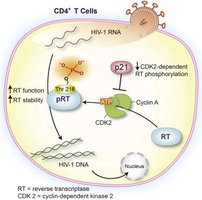
The Genetic Code
The genetic code specifies how sequences of nucleotides in DNA and RNA are translated into sequences of amino acids in proteins. - Codon: A group of three bases that specifies a particular amino acid. - The code is a triplet code, with each codon consisting of three nucleotides. - There is one start codon (AUG) for methionine and three stop codons (UAA, UAG, UGA) that signal the end of translation. 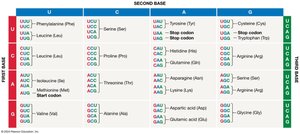
Properties of the Genetic Code
- Redundant: Most amino acids are encoded by more than one codon. - Unambiguous: Each codon specifies only one amino acid. - Non-overlapping: Codons are read one at a time. - Nearly universal: The code is shared by almost all organisms. - Conservative: Codons for the same amino acid often share the first two bases.
Using the Genetic Code
Biologists can predict amino acid sequences from DNA or mRNA sequences and vice versa. - Due to redundancy, multiple DNA sequences can code for the same amino acid sequence. 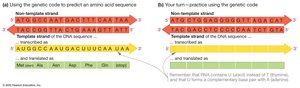
Types and Consequences of Mutation
Definition and Types of Mutation
A mutation is any permanent change in an organism’s DNA, resulting in a modification of its genotype and potentially creating new alleles. - Point mutations: Changes affecting one or a few bases. - Chromosome-level mutations: Larger-scale changes affecting chromosome structure or number.
Impacts of Point Mutations
Mutations can have varying effects on an organism’s fitness: - Beneficial mutations increase fitness. - Neutral mutations have no effect on fitness. - Deleterious mutations decrease fitness. - Most point mutations are neutral or deleterious. - Some mutations outside coding regions can affect phenotype by altering gene expression.
Table: Types of Point Mutations and Their Consequences
Type of Mutation | Effect on Codon | Consequence |
|---|---|---|
Silent | Codon changes, but amino acid does not | No effect on protein |
Missense | Codon changes, amino acid changes | Protein function may change |
Nonsense | Codon changes to stop codon | Protein synthesis stops prematurely |
Frameshift | Insertion/deletion alters reading frame | Protein sequence is drastically altered |
Summary
Chapter 16 explores how genes work by examining the flow of genetic information from DNA to RNA to proteins, the structure and properties of the genetic code, and the types and consequences of mutations. Understanding these concepts is fundamental to molecular biology and genetics. ----------------------------------------
