 Back
Chapter 16: How Genes Work – Study Notes
Study Guide - Smart Notes
 Tailored notes based on your materials, expanded with key definitions, examples, and context.
How Genes Work
Introduction
This chapter explores the molecular mechanisms by which genes control the traits of organisms. It covers the flow of genetic information from DNA to RNA to proteins, the genetic code, and the consequences of mutations. Understanding these processes is fundamental to modern biology and genetics.
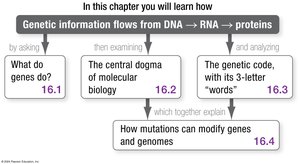
16.1 What Do Genes Do?
The One-Gene, One-Enzyme Hypothesis
Early experiments by Beadle and Tatum demonstrated that genes direct the synthesis of specific enzymes. By creating mutants in bread mold (Neurospora crassa) that could not produce certain compounds, they showed that each gene encodes a single enzyme. This concept evolved into the one-gene, one-polypeptide hypothesis, recognizing that not all proteins are enzymes and some proteins are composed of multiple polypeptides.
Null or loss-of-function alleles: Mutant alleles that do not produce functional products.
Genetic screens: Used to identify mutants lacking specific enzymes in metabolic pathways.
Example: Mutants unable to synthesize arginine due to defects in one of three enzymes in the pathway.
16.2 The Central Dogma of Molecular Biology
Flow of Genetic Information
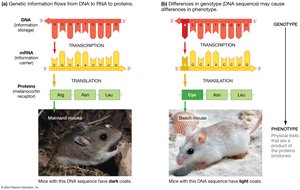
The central dogma describes how genetic information is transferred within a cell: DNA is transcribed into RNA, which is then translated into protein. This process explains how genotype determines phenotype.
Transcription: DNA is used as a template to synthesize complementary RNA.
Translation: Information in mRNA is used to assemble amino acids into proteins.
Genotype: The sequence of DNA bases.
Phenotype: The physical traits produced by proteins.
Alleles: Variants of a gene that may produce different proteins.
Modifications to the Central Dogma
Some genes code for RNAs that are not translated into proteins but have important cellular functions. Additionally, certain viruses can reverse the flow of information using reverse transcriptase, synthesizing DNA from an RNA template.
Non-coding RNAs: RNAs with structural, regulatory, or catalytic roles.
Reverse transcription: Process in some viruses where RNA is used to make DNA.
16.3 The Genetic Code
Structure and Properties of the Genetic Code
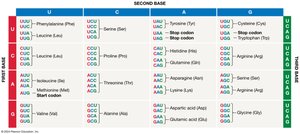
The genetic code specifies how sequences of nucleotides in DNA and RNA are translated into amino acids. Each codon consists of three bases (triplet code), and the code is nearly universal among organisms.
Codon: A group of three nucleotides that specifies a particular amino acid.
Start codon: AUG, signals the beginning of protein synthesis and codes for methionine.
Stop codons: UGA, UAA, UAG, signal the end of protein synthesis.
Redundancy: Most amino acids are specified by more than one codon.
Unambiguous: Each codon specifies only one amino acid.
Non-overlapping: Codons are read one at a time.
Conservative: Codons for the same amino acid often share the first two bases.
Cracking the Genetic Code
Researchers like Nirenberg and Matthaei synthesized RNAs with specific sequences to determine which codons corresponded to which amino acids. This led to the identification of all codons and their functions.
Example: UUU codes for phenylalanine.
Application: Predicting amino acid sequences from DNA or mRNA sequences.
16.4 Types and Consequences of Mutation
Point Mutations
Mutations are permanent changes in DNA that can alter genotype and phenotype. Point mutations affect one or a few bases and can have various effects.
Missense mutation: Changes one amino acid in a protein.
Silent mutation: Does not change the amino acid sequence due to code redundancy.
Frameshift mutation: Alters the reading frame, changing all subsequent codons.
Nonsense mutation: Changes a codon to a stop codon, truncating the protein.
Fitness effects: Mutations can be beneficial, neutral, or deleterious.
Chromosome-Level Mutations
Chromosome mutations involve changes in chromosome number or structure and can have significant effects on phenotype.
Polyploidy: Increase in the number of chromosome sets.
Aneuploidy: Addition or loss of individual chromosomes.
Inversion: Segment of chromosome is reversed.
Translocation: Segment moves to another chromosome.
Deletion: Segment is lost.
Duplication: Segment is repeated.
Karyotype: Visual representation of chromosomes, used to detect mutations.
Summary Table: Types and Consequences of Point Mutations
Type of Mutation | Effect on Protein | Possible Impact on Fitness |
|---|---|---|
Missense | Changes one amino acid | Beneficial, neutral, or deleterious |
Silent | No change in amino acid | Neutral |
Frameshift | Alters reading frame | Usually deleterious |
Nonsense | Creates stop codon | Usually deleterious |
Key Equations and Concepts
Central Dogma:
Genetic Code: Codon table mapping triplets to amino acids.
Additional info: The chapter also highlights the importance of understanding the relationship between genotype and phenotype, and how mutations can drive evolutionary change or cause disease.
