Back
Chapter 16 – The Central Dogma: Gene Expression and Mutations
Study Guide - Smart Notes
 Tailored notes based on your materials, expanded with key definitions, examples, and context.
Chapter 16 – The Central Dogma
The Central Dogma of Molecular Biology
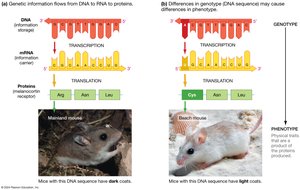
The central dogma describes the flow of genetic information within a biological system. It explains how DNA is transcribed into RNA, which is then translated into protein, ultimately determining phenotype.
DNA (deoxyribonucleic acid) stores genetic information.
Transcription is the process by which DNA is copied into messenger RNA (mRNA) by the enzyme RNA polymerase.
Translation is the process by which mRNA is decoded to synthesize proteins, catalyzed by ribosomes.
Gene Expression: From Genotype to Phenotype
Gene expression is the process by which the information encoded in a gene is used to direct the synthesis of a functional gene product, usually a protein. This process links genotype (genetic makeup) to phenotype (observable traits).
Genotype: The DNA sequence of an organism.
Phenotype: The physical expression of genetic information, such as coat color in mice.
Changes in DNA sequence (mutations) can alter the resulting protein and thus the phenotype.
Exceptions to the Central Dogma
Modifications and Exceptions
While the central dogma describes the typical flow of genetic information, there are important exceptions:
DNA Replication: DNA is copied by DNA polymerase before cell division.
RNAs That Do Not Code for Protein: Some RNAs (e.g., rRNA, tRNA, microRNA) function directly without being translated into protein.
Reverse Transcription: In some viruses (e.g., retroviruses), RNA is reverse-transcribed into DNA by the enzyme reverse transcriptase.
Additional info: These exceptions highlight the complexity and versatility of genetic information flow in cells.
The Genetic Code
Codon Table and Codon Wheel
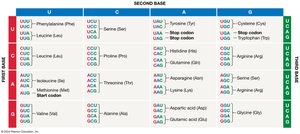
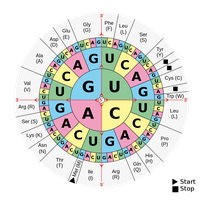
The genetic code is a set of rules by which information encoded in mRNA is translated into proteins. Each group of three nucleotides (codon) specifies a particular amino acid.
Start Codon (AUG): Codes for methionine (Met) and signals the start of translation.
Stop Codons (UAA, UAG, UGA): Signal the end of translation and do not code for any amino acid.
Features of the Genetic Code
Redundant: More than one codon can specify the same amino acid.
Unambiguous: Each codon specifies only one amino acid.
Universal: The genetic code is nearly universal among all organisms.
Additional info: The redundancy of the code helps protect against some mutations, while its universality supports the theory of common ancestry.
Transcription and Translation: Predicting Sequences
From DNA to mRNA to Protein
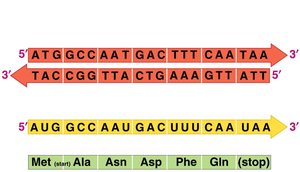
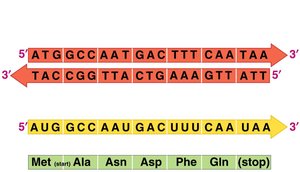
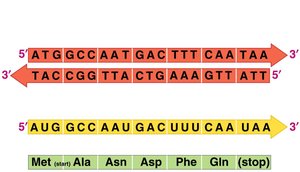
Given a DNA sequence, you can determine the resulting mRNA and protein sequence by following the rules of base pairing and the genetic code.
Template strand: The DNA strand used as a template for mRNA synthesis.
Coding (non-template) strand: The DNA strand with the same sequence as the mRNA (except T is replaced by U).
Transcription produces a complementary mRNA sequence.
Translation converts the mRNA codons into an amino acid sequence.
Practice: Using the Genetic Code
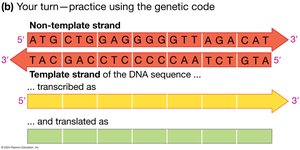
Practice problems often provide a DNA sequence and ask you to determine the mRNA and protein produced. This reinforces understanding of transcription and translation.
Mutations and Their Consequences
Point Mutations
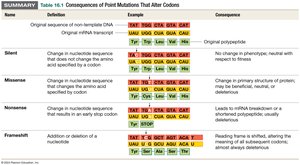
Point mutations are changes in a single nucleotide pair of a gene. They can have various effects on the resulting protein:
Silent Mutation: Alters a codon but does not change the amino acid due to redundancy.
Missense Mutation: Changes one amino acid to another, possibly altering protein function.
Nonsense Mutation: Converts a codon into a stop codon, leading to a truncated protein.
Frameshift Mutation: Insertion or deletion of nucleotides shifts the reading frame, usually resulting in a nonfunctional protein.
Type | Definition | Example | Consequence |
|---|---|---|---|
Silent | Change in nucleotide sequence that does not change the amino acid specified by a codon | TAT → TAC (both code for Tyr) | No change in phenotype; neutral with respect to fitness |
Missense | Change in nucleotide sequence that changes the amino acid specified by a codon | TAT → TTT (Tyr → Phe) | Change in primary structure of protein; may be beneficial, neutral, or deleterious |
Nonsense | Change in nucleotide sequence that results in an early stop codon | TAT → TAA (Tyr → Stop) | Leads to mRNA breakdown or a shortened polypeptide; usually deleterious |
Frameshift | Addition or deletion of a nucleotide | Insertion or deletion in the sequence | Reading frame is shifted, altering the meaning of all subsequent codons; almost always deleterious |
Chromosome Structural Mutations
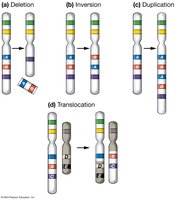
Large-scale mutations can affect chromosome structure, leading to significant genetic changes:
Deletion: Loss of a chromosome segment.
Inversion: Reversal of a chromosome segment.
Duplication: Repetition of a chromosome segment.
Translocation: Segment moves from one chromosome to another.
Karyotypes and Chromosome Mutations
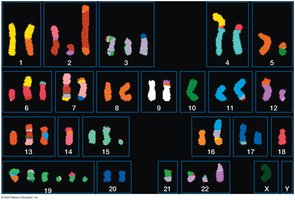
Karyotyping is a technique used to visualize chromosomes and detect large-scale mutations, such as deletions, duplications, or translocations. Abnormal karyotypes can reveal genetic disorders.