 Back
Chapter 16: The Molecular Basis of Inheritance – Study Notes
Study Guide - Smart Notes
 Tailored notes based on your materials, expanded with key definitions, examples, and context.
DNA as the Genetic Material
The Search for the Genetic Material
Early 20th-century biologists sought to identify the molecules responsible for inheritance. Chromosomes, composed of DNA and protein, were the main candidates. The role of DNA in heredity was first discovered through studies of bacteria and viruses.
Evidence That DNA Can Transform Bacteria
Frederick Griffith's experiments in 1928 demonstrated that DNA could transform bacteria. He worked with two strains of a bacterium: one pathogenic and one harmless. Mixing heat-killed pathogenic bacteria with living harmless bacteria resulted in some harmless bacteria becoming pathogenic, a process called transformation—the assimilation of foreign DNA.
Evidence That Viral DNA Can Program Cells
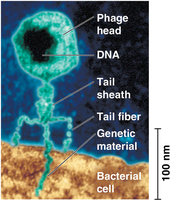
Further evidence for DNA as the genetic material came from studies of bacteriophages (viruses that infect bacteria). In 1952, Hershey and Chase showed that only DNA, not protein, enters the bacterial cell during infection, providing genetic information.
Chargaff’s Rules and DNA Composition
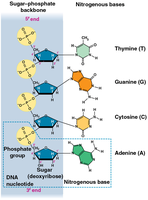
DNA is a polymer of nucleotides, each consisting of a nitrogenous base (adenine, thymine, guanine, cytosine), a sugar, and a phosphate group. Erwin Chargaff found that DNA composition varies between species and that the number of A and T bases is equal, as is the number of G and C bases. These findings became known as Chargaff’s rules.
Building a Structural Model of DNA
X-ray Crystallography and the Double Helix
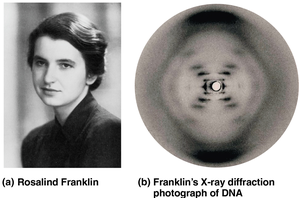
Maurice Wilkins and Rosalind Franklin used X-ray crystallography to study DNA structure. Franklin's X-ray images enabled Watson and Crick to deduce that DNA is helical and consists of two strands forming a double helix.
Watson and Crick’s Model
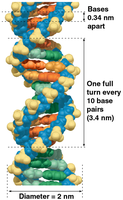
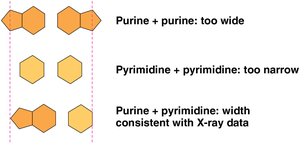
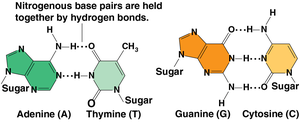
Watson and Crick built models to fit the X-ray data and chemical properties of DNA. They proposed that the two sugar-phosphate backbones are antiparallel and that nitrogenous bases pair specifically: adenine (A) with thymine (T), and guanine (G) with cytosine (C). Pairing a purine with a pyrimidine results in a uniform width consistent with X-ray data.
DNA Replication and Repair
Base Pairing to a Template Strand
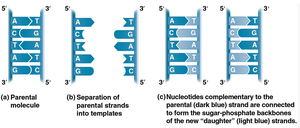
DNA replication relies on the complementary nature of the two strands. Each strand serves as a template for building a new strand, resulting in two identical DNA molecules.
Models of DNA Replication
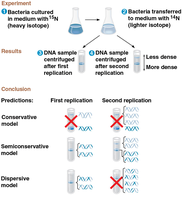
Watson and Crick’s semiconservative model predicts that each daughter DNA molecule contains one old strand and one new strand. Experiments by Meselson and Stahl confirmed this model over the conservative and dispersive models.
Initiation of DNA Replication
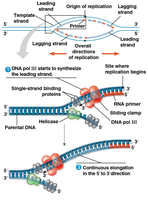
Replication begins at origins of replication, where DNA strands are separated, forming replication bubbles. At the ends of these bubbles are replication forks, where parental DNA is unwound by helicases. Single-strand binding proteins stabilize the unwound DNA, and topoisomerase relieves strain caused by unwinding.
Synthesizing a New DNA Strand
DNA polymerases require a short RNA primer, synthesized by primase, to start adding nucleotides. DNA polymerases catalyze the synthesis of new DNA, adding nucleotides to the 3′ end of the primer. Each nucleotide added is a nucleoside triphosphate, and the process involves a dehydration reaction, releasing pyrophosphate.
Antiparallel Elongation
DNA polymerases can only add nucleotides to the 3′ end, so DNA elongates in the 5′ → 3′ direction. The leading strand is synthesized continuously toward the replication fork, while the lagging strand is synthesized discontinuously as Okazaki fragments, which are joined by DNA ligase.
Proofreading and Repair
DNA polymerases proofread newly synthesized DNA, replacing incorrect nucleotides. Mismatch repair enzymes correct errors missed during proofreading. Nucleotide excision repair removes and replaces damaged DNA segments. Mutations that escape repair can be inherited and are a source of genetic variation.
Replicating the Ends of DNA Molecules
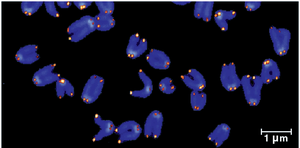
Linear DNA molecules face the problem of incomplete replication at their ends. Telomeres are special nucleotide sequences at chromosome ends that postpone gene erosion. Telomerase extends telomeres in germ cells, preventing loss of essential genes. Telomere shortening is linked to aging and may limit cancer cell division.
Chromosome Structure and DNA Packing
Bacterial vs. Eukaryotic Chromosomes
Bacterial chromosomes are double-stranded, circular DNA molecules with a small amount of protein, found in the nucleoid. Eukaryotic chromosomes are linear DNA molecules with a large amount of protein, organized into chromatin.
Chromatin Structure
In eukaryotes, DNA is combined with proteins called histones to form chromatin. The basic unit is the nucleosome, consisting of DNA wrapped around a core of eight histones. Histone tails extend outward and play a role in gene regulation.
Chromatin Packing and Gene Expression
Chromatin can be loosely packed (euchromatin) or highly condensed (heterochromatin). Dense packing of heterochromatin makes gene expression difficult. Chromatin undergoes changes in packing during the cell cycle, condensing into metaphase chromosomes before mitosis.
Histone Modification
Histones can be chemically modified, affecting chromatin condensation and gene expression. These modifications are important for regulating access to genetic information.
DNA Replication Protein | Function |
|---|---|
Helicase | Unwinds DNA at replication forks |
Single-strand binding protein | Stabilizes single-stranded DNA |
Topoisomerase | Relieves strain ahead of replication fork |
Primase | Synthesizes RNA primer |
DNA polymerase | Synthesizes new DNA strand |
DNA ligase | Joins Okazaki fragments |
Key Equations:
Dehydration reaction for nucleotide addition:
Chargaff's rule:
Example: The Meselson-Stahl experiment demonstrated the semiconservative model of DNA replication by using isotopes of nitrogen to distinguish old and new DNA strands.
Additional info: DNA replication is essential for cell division and inheritance. Errors in replication and repair mechanisms can lead to mutations, which are the basis for genetic diversity and evolution.
