 Back
Chapter 16: The Molecular Basis of Inheritance – Study Notes
Study Guide - Smart Notes
 Tailored notes based on your materials, expanded with key definitions, examples, and context.
Chapter 16: The Molecular Basis of Inheritance
DNA as the Genetic Material
The identification of DNA as the genetic material was a major milestone in biology. Early studies focused on chromosomes, which are composed of DNA and protein, as candidates for the genetic material. The role of DNA in heredity was first discovered through experiments with bacteria and viruses.
Key Point 1: Genes are located on chromosomes, which consist of DNA and protein.
Key Point 2: DNA was shown to be the genetic material through experiments with bacteria and bacteriophages.
Example: Frederick Griffith's experiment demonstrated transformation, where harmless bacteria became pathogenic by assimilating foreign DNA.
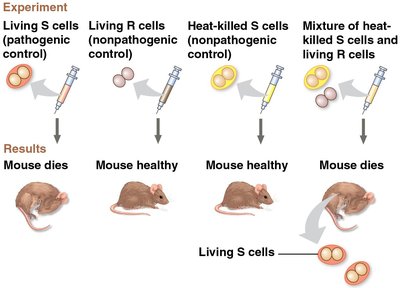
Additional info: Transformation is now defined as a change in genotype and phenotype due to assimilation of foreign DNA.
Evidence That DNA Can Transform Bacteria
Griffith's experiment in 1928 showed that DNA could transform bacteria. Later, Avery, McCarty, and MacLeod identified DNA as the transforming substance, though skepticism remained due to limited knowledge about DNA.
Key Point: Transformation is a process where genetic material from one cell is taken up by another, changing its genotype and phenotype.
Evidence That Viral DNA Can Program Cells
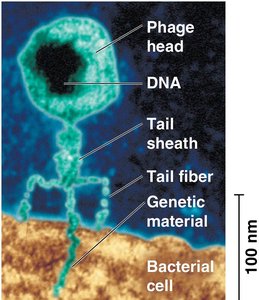
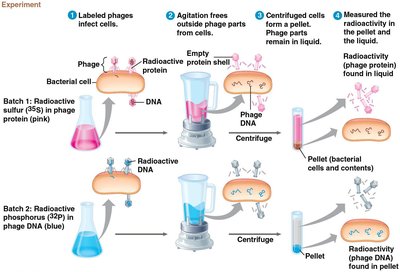
Bacteriophages (phages) are viruses that infect bacteria. Hershey and Chase's experiment in 1952 demonstrated that DNA, not protein, is the genetic material of phages.
Key Point: Only DNA enters the bacterial cell during phage infection, providing genetic information.
Example: Hershey-Chase experiment used radioactive labeling to show that DNA, not protein, was transmitted to bacteria.
DNA Structure and Chargaff's Rules
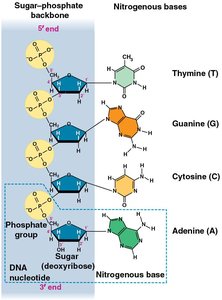
DNA is a polymer of nucleotides, each consisting of a nitrogenous base, a sugar, and a phosphate group. Chargaff's rules state that DNA composition varies between species and that the number of adenine (A) equals thymine (T), and guanine (G) equals cytosine (C).
Key Point: The four nitrogenous bases are adenine (A), thymine (T), guanine (G), and cytosine (C).
Key Point: Chargaff's rules provided evidence for the double helix structure.
Building a Structural Model of DNA
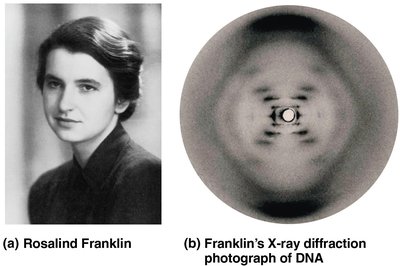
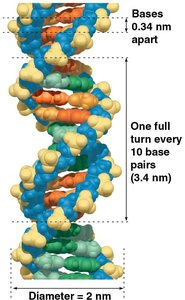
X-ray crystallography, used by Franklin and Wilkins, revealed the helical structure of DNA. Watson and Crick built a model of the double helix, with antiparallel sugar-phosphate backbones and paired nitrogenous bases in the interior.
Key Point: DNA consists of two strands forming a double helix, with bases paired in the interior.
Key Point: The backbones are antiparallel, running in opposite directions.
Base Pairing and the Double Helix
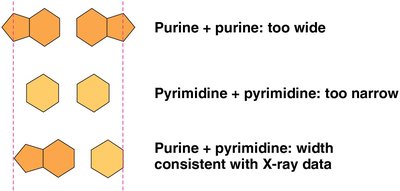
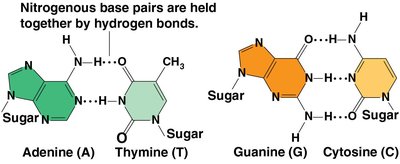
Watson and Crick determined that base pairing is specific: adenine pairs with thymine, and guanine pairs with cytosine. Pairing a purine with a pyrimidine results in a uniform width, consistent with X-ray data.
Key Point: Base pairs are held together by hydrogen bonds.
Key Point: The Watson-Crick model explains Chargaff's rules.
DNA Replication and Repair
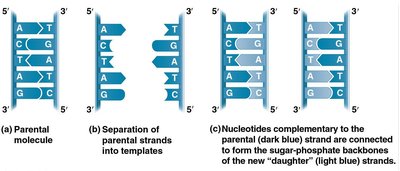
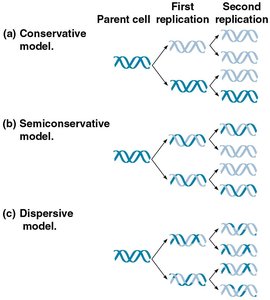
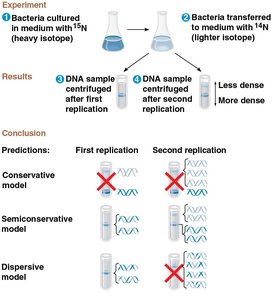
Accurate DNA replication is essential for inheritance. The semiconservative model predicts that each daughter molecule has one old strand and one new strand. Experiments by Meselson and Stahl supported this model.
Key Point: DNA replication is semiconservative, with each new molecule containing one parental and one new strand.
Key Point: Competing models were conservative and dispersive.
Example: Meselson-Stahl experiment used isotopes to distinguish between models.
DNA Replication: A Closer Look
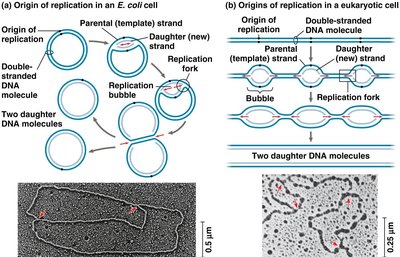
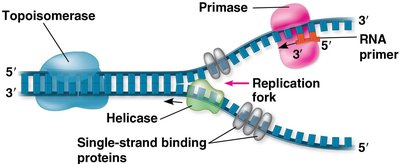
Replication begins at origins of replication, forming replication bubbles. Replication proceeds in both directions, with replication forks at each end. Helicases, single-strand binding proteins, and topoisomerase are involved in unwinding and stabilizing DNA.
Key Point: Replication bubbles and forks are sites of active DNA synthesis.
Key Point: Helicase unwinds DNA, single-strand binding proteins stabilize it, and topoisomerase relieves strain.
Synthesizing a New DNA Strand
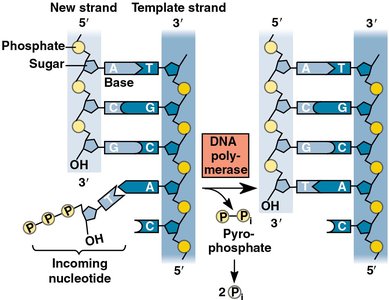
DNA polymerases require a primer, synthesized by primase, to start adding nucleotides. Each nucleotide added is a nucleoside triphosphate, and the process involves the release of pyrophosphate.
Key Point: DNA polymerases synthesize new DNA by adding nucleotides to the 3' end.
Key Point: The rate of elongation is much faster in bacteria than in human cells.
Formula:
Antiparallel Elongation
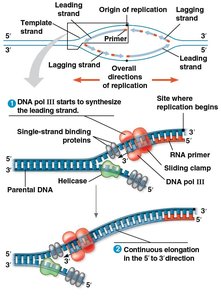
The antiparallel structure of DNA affects replication. DNA polymerases can only add nucleotides to the 3' end, so the leading strand is synthesized continuously, while the lagging strand is synthesized in fragments (Okazaki fragments).
Key Point: Leading strand synthesis is continuous; lagging strand synthesis is discontinuous.
Key Point: Okazaki fragments are joined by DNA ligase.
Proofreading and Repairing DNA
DNA polymerases proofread newly synthesized DNA, replacing incorrect nucleotides. Mismatch repair and nucleotide excision repair correct errors and damage caused by environmental factors.
Key Point: Proofreading and repair mechanisms ensure high fidelity in DNA replication.
Key Point: Mutations are permanent changes that can be passed to the next generation.
Replicating the Ends of DNA Molecules
Linear DNA molecules face challenges in replicating their ends. Telomeres are special sequences that postpone gene erosion. Telomerase extends telomeres in germ cells, and telomere shortening may be linked to aging and cancer.
Key Point: Telomeres protect chromosome ends but do not prevent shortening.
Key Point: Telomerase is active in germ cells and some cancer cells.
Chromosome Structure and DNA Packing
Bacterial chromosomes are circular and associated with a small amount of protein. Eukaryotic chromosomes are linear and packed with proteins, forming chromatin. Histones are responsible for DNA packing, and nucleosomes are the basic unit of chromatin structure.
Key Point: Chromatin can be loosely packed (euchromatin) or highly condensed (heterochromatin).
Key Point: Chromatin packing changes during the cell cycle, affecting gene expression.
Additional info: Histone modifications can regulate chromatin condensation and gene expression.
