 Back
Chapter 16: The Molecular Basis of Inheritance – Study Notes
Study Guide - Smart Notes
 Tailored notes based on your materials, expanded with key definitions, examples, and context.
Chapter 16: The Molecular Basis of Inheritance
DNA as the Genetic Material
The identification of DNA as the genetic material was a pivotal moment in biology. Early 20th-century experiments established that genes are located on chromosomes, which are composed of DNA and protein. The role of DNA in heredity was first discovered through studies of bacteria and viruses.
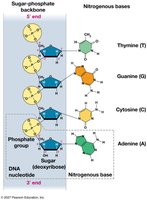
Key Point: DNA is a polymer of nucleotides, each consisting of a nitrogenous base (adenine, thymine, guanine, cytosine), a sugar, and a phosphate group.
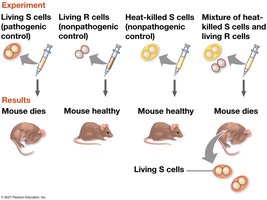
Key Point: Experiments by Frederick Griffith demonstrated transformation, where bacteria could acquire new traits by taking up foreign DNA.
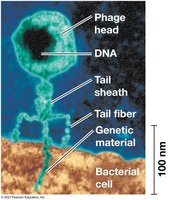
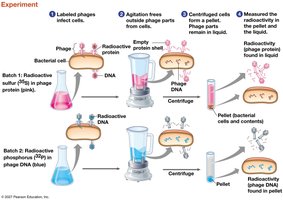
Key Point: The Hershey–Chase experiment showed that DNA, not protein, is the genetic material of phages.
Example: Griffith's experiment with pathogenic and nonpathogenic bacterial strains illustrated transformation.
Chargaff's Rules and DNA Structure
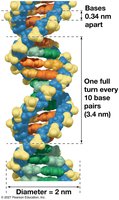
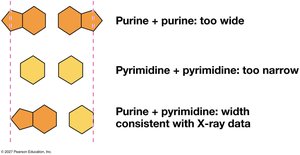
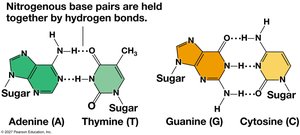
Erwin Chargaff discovered that DNA composition varies between species and that the number of adenine (A) equals thymine (T), and guanine (G) equals cytosine (C). The structure of DNA was elucidated through X-ray crystallography, revealing the double helix.
Key Point: Chargaff's rules: A = T and G = C in any species.
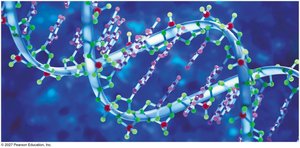
Key Point: DNA's double helix consists of two antiparallel strands with paired nitrogenous bases in the interior.
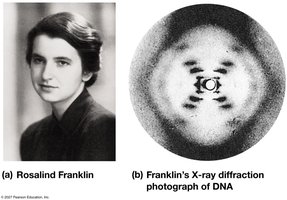
Example: Rosalind Franklin's X-ray diffraction photo provided critical evidence for the helical structure.
DNA Replication: Mechanisms and Models
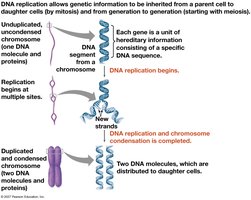
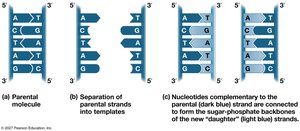
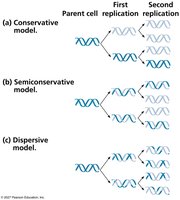
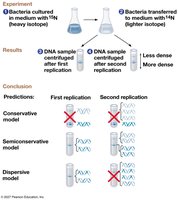
DNA replication is essential for genetic inheritance. The process relies on the principle of base pairing, where each strand serves as a template for a new strand. Three models were proposed: conservative, semiconservative, and dispersive. Experiments supported the semiconservative model.
Key Point: Semiconservative replication: Each daughter DNA molecule contains one old strand and one new strand.
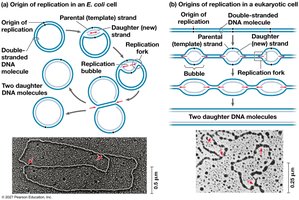
Key Point: Replication begins at origins of replication, forming replication bubbles and forks.
Example: Meselson and Stahl's experiment confirmed the semiconservative model.
Proteins Involved in DNA Replication
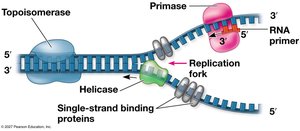
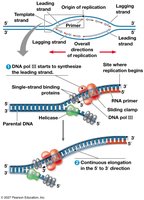
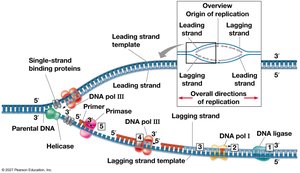
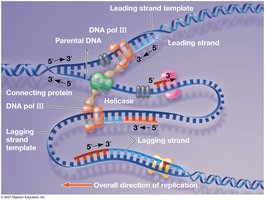
DNA replication is facilitated by a complex of proteins and enzymes. Key players include helicase, primase, DNA polymerases, single-strand binding proteins, and topoisomerase. Replication proceeds in both directions from each origin.
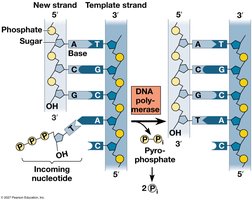
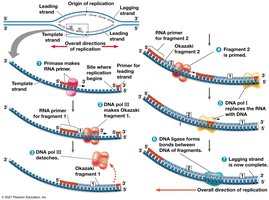
Key Point: Helicase unwinds the DNA helix; primase synthesizes RNA primers; DNA polymerase adds nucleotides.
Key Point: Replication occurs continuously on the leading strand and discontinuously on the lagging strand (Okazaki fragments).
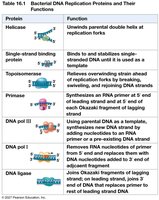
Example: Table of bacterial DNA replication proteins and their functions.
Protein | Function |
|---|---|
Helicase | Unwinds parental double helix at replication forks |
Single-strand binding protein | Binds to and stabilizes single-stranded DNA |
Topoisomerase | Relieves overwinding strain ahead of replication forks |
Primase | Synthesizes RNA primer at 5' ends of leading strand and Okazaki fragments |
DNA pol III | Using parental DNA as template, synthesizes new DNA strand by adding nucleotides to RNA primer or pre-existing DNA strand |
DNA pol I | Removes RNA nucleotides of primer and replaces them with DNA nucleotides |
DNA ligase | Joins Okazaki fragments of lagging strand; joins 3' end of DNA that replaces primer to rest of leading strand DNA |
Proofreading and Repairing DNA
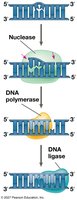
DNA polymerases proofread newly synthesized DNA, correcting errors. Additional repair mechanisms, such as mismatch repair and nucleotide excision repair, maintain DNA integrity. Mutations that escape repair can be inherited and contribute to genetic variation.
Key Point: Proofreading reduces error rate; repair enzymes correct mismatches and excise damaged DNA.
Example: Nucleotide excision repair involves nuclease, DNA polymerase, and DNA ligase.
Replicating the Ends of DNA Molecules
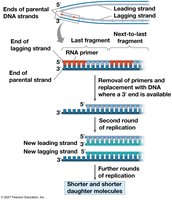
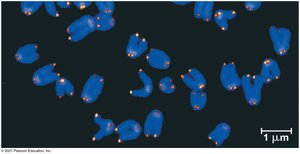
Linear DNA presents challenges for replication at chromosome ends. Eukaryotic chromosomes have telomeres, repetitive sequences that protect genes from erosion. Telomerase extends telomeres in germ cells, and telomere shortening is linked to aging and cancer.
Key Point: Telomeres postpone gene erosion; telomerase maintains telomere length in germ cells.
Example: Telomere shortening may limit cell divisions and protect against cancer.
Chromosome Structure and DNA Packing
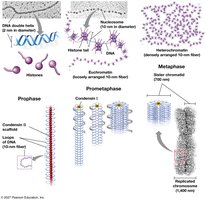
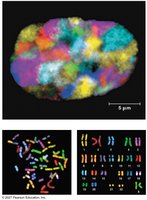
Chromosomes consist of DNA molecules packed with proteins. In bacteria, DNA is circular and supercoiled. Eukaryotic DNA is linear and organized into chromatin, with histones facilitating packing. Chromatin structure changes during the cell cycle, affecting gene expression.
Key Point: Chromatin is composed of DNA and histones; nucleosomes are the basic unit of chromatin structure.
Key Point: Euchromatin is loosely packed and accessible; heterochromatin is highly condensed and less accessible.
Example: Chromatin packing enables chromosomes to fit into the nucleus and regulates gene expression.
Additional info:
DNA replication is fundamental to both mitosis and meiosis, ensuring faithful transmission of genetic information.
Mutations arising from replication errors are the source of genetic diversity and evolution.
Histone modifications can regulate chromatin structure and gene expression, contributing to epigenetic regulation.
