 Back
Chapter 16: The Molecular Basis of Inheritance – Study Notes
Study Guide - Smart Notes
 Tailored notes based on your materials, expanded with key definitions, examples, and context.
Chapter 16: The Molecular Basis of Inheritance
Concept 16.1: DNA is the Genetic Material
The identification of DNA as the genetic material was a major milestone in biology. Early 20th-century experiments established that genes are located on chromosomes, which are composed of DNA and protein. The role of DNA in heredity was elucidated through studies of bacteria and viruses.
Key Point 1: DNA and protein were candidates for genetic material. Experiments with bacteria and viruses demonstrated that DNA is responsible for heredity.
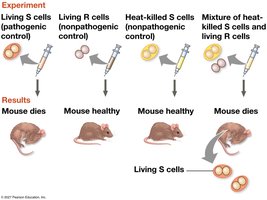
Key Point 2: Frederick Griffith's experiment showed that DNA can transform bacteria, a process called transformation.
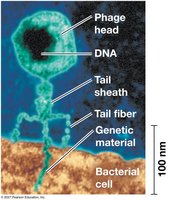
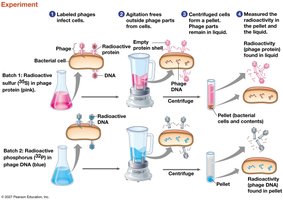
Key Point 3: The Hershey-Chase experiment confirmed that DNA, not protein, is the genetic material in phages.
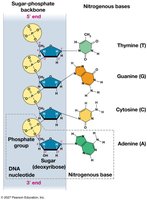
Key Point 4: DNA is a polymer of nucleotides, each consisting of a nitrogenous base (A, T, G, C), a sugar, and a phosphate group.
Key Point 5: Chargaff's rules: DNA composition varies between species, and in any species, the number of A and T bases is equal, as is the number of G and C bases.
Example: Griffith's experiment with pathogenic and nonpathogenic bacteria demonstrated transformation.
Building a Structural Model of DNA
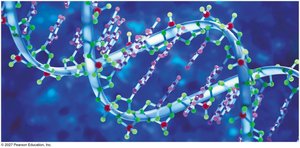
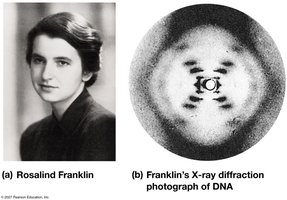
Understanding DNA's structure was crucial for explaining its function in inheritance. X-ray crystallography, performed by Rosalind Franklin, provided key insights into DNA's double-helical structure. Watson and Crick built a model based on these findings.
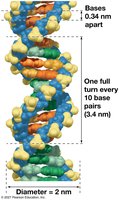
Key Point 1: DNA is composed of two antiparallel strands forming a double helix.
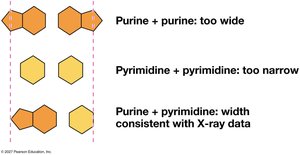
Key Point 2: The sugar-phosphate backbone is on the outside, with nitrogenous bases paired in the interior.
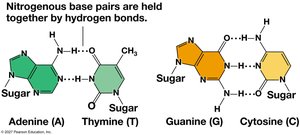
Key Point 3: Base pairing is specific: adenine pairs with thymine, guanine pairs with cytosine.
Key Point 4: Purine-pyrimidine pairing results in a uniform width consistent with X-ray data.
Example: Franklin's X-ray diffraction photo enabled Watson and Crick to deduce the helical structure.
Concept 16.2: DNA Replication and Repair
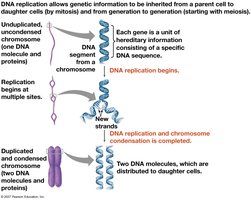
DNA replication ensures the faithful transmission of genetic information. The process is highly accurate and involves many proteins and enzymes. The semiconservative model of replication was confirmed by experiments.
Key Point 1: Each DNA strand serves as a template for a new strand, resulting in two identical DNA molecules.
Key Point 2: The semiconservative model: each daughter molecule has one old strand and one new strand.
Key Point 3: Replication begins at origins of replication, forming replication bubbles and forks.
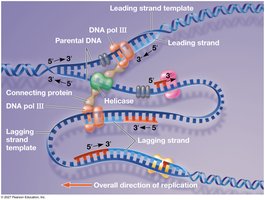
Key Point 4: Key enzymes: helicase (unwinds DNA), primase (synthesizes RNA primer), DNA polymerase (synthesizes new DNA), ligase (joins fragments).
Key Point 5: Leading strand is synthesized continuously; lagging strand is synthesized in Okazaki fragments.
Key Point 6: DNA polymerases proofread and repair DNA, reducing error rates.
Example: Meselson-Stahl experiment confirmed the semiconservative model of DNA replication.
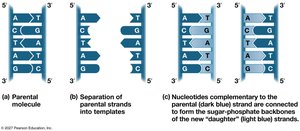
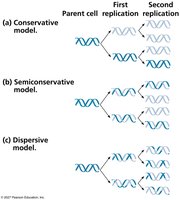
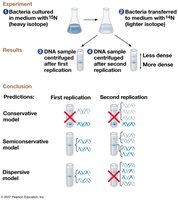
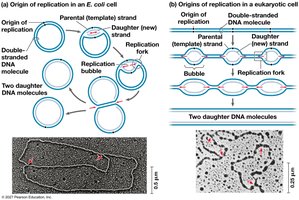
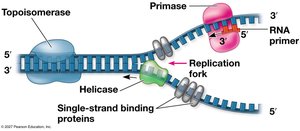
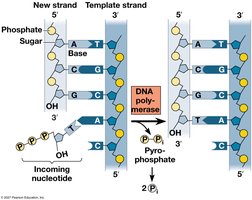
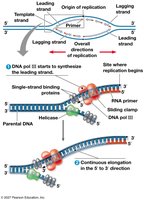
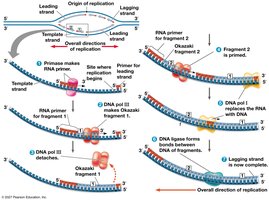
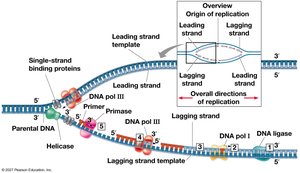
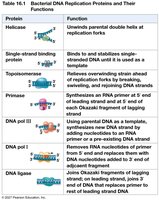
Table: Bacterial DNA Replication Proteins and Their Functions
Protein | Function |
|---|---|
Helicase | Unwinds parental double helix at replication forks |
Single-strand binding protein | Binds to and stabilizes single-stranded DNA |
Topoisomerase | Relieves overwinding strain ahead of replication forks by breaking, swiveling, and rejoining DNA strands |
Primase | Synthesizes an RNA primer at 5' ends of leading strand and at 5' end of each Okazaki fragment |
DNA pol III | Using parental DNA as template, synthesizes new DNA strand by adding nucleotides to RNA primer or pre-existing DNA strand |
DNA pol I | Removes RNA nucleotides of primer from 5' end and replaces them with DNA nucleotides |
DNA ligase | Joins Okazaki fragments of lagging strand; joins 3' end of DNA that replaces primer to rest of leading strand DNA |
The DNA Replication Complex
The proteins involved in DNA replication form a large complex, sometimes referred to as the "DNA replication machine." This complex may be stationary, with DNA polymerase molecules reeling in parental DNA and extruding newly made daughter DNA molecules.
Key Point: The exact mechanism of the DNA replication complex is still under investigation.
Proofreading and Repairing DNA
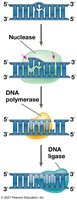
DNA polymerases proofread newly synthesized DNA, replacing incorrect nucleotides. Additional repair mechanisms, such as mismatch repair and nucleotide excision repair, further ensure DNA integrity.
Key Point 1: Mismatch repair enzymes correct errors that escape proofreading.
Key Point 2: Nucleotide excision repair removes damaged DNA segments and replaces them.
Example: Exposure to X-rays or cigarette smoke can cause DNA damage, which is repaired by excision repair mechanisms.
Evolutionary Significance of DNA Mutations
Although DNA replication is highly accurate, some errors persist. These mutations are a source of genetic variation, which is essential for evolution and natural selection.
Key Point: Mutations can be passed to the next generation and are responsible for the appearance of new species.
Replicating the Ends of DNA Molecules
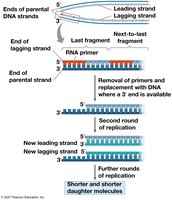
Linear DNA molecules, such as those in eukaryotic chromosomes, face challenges in replicating their ends. Special sequences called telomeres and the enzyme telomerase help address this issue.
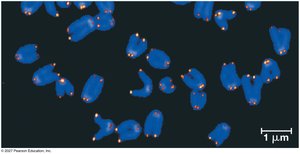
Key Point 1: Telomeres postpone the erosion of genes near chromosome ends.
Key Point 2: Telomerase catalyzes the lengthening of telomeres in germ cells.
Key Point 3: Telomere shortening may limit cell divisions and protect against cancer.
Example: Telomerase activity is observed in cancer cells, allowing them to persist.
Concept 16.3: Chromosome Structure and DNA Packing
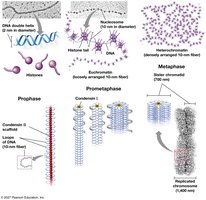
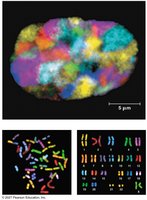
Chromosomes consist of DNA molecules packed with proteins. Bacterial chromosomes are circular and associated with a small amount of protein, while eukaryotic chromosomes are linear and associated with large amounts of protein.
Key Point 1: In bacteria, DNA is supercoiled and found in the nucleoid.
Key Point 2: In eukaryotes, DNA is combined with proteins to form chromatin.
Key Point 3: Chromatin packing involves nucleosomes, histones, and higher-order structures.
Key Point 4: Euchromatin is loosely packed and accessible; heterochromatin is highly condensed and less accessible.
Key Point 5: Chromatin undergoes changes during the cell cycle, condensing into metaphase chromosomes.
Key Point 6: Histone modifications affect chromatin structure and gene expression.
Example: Chromatin packing allows chromosomes to fit into the nucleus and regulates gene expression.
Additional info: DNA replication and repair are fundamental to genetic inheritance, cell division, and evolution. Understanding these processes is essential for fields such as genetics, molecular biology, and biotechnology.
