 Back
Chapter 16: The Molecular Basis of Inheritance – DNA Structure and Replication
Study Guide - Smart Notes
 Tailored notes based on your materials, expanded with key definitions, examples, and context.
The Molecular Basis of Inheritance
Introduction
The discovery of DNA as the genetic material revolutionized biology, providing insight into how traits are inherited and how genetic information is faithfully transmitted from one generation to the next. This chapter explores the experiments and evidence that established DNA as the hereditary material, its structural features, and the mechanisms of DNA replication.
Evidence for DNA as the Genetic Material
Griffith's Transformation Experiment
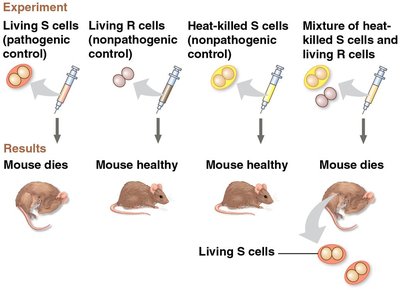
Frederick Griffith's 1928 experiment demonstrated that genetic traits could be transferred between bacterial strains, suggesting the existence of a "transforming principle." He worked with two strains of Streptococcus pneumoniae: a pathogenic (S) strain and a nonpathogenic (R) strain.
Transformation: A change in genotype and phenotype due to assimilation of foreign DNA.
Key Result: Mixing heat-killed S cells with living R cells resulted in the death of mice and recovery of living S cells, indicating genetic transformation.
Avery, McCarty, and MacLeod's Experiment
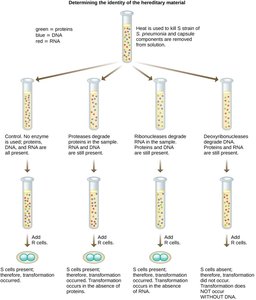
Building on Griffith's work, Avery, McCarty, and MacLeod identified DNA as the transforming substance by systematically eliminating proteins and RNA from bacterial extracts.
Key Finding: Only extracts treated to remove DNA lost the ability to transform R cells into S cells, confirming DNA as the hereditary material.
Hershey-Chase Experiment
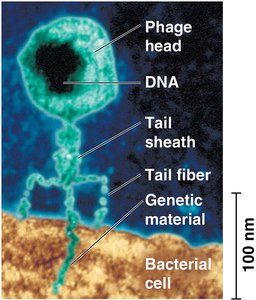
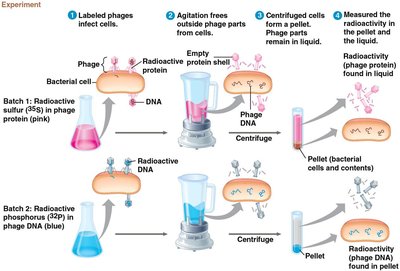
Alfred Hershey and Martha Chase used bacteriophages (viruses that infect bacteria) to show that DNA, not protein, is the genetic material. They labeled phage DNA with radioactive phosphorus and protein with radioactive sulfur, then tracked which component entered bacterial cells during infection.
Bacteriophage: A virus that infects bacteria, composed of DNA (or RNA) and a protein coat.
Key Result: Only DNA entered the bacterial cells and directed viral replication, confirming DNA as the genetic material.
DNA Structure and Composition
DNA as a Polymer of Nucleotides
DNA is composed of nucleotides, each containing a nitrogenous base (adenine, thymine, guanine, or cytosine), a sugar (deoxyribose), and a phosphate group.
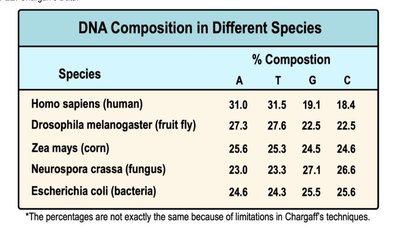
Chargaff's Rules: The base composition of DNA varies between species, but within any species, the amount of adenine equals thymine, and the amount of guanine equals cytosine.
Species | A (%) | T (%) | G (%) | C (%) |
|---|---|---|---|---|
Homo sapiens | 31.0 | 31.5 | 19.1 | 18.4 |
Drosophila melanogaster | 27.3 | 27.6 | 22.5 | 22.5 |
Zea mays | 25.6 | 25.3 | 24.5 | 24.6 |
Neurospora crassa | 23.0 | 23.3 | 27.1 | 26.6 |
Escherichia coli | 24.6 | 24.3 | 25.5 | 25.6 |
Discovery of the Double Helix
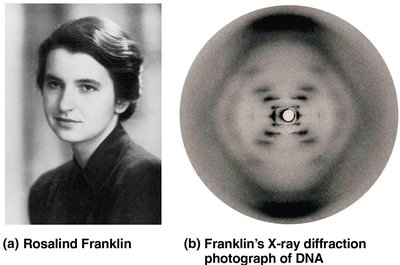
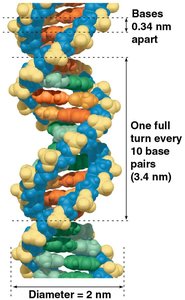
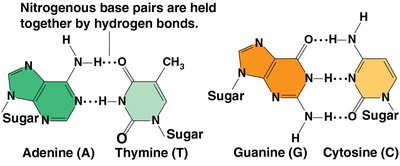
Rosalind Franklin's X-ray crystallography provided critical evidence for the helical structure of DNA. Watson and Crick used this data to build the double helix model, showing two antiparallel strands with paired bases in the interior.
Antiparallel: The two DNA strands run in opposite directions.
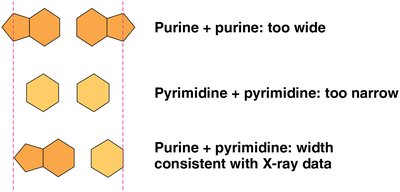
Base Pairing: Purines (A, G) pair with pyrimidines (T, C) to maintain uniform width.
DNA Replication
Basic Principle: Base Pairing to a Template Strand
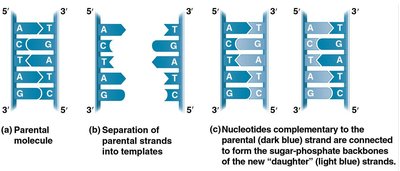
DNA replication relies on the complementarity of the two strands. Each strand serves as a template for the synthesis of a new strand, resulting in two identical DNA molecules.
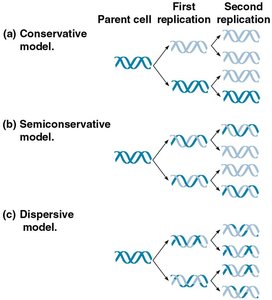
Semiconservative Model: Each new DNA molecule consists of one old (parental) strand and one newly synthesized strand.
Alternative Models: Conservative (parent strands rejoin) and dispersive (each strand is a mix of old and new).
Meselson-Stahl Experiment
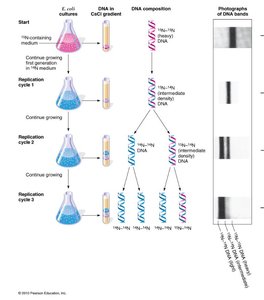
Matthew Meselson and Franklin Stahl provided experimental evidence supporting the semiconservative model of DNA replication by using isotopic labeling and density gradient centrifugation.
Mechanism of DNA Replication
Origins of Replication and Replication Forks
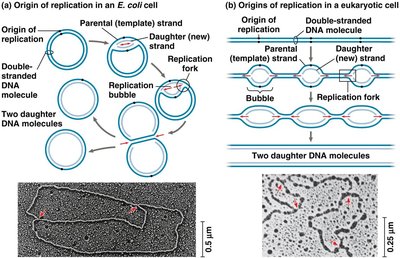
Replication begins at specific sites called origins of replication, where the DNA strands are separated, forming replication bubbles. Each bubble has two replication forks, where DNA is actively unwound and synthesized.
Prokaryotes: Typically have a single origin of replication.
Eukaryotes: Have multiple origins per chromosome.
Proteins and Enzymes Involved in Replication
Several proteins and enzymes coordinate the unwinding and synthesis of DNA:
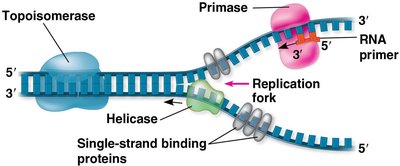
Helicase: Unwinds the DNA helix at the replication fork.
Single-strand binding proteins: Stabilize unwound DNA.
Topoisomerase: Relieves strain ahead of the replication fork.
Primase: Synthesizes RNA primers needed for DNA polymerase to begin synthesis.
Synthesizing a New DNA Strand
DNA polymerases catalyze the addition of nucleotides to the growing DNA strand. Synthesis requires a primer and proceeds in the 5' to 3' direction.
Antiparallel Elongation: The leading strand is synthesized continuously toward the replication fork, while the lagging strand is synthesized discontinuously as Okazaki fragments, which are joined by DNA ligase.
DNA Pol III vs. DNA Pol I: DNA Pol III synthesizes most of the new DNA; DNA Pol I replaces RNA primers with DNA.
Summary of Bacterial DNA Replication
Replication in bacteria involves coordinated action of multiple enzymes and proteins, ensuring accurate and efficient duplication of the genome.
*Additional info: Eukaryotic replication is fundamentally similar but involves more complex regulation and multiple origins per chromosome.*
Key Terms and Concepts
Gene: A unit of hereditary information consisting of a specific DNA sequence.
Bacteriophage: A virus that infects bacteria.
Transformation: The assimilation of foreign DNA by a cell.
Base Composition: The relative amounts of A, T, G, and C in DNA.
Semiconservative Replication: Each new DNA molecule contains one old and one new strand.
Okazaki Fragments: Short DNA segments synthesized on the lagging strand.
