 Back
Chapter 16: The Molecular Basis of Inheritance – Study Notes
Study Guide - Smart Notes
 Tailored notes based on your materials, expanded with key definitions, examples, and context.
The Molecular Basis of Inheritance
Introduction
This chapter explores the discovery that DNA is the genetic material, the experiments that established its role, and the structural features that enable DNA to transmit hereditary information. Understanding these concepts is fundamental to modern biology and genetics.
Evidence for DNA as the Genetic Material
Historical Experiments and Scientific Inquiry
Early research focused on identifying whether DNA or protein was the genetic material. Key experiments with bacteria and viruses provided crucial evidence.
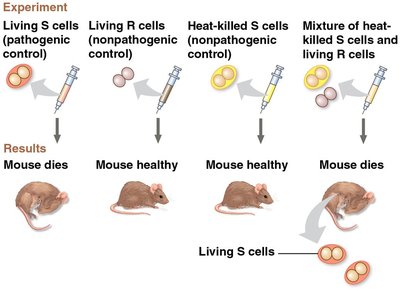
Frederick Griffith's Experiment (1928): Demonstrated transformation, where harmless bacteria became pathogenic by assimilating genetic material from dead pathogenic cells.
Transformation: Defined as a change in genotype and phenotype due to assimilation of foreign DNA.
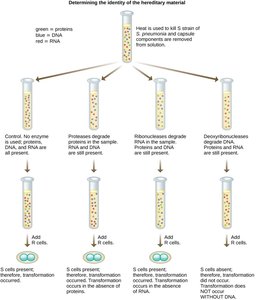
Avery, McCarty, and MacLeod: Identified DNA as the transforming substance, confirming its role in heredity.
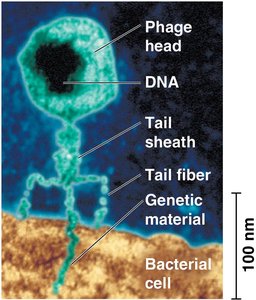
Bacteriophage: A virus that infects bacteria, used in experiments to study genetic material.
Hershey-Chase Experiment
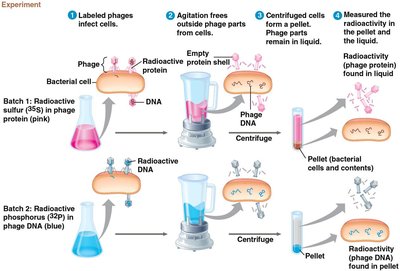
Alfred Hershey and Martha Chase (1952) used bacteriophage T2 to show that DNA, not protein, enters bacterial cells and directs viral reproduction.
Experimental Design: Radioactive labeling of DNA and protein allowed tracking of which component entered the cell.
Conclusion: Only DNA entered the host cell, confirming its role as genetic material.
DNA Structure and Composition
Nucleotide Structure and Chargaff's Rules
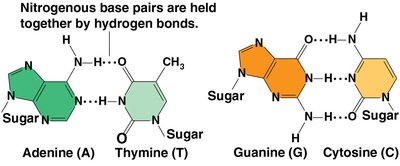
DNA is a polymer of nucleotides, each consisting of a nitrogenous base, a sugar, and a phosphate group. The four bases are adenine (A), thymine (T), guanine (G), and cytosine (C).
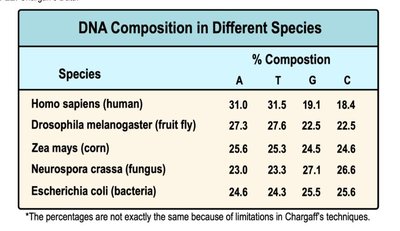
Chargaff's Rules: The base composition of DNA varies between species. In any species, the number of A and T bases is equal, and the number of G and C bases is equal.
Implication: These rules were explained by the double helix structure.
Species | A (%) | T (%) | G (%) | C (%) |
|---|---|---|---|---|
Homo sapiens (human) | 31.0 | 31.5 | 19.1 | 18.4 |
Drosophila melanogaster (fruit fly) | 27.3 | 27.6 | 22.5 | 22.5 |
Zea mays (corn) | 25.6 | 25.3 | 24.5 | 24.6 |
Neurospora crassa (fungus) | 23.0 | 23.3 | 27.1 | 26.6 |
Escherichia coli (bacteria) | 24.6 | 24.3 | 25.5 | 25.6 |
Discovery of the Double Helix
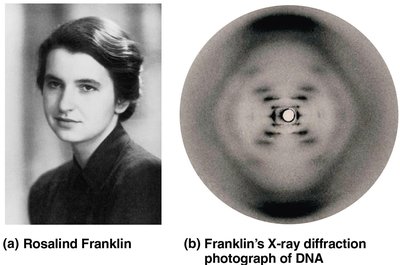
After DNA was accepted as the genetic material, its structure was elucidated using X-ray crystallography.
Rosalind Franklin: Produced X-ray diffraction images that revealed DNA's helical structure.
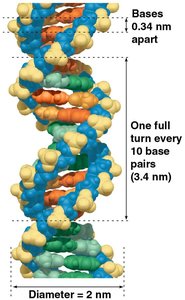
Watson and Crick: Built a model of DNA as a double helix with antiparallel sugar-phosphate backbones and paired nitrogenous bases in the interior.
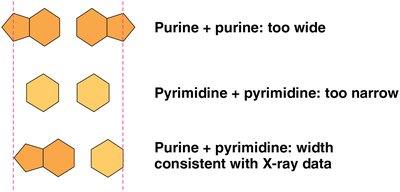
Base Pairing: Purines (A, G) pair with pyrimidines (T, C), resulting in uniform width.
DNA Replication: Mechanisms and Models
Principle of Base Pairing to a Template Strand
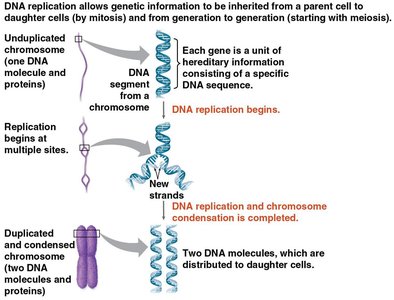
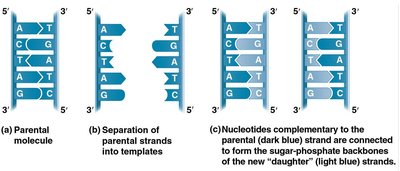
DNA replication relies on the complementarity of the two strands. Each strand serves as a template for the synthesis of a new strand, ensuring accurate transmission of genetic information.
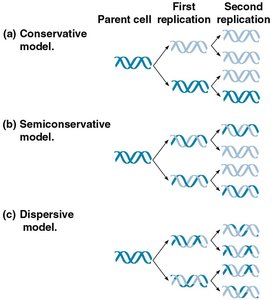
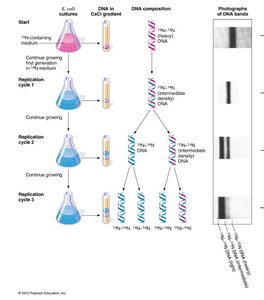
Semiconservative Model: Each daughter DNA molecule consists of one old (parental) strand and one newly synthesized strand.
Alternative Models: Conservative (parent strands rejoin) and dispersive (each strand is a mix of old and new).
Experimental Evidence: Meselson and Stahl's experiment supported the semiconservative model.
Key Terms and Concepts
Gene: A unit of hereditary information consisting of a specific DNA sequence.
Bacteriophage: A virus that infects bacteria.
Transformation: The assimilation of foreign DNA by a cell, resulting in a change in genotype and phenotype.
Base Composition: The relative amounts of A, T, G, and C in DNA, which vary between species.
Summary Table: DNA Replication Models
Model | Description | Experimental Support |
|---|---|---|
Conservative | Parent strands rejoin; new molecule is entirely new DNA | Not supported |
Semiconservative | Each molecule has one old and one new strand | Supported by Meselson-Stahl |
Dispersive | Each strand is a mix of old and new DNA | Not supported |
Key Equations
Base pairing in DNA:
Semiconservative replication:
Additional info:
These notes expand on the brief points in the original slides, providing academic context and definitions to ensure completeness and clarity for exam preparation.
