 Back
Chapter 16: The Molecular Basis of Inheritance – DNA Structure, Replication, and Packaging
Study Guide - Smart Notes
 Tailored notes based on your materials, expanded with key definitions, examples, and context.
Life’s Operating Instructions: DNA as the Genetic Material
Introduction to DNA
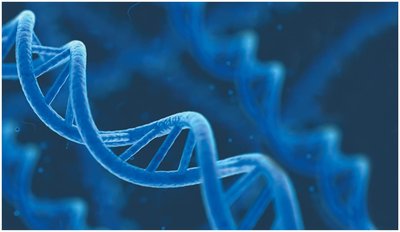
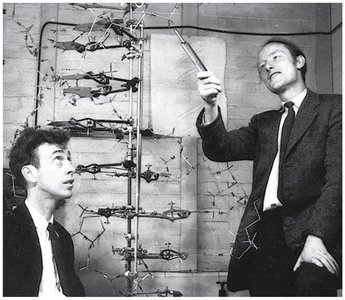
Deoxyribonucleic acid (DNA) is the molecule that encodes hereditary information and directs the development of biochemical, anatomical, physiological, and behavioral traits in all living organisms. The discovery of its double-helical structure by James Watson and Francis Crick in 1953 revolutionized our understanding of genetics and inheritance.
DNA Replication: The process by which DNA is copied before cell division.
DNA Repair: Mechanisms that correct damage or errors in DNA.
Genetic Program: DNA directs cellular functions and organismal development.
The Search for the Genetic Material
Early Experiments and the Discovery of DNA’s Role
In the early 20th century, biologists sought to identify the molecules responsible for inheritance. Chromosomes, composed of DNA and protein, were the main candidates. The role of DNA was first elucidated through studies of bacteria and viruses.
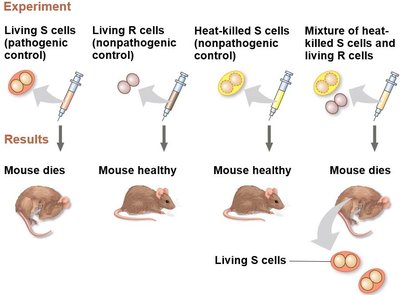
Frederick Griffith’s Experiment (1928): Demonstrated transformation, where non-pathogenic bacteria became pathogenic after exposure to heat-killed pathogenic bacteria.
Transformation: Change in genotype and phenotype due to assimilation of foreign DNA.
Evidence from Viruses and Bacteriophages
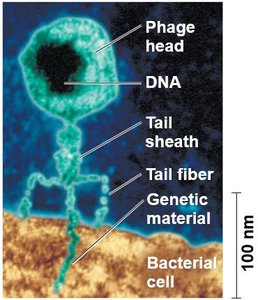
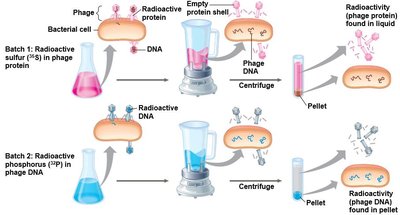
Bacteriophages (phages) are viruses that infect bacteria and were crucial in demonstrating that DNA, not protein, is the genetic material.
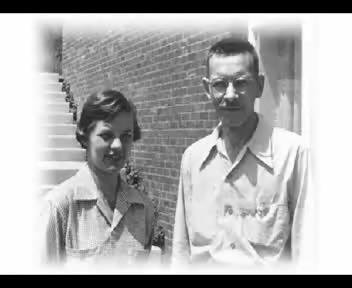
Hershey-Chase Experiment (1952): Used radioactive labeling to show that only DNA enters the bacterial cell during infection, confirming DNA as the genetic material.
DNA Structure and Composition
Nucleotides and Chargaff’s Rules
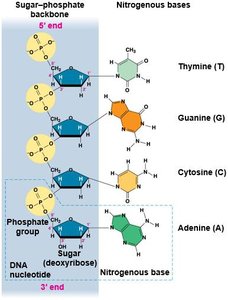
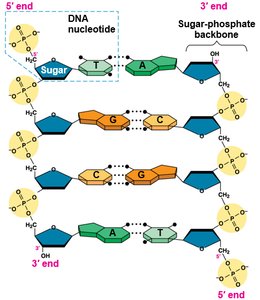
DNA is a polymer of nucleotides, each consisting of a nitrogenous base, a sugar (deoxyribose), and a phosphate group. The four bases are adenine (A), thymine (T), guanine (G), and cytosine (C).
Chargaff’s Rules: 1) DNA composition varies between species; 2) In any species, A = T and G = C.
DNA vs RNA: Structure and Differences
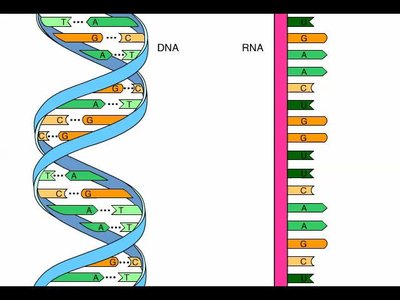
Both DNA and RNA are nucleic acids, but DNA is double-stranded and contains thymine, while RNA is single-stranded and contains uracil instead of thymine.
DNA: Double helix, deoxyribose sugar, bases A, T, G, C.
RNA: Single strand, ribose sugar, bases A, U, G, C.
Building the Structural Model of DNA
X-ray Crystallography and the Double Helix
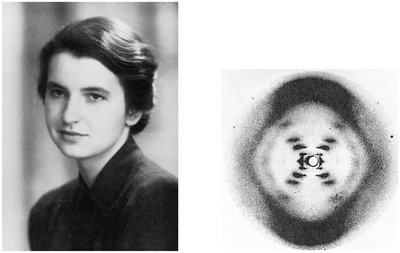
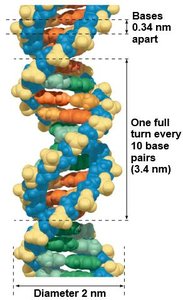
Maurice Wilkins and Rosalind Franklin used X-ray crystallography to study DNA’s molecular structure. Franklin’s images enabled Watson and Crick to deduce the helical structure and the width of the helix.
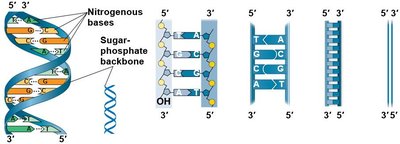
Double Helix: Two strands twisted around each other, with bases paired in the interior.
Antiparallel Backbones: The two sugar-phosphate backbones run in opposite directions.
Base Pairing and Chargaff’s Rule
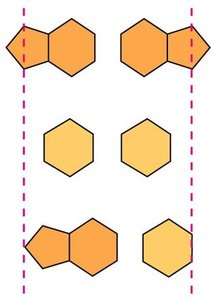
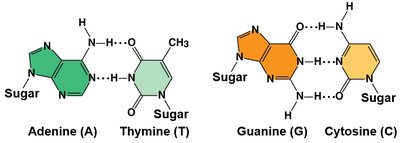
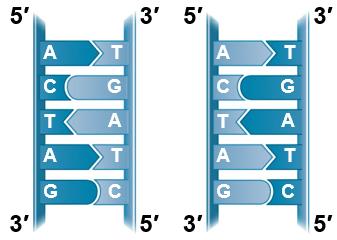
Watson and Crick determined that base pairing is dictated by the structure of the bases: adenine pairs with thymine, and guanine pairs with cytosine. This explains Chargaff’s rule.
Purine + Pyrimidine: Maintains uniform width of the helix.
Base Pairing: A-T and G-C pairs are held together by hydrogen bonds.
DNA Replication: Mechanism and Models
Base Pairing to a Template Strand
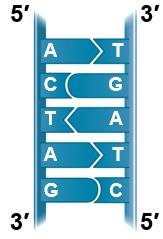
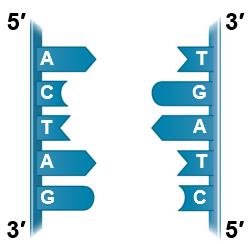
The double helix structure allows each strand to serve as a template for replication. DNA replication involves unwinding the parent molecule and synthesizing new complementary strands.
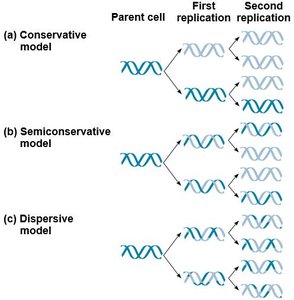
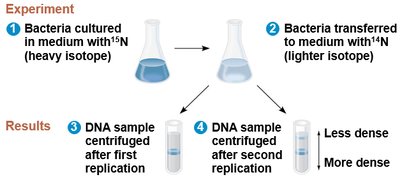
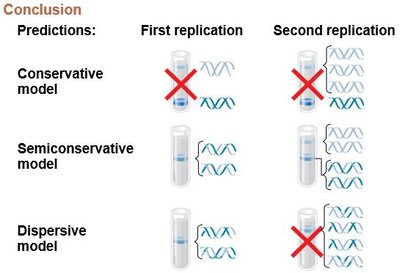
Semiconservative Model: Each daughter DNA molecule has one old strand and one new strand.
Alternative Models: Conservative (parent strands rejoin), Dispersive (mix of old and new).
DNA Replication: A Closer Look
Origins of Replication and Replication Forks
Replication begins at origins of replication, where the DNA strands separate and form replication bubbles. Bacteria have a single origin, while eukaryotes have multiple origins.
Replication Fork: Y-shaped region where new DNA strands are synthesized.
Helicase: Enzyme that unwinds the DNA helix.
Single-Strand Binding Proteins: Stabilize single-stranded DNA.
Topoisomerase: Relieves strain ahead of the replication fork.
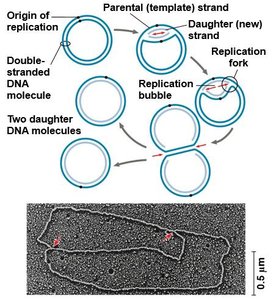
Synthesizing a New DNA Strand
DNA polymerases synthesize new DNA by adding nucleotides to the 3’ end of a primer. Primase synthesizes a short RNA primer to initiate DNA synthesis.
Primer: Short RNA strand required for DNA polymerase to start synthesis.
DNA Polymerase: Enzyme that adds nucleotides to the growing DNA strand.
Nucleoside Triphosphate: Each added nucleotide loses two phosphate groups as pyrophosphate.
Antiparallel Elongation: Leading and Lagging Strands
DNA polymerases can only add nucleotides in the 5’ to 3’ direction. The leading strand is synthesized continuously, while the lagging strand is synthesized in fragments (Okazaki fragments) joined by DNA ligase.
Leading Strand: Synthesized toward the replication fork.
Lagging Strand: Synthesized away from the fork in Okazaki fragments.
DNA Ligase: Joins Okazaki fragments.
DNA Proofreading and Repair
Mechanisms of DNA Repair
DNA polymerases proofread newly synthesized DNA and replace incorrect nucleotides. Additional repair mechanisms include mismatch repair and nucleotide excision repair.
Mismatch Repa ir: Corrects errors in base pairing.
Nucleotide Excision Repair: Removes and replaces damaged DNA segments.
Mutations: Permanent changes in DNA sequence, source of genetic variation.
DNA Packaging in Chromosomes
Bacterial vs Eukaryotic Chromosomes
Bacterial chromosomes are circular and supercoiled, while eukaryotic chromosomes are linear and associated with proteins (histones) forming chromatin.
Chromatin: DNA-protein complex in eukaryotes.
Histones: Proteins responsible for DNA packing.
Nucleosome: Basic unit of DNA packaging, DNA wrapped around histone core.
Chromatin Packing and Gene Expression
Chromatin undergoes changes in packing during the cell cycle. Loosely packed chromatin (euchromatin) is accessible for gene expression, while tightly packed chromatin (heterochromatin) is less accessible.
Epigenetics: Chemical modifications of histones affect chromatin structure and gene expression.
Summary Table: Bacterial DNA Replication Proteins and Their Functions
Protein | Function |
|---|---|
Helicase | Unwinds parental double helix at replication forks |
Single-strand binding protein | Binds to and stabilizes single-stranded DNA |
Topoisomerase | Relieves overwinding strain ahead of replication forks |
Primase | Synthesizes RNA primer at 5' end of leading strand and each Okazaki fragment |
DNA polymerase III | Synthesizes new DNA strand by adding nucleotides to primer or pre-existing DNA |
DNA polymerase I | Removes RNA primer and replaces with DNA nucleotides |
DNA ligase | Joins Okazaki fragments and DNA segments |
Key Terms and Definitions
DNA Replication: Copying of DNA before cell division.
Transformation: Uptake of foreign DNA by a cell.
Phages: Viruses that infect bacteria.
Virus: Infectious particle with genetic material (DNA or RNA) in a protein coat.
Double Helix: Two intertwined DNA strands.
Antiparallel: Opposite orientation of DNA strands.
Origins of Replication: Sites where DNA replication begins.
Parental DNA: Original DNA strand used as template.
Leading Strand: Continuously synthesized DNA strand.
Lagging Strand: Discontinuously synthesized DNA strand.
Okazaki Fragments: Short DNA segments on lagging strand.
Mismatch Repair: Correction of base pairing errors.
Nucleotide Excision Repair: Removal and replacement of damaged DNA.
Histones: DNA-packaging proteins in eukaryotes.
Euchromatin: Loosely packed chromatin, active in gene expression.
Heterochromatin: Densely packed chromatin, less active.
Epigenetics: Heritable changes in gene expression not due to DNA sequence.
