 Back
Chapter 16: The Molecular Basis of Inheritance – DNA Structure, Replication, and Chromosome Organization
Study Guide - Smart Notes
 Tailored notes based on your materials, expanded with key definitions, examples, and context.
The Molecular Basis of Inheritance
Introduction
DNA is the fundamental molecule responsible for storing genetic information in all living organisms. Accurate copying of DNA ensures the transmission of genetic instructions from cell to cell and from parents to offspring. This chapter explores the discovery, structure, replication, and packaging of DNA.
DNA Is the Genetic Material
Key Properties of DNA
DNA stores instructions: Directs cells in protein synthesis, which is essential for organismal function.
DNA is inherited: Half of nuclear DNA is inherited from each parent.
DNA must be copied: Prior to cell division, DNA is replicated so each new cell receives a complete set.
Genes: Segments of DNA encoding specific functional products, usually proteins.
Discovery of DNA as Genetic Material
Griffith's Experiment: Demonstrated transformation in bacteria, showing genetic material could be transferred.
Avery, MacLeod, and McCarty: Identified DNA as the substance responsible for transformation.
Hershey and Chase: Used bacteriophages to confirm DNA carries genetic information.
Rosalind Franklin: Provided X-ray evidence of DNA's helical structure.
Watson and Crick: Developed the double helix model of DNA.
Main takeaway: DNA is the genetic material responsible for inheritance.
Structure of DNA
Nucleotide Composition
DNA is composed of repeating units called nucleotides, each consisting of:
A phosphate group
A five-carbon sugar (deoxyribose)
A nitrogenous base
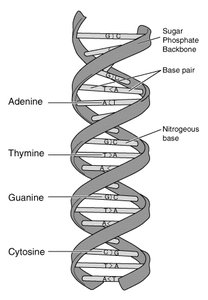
The four nitrogenous bases are Adenine (A), Thymine (T), Guanine (G), and Cytosine (C).
DNA forms a double helix structure, with two strands twisted around each other. The sugar-phosphate backbone is on the outside, and nitrogenous bases are paired on the inside, held together by hydrogen bonds.
Chargaff's Rules
Base pairing: Adenine (A) pairs with Thymine (T); Guanine (G) pairs with Cytosine (C).
Quantitative relationships: Amount of A equals T; amount of G equals C.
Purines: Adenine and Guanine (two rings).
Pyrimidines: Cytosine and Thymine (one ring).
DNA always pairs one purine with one pyrimidine to maintain consistent width.
Example: If DNA contains 30% adenine, it also contains 30% thymine, 20% guanine, and 20% cytosine.
Antiparallel DNA Strands
DNA strands run in opposite directions: one 5′ → 3′, the other 3′ → 5′.
DNA polymerase adds nucleotides only to the 3′ end, so new DNA is synthesized 5′ → 3′.
DNA Replication and Repair
Semiconservative Replication
DNA replication occurs before cell division, ensuring each daughter cell receives a complete set of DNA. Replication is semiconservative: each new DNA molecule contains one original strand and one newly synthesized strand.
Conservative model: Original DNA stays together; new molecule is entirely new.
Semiconservative model: Each new molecule has one old and one new strand.
Dispersive model: Strands contain mixed sections of old and new DNA.
Conclusion: DNA replication is semiconservative.
Steps of DNA Replication
Initiation: Replication begins at the origin, forming a replication bubble and forks.
Unwinding: Helicase unzips DNA; single-strand binding proteins keep strands apart; topoisomerase relieves tension.
Primer Addition: Primase synthesizes a short RNA primer for DNA polymerase to start.
Building New DNA: DNA polymerase adds complementary nucleotides (A–T, G–C) in the 5′ → 3′ direction.
Finishing: RNA primers are replaced with DNA; DNA ligase seals fragments.
Key Enzymes in DNA Replication
Enzyme | Function |
|---|---|
Helicase | Unzips DNA |
Topoisomerase | Relieves twisting |
Single-strand binding proteins | Keep DNA strands separated |
Primase | Makes RNA primers |
DNA polymerase | Builds new DNA (5′ → 3′) |
DNA ligase | Seals DNA fragments together |
Leading Strand vs. Lagging Strand
Leading strand: Synthesized continuously toward the replication fork; requires one primer.
Lagging strand: Synthesized discontinuously away from the fork; requires multiple primers; produces Okazaki fragments.
DNA ligase joins Okazaki fragments into a continuous strand.
Both strands are synthesized 5′ → 3′.
Okazaki Fragments
Short DNA segments on the lagging strand.
Necessary due to the directionality of DNA polymerase.
DNA ligase joins fragments into a continuous strand.
DNA Proofreading and Repair
DNA polymerase proofreading: Checks and corrects newly added nucleotides.
Mismatch repair: Fixes incorrectly paired bases.
Nucleotide excision repair: Removes damaged DNA; DNA polymerase and ligase restore the sequence.
DNA damage sources: X-rays, chemicals, cigarette smoke, spontaneous changes.
Mutations
Changes in DNA sequence.
Can result from replication errors not repaired.
Heritable mutations contribute to genetic variation and evolution.
Main takeaway: DNA repair reduces mutations, but some changes remain and contribute to genetic diversity.
Telomeres and Telomerase
Telomeres: Repetitive DNA sequences at chromosome ends; protect genetic information.
Telomerase: Enzyme that lengthens telomeres; active in germ cells and many cancer cells.
DNA polymerase cannot fully replicate chromosome ends, leading to gradual shortening.
Main takeaway: Telomeres protect chromosome ends; telomerase maintains their length.
Chromosome Structure and DNA Packaging
Prokaryotic vs. Eukaryotic Chromosomes
Feature | Prokaryotes | Eukaryotes |
|---|---|---|
DNA shape | Circular | Linear |
Location | Nucleoid | Nucleus |
Number | Usually one | Multiple |
Associated proteins | Less | More |
Supercoiling | Common | Not typical |
Chromatin
Chromatin = DNA + proteins (mainly histones).
Organizes and packages DNA inside the nucleus.
Histone proteins help package DNA.
Nucleosomes
Basic units of DNA packaging.
DNA wraps around eight histone proteins.
Resemble beads on a string.
Packaging progresses: DNA double helix → nucleosomes → higher-order chromatin → condensed chromosome.
Euchromatin vs. Heterochromatin
Euchromatin: Loosely packed, accessible, active gene expression.
Heterochromatin: Tightly packed, less accessible, reduced gene expression.
Easy way to remember: Euchromatin = Easier to access; Heterochromatin = Harder to access.
Chromosome Condensation
DNA packaging changes during the cell cycle.
Interphase: Chromatin is loose and accessible.
Mitosis: Chromatin condenses, chromosomes become shorter and thicker for separation.
Histone modifications can alter chromatin packing and influence gene expression.
Additional info: DNA structure and replication are foundational to understanding inheritance, genetic variation, and cell division. Chromosome packaging ensures efficient storage and regulation of genetic material.
