 Back
Chapter 17: From Genes to Protein – Gene Expression and the Central Dogma
Study Guide - Smart Notes
 Tailored notes based on your materials, expanded with key definitions, examples, and context.
Gene Expression: From Genes to Proteins
Historical Foundations of Gene Expression
Gene expression is the process by which information encoded in DNA is used to direct the synthesis of proteins, which ultimately determine an organism's phenotype. Early studies established the link between genes and metabolic pathways.
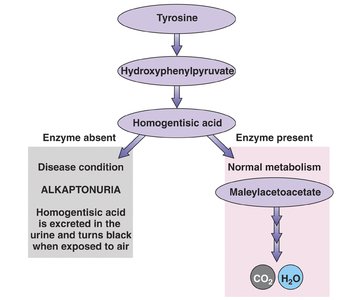
Inborn Errors of Metabolism (Garrod, 1908): Certain diseases arise from metabolic disorders caused by defective genes.
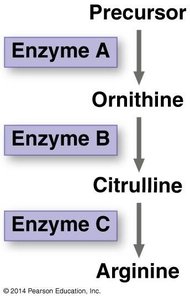
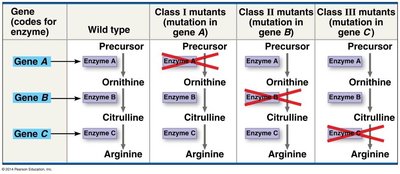
Beadle and Tatum (1940s): Experiments with Neurospora mutants showed that each gene affects a single step in a metabolic pathway, leading to the "one gene, one enzyme" hypothesis.
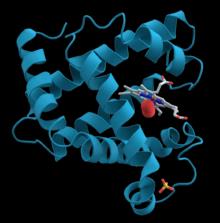
Refinement: Not all proteins are enzymes; many proteins are composed of multiple polypeptides, each encoded by a separate gene. This led to the "one gene, one polypeptide" hypothesis.
The Central Dogma of Molecular Biology
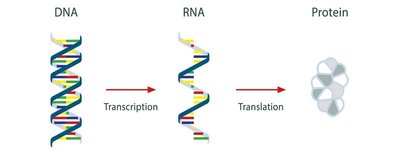
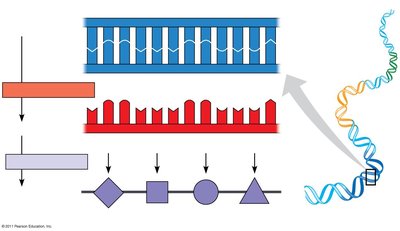
The central dogma describes the flow of genetic information: DNA is transcribed into RNA, which is then translated into protein. This process is fundamental to all living organisms.
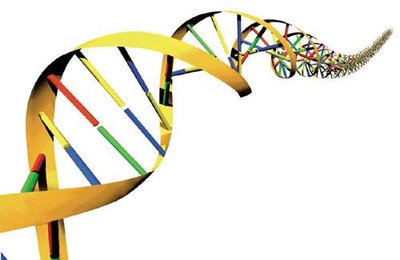
DNA: Contains the genetic instructions for making proteins.
RNA: Acts as an intermediary, carrying instructions from DNA to the ribosome.
Protein: The functional product that determines phenotype.
RNA Structure and Types
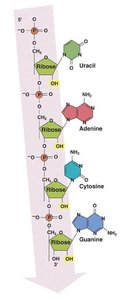
RNA is structurally distinct from DNA and exists in several forms, each with a specific function in gene expression.
Single-stranded molecule with ribose sugar.
Uracil (U) replaces thymine (T).
Types: mRNA (messenger), tRNA (transfer), rRNA (ribosomal).
Transcription: DNA-Directed Synthesis of RNA
Overview of Transcription
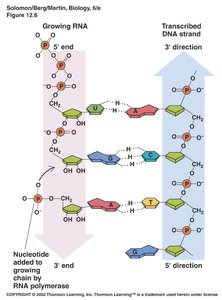
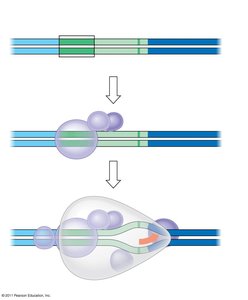
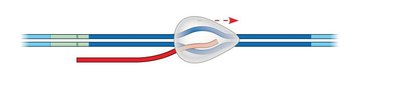
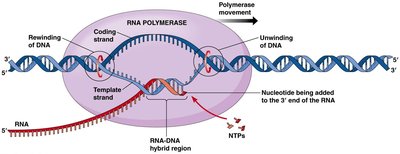
Transcription is the first stage of gene expression, where a DNA sequence is copied into RNA by RNA polymerase.
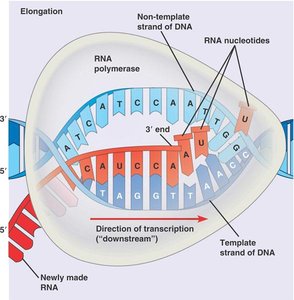
RNA polymerase: Catalyzes the synthesis of RNA from a DNA template.
Direction: RNA is synthesized in the 5' → 3' direction; DNA is read in the 3' → 5' direction.
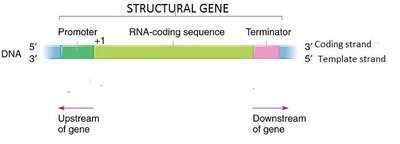
Template strand: The DNA strand that is transcribed.
Stages of Transcription
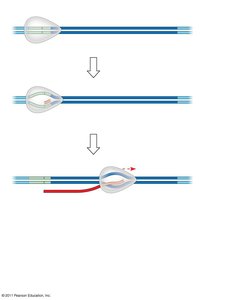
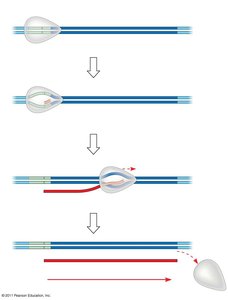
Transcription occurs in three main stages: initiation, elongation, and termination.
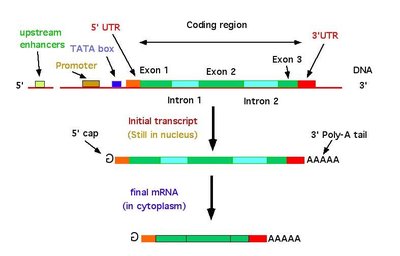
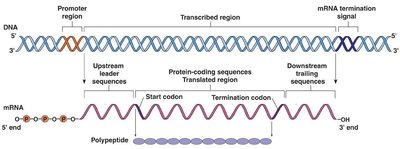
Initiation: RNA polymerase binds to the promoter region, often with the help of transcription factors (in eukaryotes, the TATA box is crucial).
Elongation: RNA polymerase moves along the DNA, unwinding the helix and synthesizing RNA.
Termination: Transcription ends when RNA polymerase reaches a terminator sequence (bacteria) or a polyadenylation signal (eukaryotes).
RNA Processing in Eukaryotes
Modification of Pre-mRNA
In eukaryotes, the primary RNA transcript (pre-mRNA) undergoes several modifications before becoming mature mRNA.
5' Cap: A modified guanine nucleotide is added to the 5' end.
Poly-A Tail: A string of adenine nucleotides is added to the 3' end.
Functions: These modifications facilitate mRNA export, protect from degradation, and help ribosome binding.

RNA Splicing
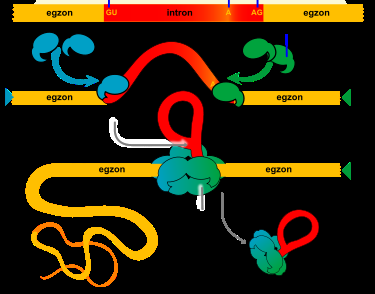
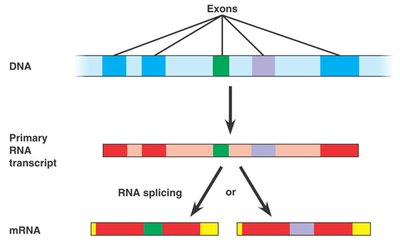
RNA splicing removes noncoding regions (introns) and joins coding regions (exons) to produce a continuous coding sequence.
Introns: Noncoding regions removed from pre-mRNA.
Exons: Coding regions retained in mature mRNA.
Spliceosome: A complex of proteins and snRNPs that carries out splicing.
Alternative splicing: Allows one gene to code for multiple polypeptides.
Translation: RNA-Directed Protein Synthesis
The Genetic Code
The genetic code is a set of rules by which information in mRNA is translated into a sequence of amino acids in a protein.
Codon: A sequence of three RNA bases that codes for a specific amino acid or stop signal.
Start codon: AUG (methionine) signals the beginning of translation.
Stop codons: UAA, UGA, UAG signal the end of translation.
Degeneracy: Multiple codons can code for the same amino acid.
Mechanism of Translation
Translation occurs in three stages: initiation, elongation, and termination, and is carried out by ribosomes with the help of tRNA.
Initiation: The small ribosomal subunit binds to mRNA and locates the start codon. The first tRNA binds, followed by the large subunit.
Elongation: Amino acids are added one by one to the growing polypeptide chain, facilitated by elongation factors.
Termination: When a stop codon is reached, a release factor binds, freeing the polypeptide.
Polyribosomes and Prokaryotic Translation
Multiple ribosomes can translate a single mRNA simultaneously, forming polyribosomes. In prokaryotes, transcription and translation are often coupled.
Polyribosomes: Allow rapid and efficient protein synthesis.
Coupling: In prokaryotes, translation can begin before transcription is complete.
Mutations and Their Effects
Types of Mutations
Mutations are changes in the DNA sequence that can affect gene expression and protein function.
Point mutations: Substitution of one base for another.
Silent mutation: No change in amino acid.
Missense mutation: Changes one amino acid (e.g., sickle-cell anemia).
Nonsense mutation: Creates a stop codon, leading to premature termination.
Frameshift mutations: Insertions or deletions that shift the reading frame.
Transposons: DNA elements that can move within the genome.
Mutation Type | Effect | Example |
|---|---|---|
Silent | No change in protein | Base change, same amino acid |
Missense | Change in one amino acid | Sickle-cell anemia |
Nonsense | Premature stop codon | Truncated protein |
Frameshift | Shift in reading frame | Insertion/deletion |
Summary Table: Central Dogma and Gene Expression
Process | Location | Key Molecules | Outcome |
|---|---|---|---|
Transcription | Nucleus (eukaryotes) | RNA polymerase, DNA, NTPs | mRNA |
RNA Processing | Nucleus (eukaryotes) | Spliceosome, enzymes | Mature mRNA |
Translation | Cytoplasm | Ribosome, tRNA, mRNA | Polypeptide |
Key Equations and Concepts
Transcription direction:
Genetic code:
Peptide bond formation:
Additional info:
Alternative splicing increases protein diversity from a single gene.
Mutations in regulatory regions can affect gene expression without altering protein sequence.
