 Back
Chapter 17: Gene Expression – From Gene to Protein
Study Guide - Smart Notes
 Tailored notes based on your materials, expanded with key definitions, examples, and context.
Gene Expression: From Gene to Protein
Overview: The Flow of Genetic Information
The information content of DNA is encoded in specific sequences of nucleotides. This genetic information directs the synthesis of proteins, which are responsible for cellular structure and catalytic activities, ultimately establishing an organism's phenotype.
DNA Function: Provides genetic instructions for cell structure and function.
Gene Expression: The process by which DNA directs protein synthesis, involving two main stages: transcription and translation.
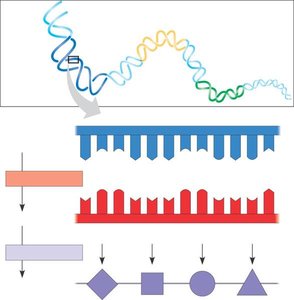
Central Dogma of Biology
The central dogma describes the directional flow of genetic information: DNA is transcribed into RNA, which is then translated into protein.
Transcription: DNA → RNA
Translation: RNA → Protein

Revision of the One Gene-One Enzyme Hypothesis
Research has shown that genes code for polypeptide chains or RNA molecules, not just enzymes. The updated hypothesis is "one gene-one polypeptide." Cells are governed by a chain of command: DNA → RNA → protein.
Basic Principles of Transcription and Translation
Transcription is the synthesis of RNA under the direction of DNA, producing mRNA, tRNA, and rRNA. Translation is the synthesis of a polypeptide under the direction of mRNA, occurring on ribosomes.
Transcription: Produces mRNA, tRNA, rRNA.
Translation: Occurs on ribosomes, synthesizing polypeptides.
Three Classes of RNA
Messenger RNA (mRNA): Carries protein-building instructions.
Ribosomal RNA (rRNA): Major component of ribosomes.
Transfer RNA (tRNA): Delivers amino acids to ribosomes.
Transcription and Translation in Prokaryotes vs. Eukaryotes
In prokaryotes, transcription and translation occur simultaneously. In eukaryotes, RNA transcripts are modified before becoming functional mRNA.
Prokaryotes: mRNA is immediately translated.
Eukaryotes: RNA processing occurs before translation.


Transcription: DNA to RNA
Molecular Components of Transcription
Transcription is catalyzed by RNA polymerase II, which separates DNA strands and assembles RNA nucleotides. RNA synthesis follows base-pairing rules, with uracil replacing thymine in RNA.
RNA Polymerase: Catalyzes RNA synthesis.
Base Pairing: A-U, C-G in RNA.

Stages of Transcription
Initiation: RNA polymerase binds to the promoter, DNA unwinds, and RNA synthesis begins.
Elongation: RNA polymerase moves downstream, elongating the RNA transcript in the 5' to 3' direction.
Termination: RNA polymerase reaches a termination sequence, and the RNA transcript is released.

Promoters and Transcription Initiation Complex
Promoters signal the initiation of RNA synthesis. In eukaryotes, transcription factors help RNA polymerase recognize promoter sequences (such as the TATA box). The transcription initiation complex forms when these factors and RNA polymerase bind to the promoter.

Termination and RNA Processing in Eukaryotes
In eukaryotes, RNA polymerase II transcribes a polyadenylation signal (AAUAAA). Proteins cut the RNA transcript free downstream. Enzymes modify pre-mRNA before it is exported to the cytoplasm.
Alteration of mRNA Ends
5' Cap: Modified guanine nucleotide added to the 5' end.
Poly-A Tail: 50-250 adenine nucleotides added to the 3' end.
Functions: Facilitate export, protect mRNA, help ribosome attachment.


RNA Splicing: Removal of Introns
Most eukaryotic genes contain noncoding regions (introns) between coding regions (exons). RNA splicing removes introns and joins exons, creating a continuous coding sequence.
Introns: Noncoding intervening sequences.
Exons: Coding regions expressed as amino acid sequences.
Spliceosomes: Complexes that carry out RNA splicing.



Ribozymes: Catalytic RNA Molecules
Ribozymes are RNA molecules that function as enzymes and can splice RNA. Some intron RNA acts as a ribozyme, demonstrating that not all enzymes are proteins.
Exons and Protein Domains
Proteins often have modular architecture with domains. Different exons may code for different domains in a protein.

Translation: RNA to Protein
Molecular Components of Translation
Translation is the RNA-directed synthesis of a polypeptide, involving tRNA and ribosomes.
tRNA: Transfers amino acids to ribosomes.
rRNA: Forms the core of ribosome structure and catalyzes protein synthesis.
mRNA: Provides the template for translation.
Structure and Function of tRNA
tRNA: Single RNA strand (~80 nucleotides), L-shaped.
Amino Acid Attachment: Each tRNA carries a specific amino acid.
Anticodon: Region that base-pairs with mRNA codon.

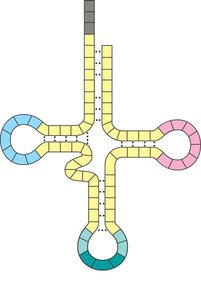
Aminoacyl-tRNA Synthetase
This enzyme joins each amino acid to the correct tRNA, forming an "activated" amino acid.

Ribosomes: Sites of Protein Synthesis
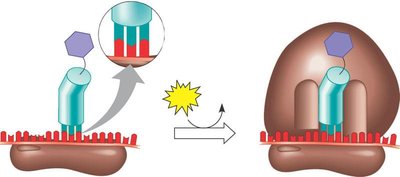
Ribosomes: Facilitate coupling of tRNA anticodons with mRNA codons.
Subunits: Composed of proteins and rRNA.

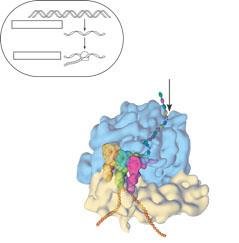
Ribosome Binding Sites for tRNA
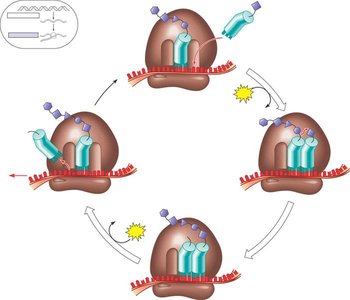
P site: Holds tRNA attached to growing polypeptide.
A site: Holds tRNA carrying next amino acid.
E site: Exit site for discharged tRNA.

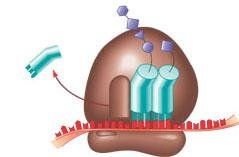
Stages of Translation
Initiation: Brings together mRNA, initiator tRNA, and ribosomal subunits.
Elongation: Amino acids are added one by one to the growing polypeptide chain.
Termination: Ribosome reaches a stop codon, and the polypeptide is released.


Polyribosomes
Multiple ribosomes can translate a single mRNA simultaneously, forming polyribosomes.
Post-Translational Modifications and Protein Targeting
Modifications: Polypeptides may be modified after translation, affecting their shape and function.
Targeting: Proteins destined for secretion or the endomembrane system are transported into the ER, guided by signal peptides and signal-recognition particles (SRP).
Mutations and Their Effects
Point Mutations
Definition: Changes in a single nucleotide pair of a gene.
Effects: Can produce abnormal proteins, such as in sickle-cell anemia.
Types of Point Mutations
Base-Pair Substitutions: Replacement of one nucleotide pair with another.
Missense Mutation: Changes one amino acid to another.
Nonsense Mutation: Changes a codon to a stop codon.
Insertions/Deletions: Addition or loss of nucleotide pairs, may cause frameshift mutations.
Type of Mutation | Description | Example Disease |
|---|---|---|
Base-Pair Substitution | Replacement of one nucleotide pair | Sickle cell anemia |
Missense Mutation | Change in amino acid | Marfan's syndrome |
Nonsense Mutation | Codon changed to stop codon | Tay-Sachs disease |
Frameshift Mutation | Insertion/deletion alters reading frame | Hemophilia A & B |
Concept Check
Enzyme for mRNA transcription: RNA polymerase; transcription proceeds 5' to 3'.
Promoter, TATA box, transcription factors: Initiate transcription by guiding RNA polymerase.
RNA alteration in eukaryotes: 5' cap, poly-A tail, splicing; functions include export, protection, ribosome attachment.
Polyadenylation: Adds poly-A tail for stability and export.
Spliceosome: Complex that removes introns and joins exons.
Exons and Introns: Exons are coding, introns are noncoding; splicing creates mature mRNA.
Translation roles: tRNA (amino acid delivery), rRNA (ribosome structure), mRNA (template), codon (mRNA triplet), anticodon (tRNA triplet), amino acids (building blocks), genetic code (translation rules).
Missense vs. Nonsense Mutation: Missense changes amino acid, nonsense creates stop codon; frameshift alters reading frame.
Transcription Exercise: DNA template: 3' TACAGTGTATTCCAGCGGATC 5' → mRNA: 5' AUGUCACAUAA GG UCGCCUAG 3' → tRNA anticodon: UACAGUGUAU UCCAGCGGAUC → Amino acids: Met-Ser-His-Ile-Gly-Ser-Pro-Arg
Additional info: The notes expand on the original slides with definitions, examples, and context for each process and mutation type.
