 Back
Chapter 2: The Chemical Basis of Life – Atoms, Molecules, and Water
Study Guide - Smart Notes
 Tailored notes based on your materials, expanded with key definitions, examples, and context.
Chapter Overview
Chemistry and the Evolution of Life
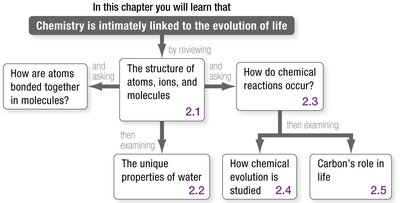
This chapter explores how chemistry is fundamentally linked to the evolution of life. It reviews the structure of atoms, ions, and molecules, examines how chemical reactions occur, and discusses the unique properties of water and the role of carbon in life.
The Structure of Atoms, Ions, and Molecules
Basic Atomic Structure
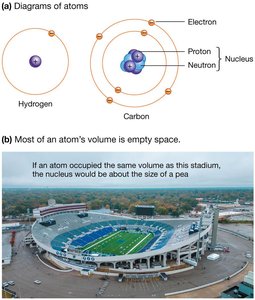
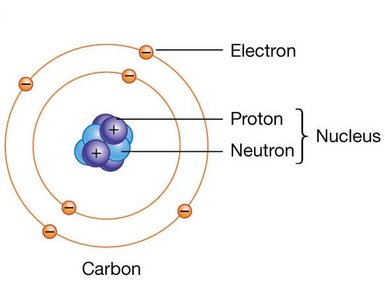
Atoms are the fundamental units of matter, composed of a nucleus containing protons and neutrons, surrounded by orbiting electrons. Four types of atoms—hydrogen, carbon, nitrogen, and oxygen—make up 96% of matter in organisms.
Protons: Positively charged particles (+1)
Neutrons: Neutral particles
Electrons: Negatively charged particles (-1), orbiting the nucleus
Electrically neutral atom: Equal number of protons and electrons
Elements, Atomic Number, and Mass Number
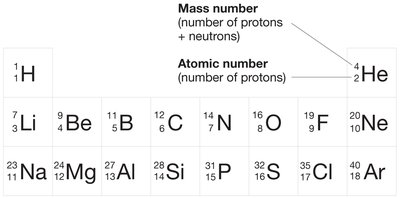
Elements consist entirely of a single type of atom. The atomic number is the characteristic number of protons in the nucleus, while the mass number is the sum of protons and neutrons. The mass of an atom is measured in daltons (Da).
Atomic number: Number of protons
Mass number: Protons + neutrons
Dalton: Unit of atomic mass
Isotopes and Atomic Weight
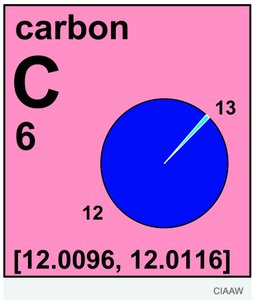
Isotopes are atoms of the same element with different numbers of neutrons, resulting in different masses. Atomic weight is the average mass of all naturally occurring isotopes, weighted by their abundance. Some isotopes are radioactive and decay over time.
Example: Carbon-12, Carbon-13, Carbon-14
Electron Arrangement and Shells
Electrons occupy specific regions called orbitals, grouped into electron shells. Each shell can hold a certain number of electrons, and the outermost shell (valence shell) determines chemical reactivity.
Valence electrons: Electrons in the outermost shell
Valence: Number of unpaired valence electrons
Chemical Bonds and Molecules
Covalent Bonds
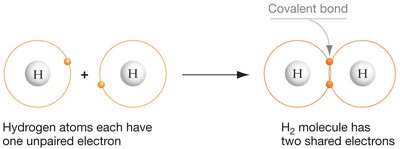
Covalent bonds form when atoms share unpaired valence electrons, resulting in stable molecules. Hydrogen atoms, for example, share electrons to fill their valence shells.
Molecule: Group of atoms bonded together
Covalent bond: Shared pair of electrons
Nonpolar and Polar Covalent Bonds
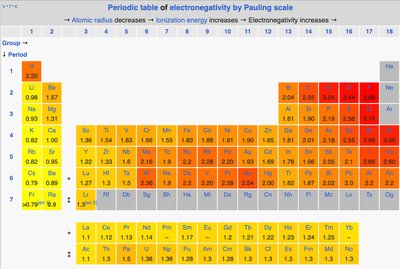
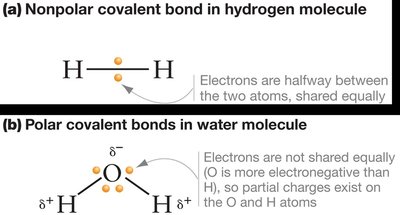
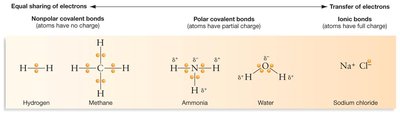
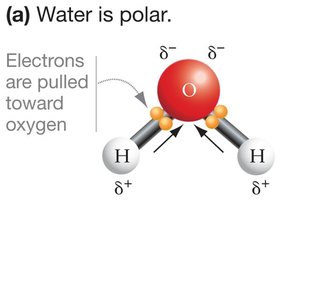
Electrons in covalent bonds are not always shared equally. Electronegativity is the strength with which atoms pull electrons toward themselves. Nonpolar covalent bonds have equal sharing, while polar covalent bonds have unequal sharing, resulting in partial charges.
Electronegativity: Increases up and to the right on the periodic table (O > N > S, C, H, P)
Nonpolar bond: Symmetrical electron sharing (e.g., C–H)
Polar bond: Asymmetrical electron sharing (e.g., O–H in water)
Ionic Bonds and Ions
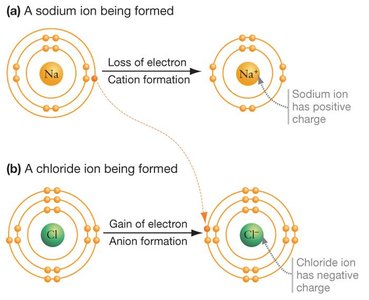
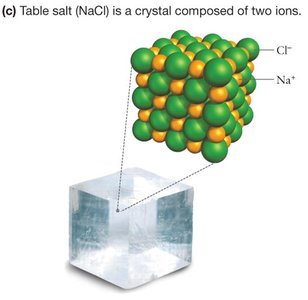
Ionic bonds form when electrons are completely transferred from one atom to another, resulting in charged ions. Cations are positively charged (loss of electron), and anions are negatively charged (gain of electron).
Ionic bond: Complete transfer of electrons
Cation: Positive ion
Anion: Negative ion
Electron Sharing Continuum
The degree to which electrons are shared forms a continuum: from equal sharing in nonpolar covalent bonds, to unequal sharing in polar covalent bonds, to complete transfer in ionic bonds.
Bond Types and Molecular Geometry
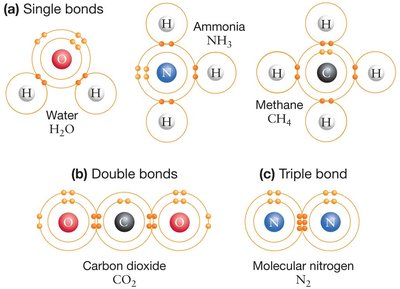
The number of unpaired electrons determines the number of bonds an atom can form. Atoms with more than one unpaired electron can form double or triple bonds. The geometry of molecules, such as methane (tetrahedral) and water (bent), affects their behavior.
Single, double, triple bonds: Number of shared electron pairs
Molecular geometry: Dictates chemical properties
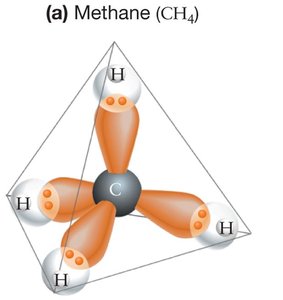
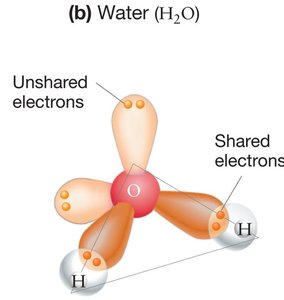
Representing Molecules
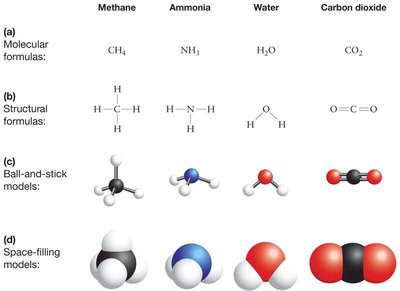
Molecules can be represented by molecular formulas, structural formulas, ball-and-stick models, and space-filling models, each providing different information about composition and structure.
Molecular formula: Types and numbers of atoms
Structural formula: Bonding relationships
Ball-and-stick/space-filling: 3D geometry
Properties of Water
Water as a Solvent
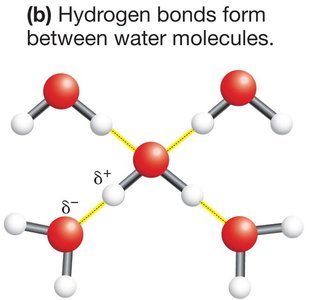
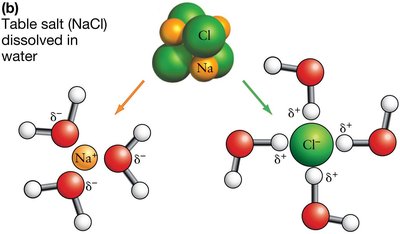
Water is an excellent solvent due to its polarity and bent shape. It dissolves solutes to form solutions, facilitating chemical reactions. Water's structure allows it to form hydrogen bonds, which are weak electrical attractions between partial charges.
Solvent: Substance in which solutes dissolve
Hydrogen bond: Weak interaction between partial charges
Hydrophilic and Hydrophobic Molecules
Hydrophilic molecules (ions and polar compounds) dissolve readily in water due to hydrogen bonding. Hydrophobic molecules (nonpolar compounds) do not dissolve and interact through hydrophobic interactions and van der Waals forces.
Hydrophilic: Water-loving, dissolves in water
Hydrophobic: Water-fearing, does not dissolve
Density of Water
Water is denser as a liquid than as a solid. As water freezes, it forms an open crystal structure, causing ice to float and act as an insulating layer.
Ice: Less dense than liquid water
Crystal structure: Open, allows floating
Acid–Base Chemistry and pH
Acids donate protons and increase hydronium ion concentration, while bases accept protons and decrease it. Water can dissociate into hydrogen and hydroxide ions. The pH scale measures proton concentration, with buffers helping maintain stable pH in organisms.
Acid: pH < 7
Base: pH > 7
Neutral: pH = 7
Buffer: Minimizes pH changes
Equation:
Energy in Chemical Bonds
Potential and Kinetic Energy
Energy is the capacity to do work or supply heat. Potential energy is stored due to position, such as the arrangement of electrons in bonds. Kinetic energy is energy of motion. Chemical energy is a type of potential energy stored in molecular bonds.
Long, weak bonds: Higher potential energy
Short, strong bonds: Lower potential energy
Carbon: The Backbone of Life
Carbon's Versatility
Carbon forms four covalent bonds, allowing for a limitless array of molecular shapes and combinations. Organic compounds contain carbon bonded to other elements, and molecules with multiple carbon atoms have complex shapes.
Organic compounds: Carbon-containing molecules
Single/double bonds: Shape and reactivity
Functional Groups
Functional groups are specific groups of atoms within molecules that determine their chemical behavior. Common functional groups include amino, carboxyl, carbonyl, hydroxyl, phosphate, and sulfhydryl.
Amino: Acts as a base
Carboxyl: Acts as an acid
Carbonyl: Links molecules
Hydroxyl: Weak acid
Phosphate: Two negative charges
Sulfhydryl: Forms disulfide bonds
Macromolecules and Polymerization
Monomers and Polymers
Macromolecules are large molecules made of smaller subunits called monomers. Polymerization is the process of linking monomers together to form polymers. Condensation (dehydration) reactions join monomers, releasing water, while hydrolysis breaks polymers apart by adding water.
Macromolecule: Large molecule made of monomers
Polymer: Chain of monomers
Condensation reaction: Joins monomers, releases water
Hydrolysis: Breaks polymers, adds water
