 Back
BackChapter 2: The Chemical Context of Life – Study Notes
Study Guide - Smart Notes
 Tailored notes based on your materials, expanded with key definitions, examples, and context.
Overview: The Importance of Chemistry to Life
Matter, Elements, and Compounds
Definitions and Properties
Matter: Anything that takes up space and has mass.
Element: A substance that cannot be broken down to other substances by chemical reactions.
Compound: A substance consisting of two or more elements in a fixed ratio, exhibiting emergent properties distinct from its constituent elements.
The Elements of Life
Essential and Trace Elements
About 20–25% of the 92 natural elements are essential for life.
Essential elements: Required for an organism to live a healthy life and reproduce.
Trace elements: Required in minute quantities (e.g., iodine for thyroid function in vertebrates).
Atomic Structure and Subatomic Particles
Atoms and Their Components
Atom = smallest unit of an element
Made of:
protons (+)
neutrons (0)
electrons (−)
Chemical reactions involve electron rearrangement that breaks and forms chemical bonds between atoms
Atoms react by gaining, losing, or sharing electrons to become stable
Atoms form bonds to achieve stability (full outer shell)
Electron Distribution and Chemical Properties
Valence Electrons and Reactivity
Valence shell = outermost electron shell
Valence electrons = outer shell electrons
Determine bonding and reactivity
C = 4
H = 1
O = 6
N = 5
Atoms want a full outer shell for stability
Chemical Bonds and Molecular Formation
Types of Chemical Bonds
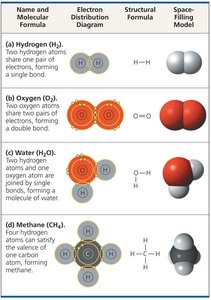
Covalent bonds: sharing electrons
Nonpolar = equal sharing (O₂)
Polar = unequal sharing (H₂O)
Electronegativity = how strongly atoms attract electrons
Ionic bonds: transfer electrons, form ions (positive + negative)
Example: NaCl
Formed when one atom transfers an electron to another, creating ions (cation: positive, anion: negative).
Ionic compounds (salts) often form crystalline structures.
Hydrogen bonds: attraction between H (bonded to O/N/F) and another electronegative atom
Bonds | Description |
|---|---|
Ionic | transfer of electrons |
Covalent | sharing of electrons |
Hydrogen | attraction between molecules |
Weak Chemical Interactions
Weak bonds (hydrogen bonds, van der Waals interactions) are crucial for the structure and function of large biological molecules.
Water and Life
Hydrogen Bonding in Water
Water is a polar molecule, with a partial negative charge on oxygen and partial positive charges on hydrogen.
Hydrogen bonds between water molecules give rise to unique properties essential for life.
Water supports life processes, regulates temperature, and dissolves substances
Hydrogen bonding is the reason for water’s unique properties
Emergent Properties of Water
Cohesion: Water molecules stick together due to hydrogen bonding.
Adhesion: Water molecules stick to other substances.
Surface tension: The difficulty of breaking the surface of a liquid due to cohesion.
High specific heat: Water resists temperature changes, stabilizing environments.
Expansion upon freezing: Ice is less dense than liquid water, allowing it to float.
Versatility as a solvent: Water dissolves many substances due to its polarity.
Examples
Cohesion → water droplets
Adhesion → water climbing glass/plant walls
Surface tension → water striders
Capillary action → plants pulling water up
Solvent → salt dissolving in water
Water as a Solvent
Solutions, Solvents, and Solutes
Solution: Homogeneous mixture of substances.
Solvent: Dissolving agent (water in aqueous solutions).
Solute: Substance dissolved in the solvent.
Water forms hydration shells around ions and can dissolve polar molecules.
Hydrophilic and Hydrophobic Substances
Hydrophilic: Substances with an affinity for water (e.g., salts, sugars).
Hydrophobic: Substances that repel water (e.g., oils).
Acids, Bases, and pH
Water Dissociation and pH Scale
Water can dissociate into H+ (hydronium ion) and OH- (hydroxide ion).
Acids: Increase H+ concentration.
Bases: Reduce H+ concentration.
pH scale: Measures H+ concentration; pH = -log[H+].
pH 7 is neutral; lower values are acidic, higher values are basic.
pH affects enzyme shape, reaction rates, and protein function
low pH = high H⁺
high pH = low H⁺
pH affects:
enzyme shape
reaction rates
protein function
Buffers
Buffers minimize changes in pH by accepting or donating H+ as needed.
Example: Carbonic acid acts as a buffer in human blood.
Buffers prevent sudden pH changes in organisms
