 Back
BackChapter 2: The Chemical Context of Life – Study Notes
Study Guide - Smart Notes
 Tailored notes based on your materials, expanded with key definitions, examples, and context.
•'e
The Chemical Context of LifeChemistry of Life: Creating Compounds
All living organisms are composed of matter, which is anything th
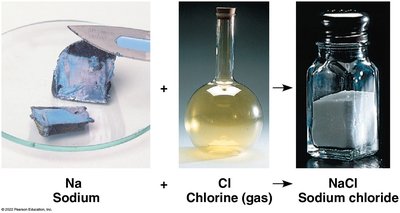
at occupies space and has mass. The basic building blocks of matter are elements, substances that cannot be broken down or converted into other substances by chemical means. The smallest unit of an element that retains its chemical properties is an atom. When two or more elements combine in a fixed ratio, they form a compound, which exhibits emergent properties distinct from its constituent elements.
Element: Pure substance consisting of only one type of atom.
Atom: Smallest unit of an element, retaining its properties.
Compound: Substance formed from two or more elements in a fixed ratio.
Emergent properties: New characteristics that arise when elements combine.
Example: Sodium (Na) and chlorine (Cl) combine to form sodium chloride (NaCl), a compound with properties different from either element.
Elements of Life
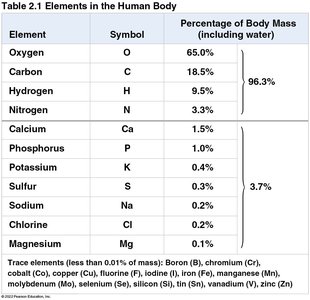
Of the 92 naturally occurring elements, only about 20-25% are essential for life. These essential elements are required for organisms to survive, grow, and reproduce. Trace elements are needed in minute quantities but are still vital for proper biological function.
Essential elements: Oxygen, carbon, hydrogen, nitrogen, calcium, phosphorus, potassium, sulfur, sodium, chlorine, magnesium.
Trace elements: Iodine, iron, zinc, copper, etc.
Example: Iodine is required for normal thyroid function; deficiency can cause goiter.
Element | Symbol | Percentage of Body Mass |
|---|---|---|
Oxygen | O | 65.0% |
Carbon | C | 18.5% |
Hydrogen | H | 9.5% |
Nitrogen | N | 3.3% |
Calcium | Ca | 1.5% |
Phosphorus | P | 1.0% |
Potassium | K | 0.4% |
Sulfur | S | 0.3% |
Sodium | Na | 0.2% |
Chlorine | Cl | 0.2% |
Magnesium | Mg | 0.1% |
Evolution of Tolerance to Toxic Elements
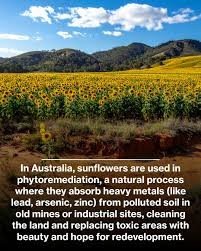
Some elements are toxic to most organisms, but certain species have evolved mechanisms to tolerate or even utilize these elements. Phytoremediation is a process where plants, such as sunflowers, absorb heavy metals from contaminated soils, helping to detoxify the environment.
Phytoremediation: Use of plants to remove toxins from soil.
Example: Sunflowers absorb lead, zinc, and other heavy metals, used after environmental disasters.
Element Properties Depend on Atomic Structure
Atomic Structure
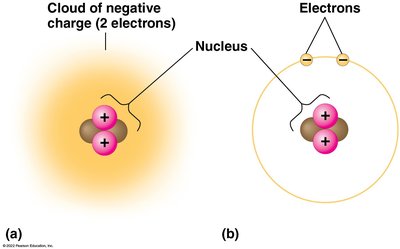
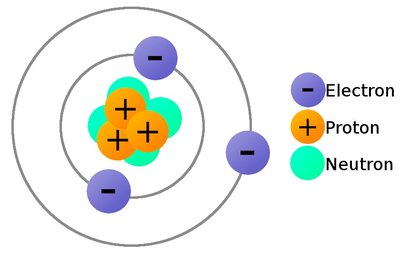
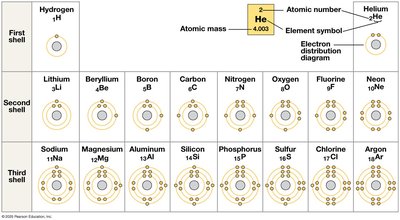
Atoms are composed of three types of subatomic particles: neutrons (no charge), protons (positive charge), and electrons (negative charge). The atomic nucleus contains protons and neutrons, while electrons form a cloud around the nucleus.
Proton: Positive charge, found in nucleus.
Neutron: No charge, found in nucleus.
Electron: Negative charge, found in electron cloud.
Atomic Number and Atomic Mass
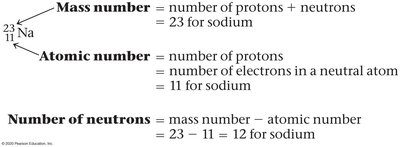
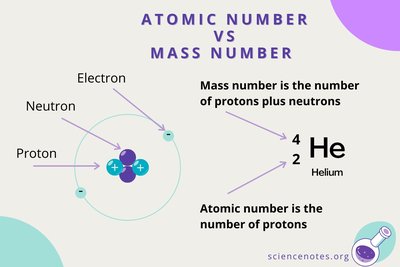
Atoms of different elements differ in their number of subatomic particles. The atomic number is the number of protons in the nucleus, while the mass number is the sum of protons and neutrons. The atomic mass is approximately equal to the mass number.
Atomic number: Number of protons (and electrons in a neutral atom).
Mass number: Number of protons plus neutrons.
Number of neutrons: Mass number minus atomic number.
Example: Sodium has 11 protons, 12 neutrons, mass number 23.
Isotopes
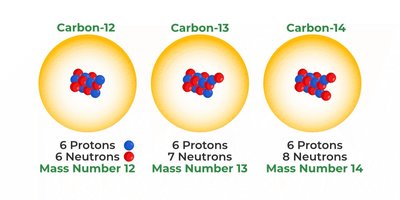
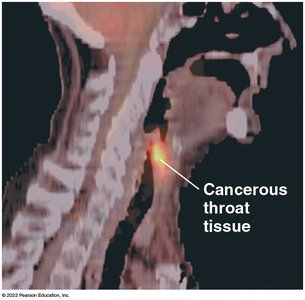
Isotopes are atomic forms of an element that differ in the number of neutrons. Radioactive isotopes decay spontaneously, emitting particles and energy. They are used in dating fossils, tracing metabolic processes, and diagnosing medical disorders, but can also pose environmental hazards.
Isotope: Same number of protons, different number of neutrons.
Radioactive isotope: Unstable nucleus, emits radiation.
Example: Carbon-12, Carbon-13, Carbon-14.
Energy and Electrons
Energy Levels and Electron Shells
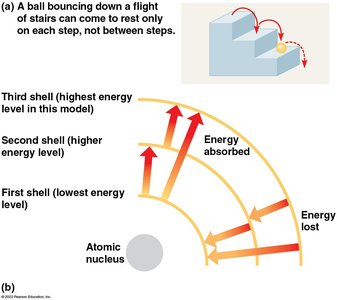
Energy is the capacity to cause change. Electrons have potential energy due to their position relative to the nucleus. Electrons occupy specific electron shells, and can move between shells by absorbing or releasing energy.
Potential energy: Energy due to position or structure.
Electron shell: Energy level where electrons reside.
Energy absorption: Electron moves to higher shell.
Energy release: Electron moves to lower shell.
Chemical Bonds
Covalent Bonds
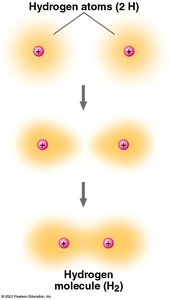
The chemical behavior of an atom is determined by the number of electrons in its outermost (valence) shell. Atoms with incomplete valence shells can share or transfer electrons, forming chemical bonds. Covalent bonds involve the sharing of electron pairs between atoms, resulting in the formation of molecules.
Covalent bond: Sharing of electron pairs.
Single bond: One pair of electrons shared.
Double bond: Two pairs of electrons shared.
Example: Hydrogen molecule (H2).
Electronegativity and Polar Covalent Bonds
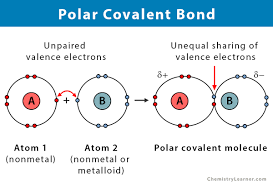
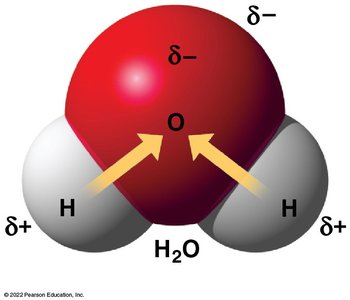
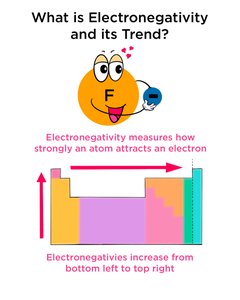
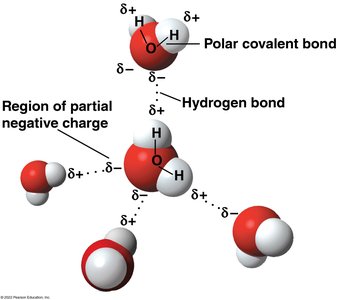
Electronegativity is the tendency of an atom to attract electrons. When atoms with different electronegativities form covalent bonds, the electrons are shared unequally, resulting in polar covalent bonds. This creates partial positive and negative charges within the molecule.
Electronegativity: Measure of electron attraction.
Polar covalent bond: Unequal sharing of electrons.
Example: Water (H2O) has polar covalent bonds.
Ionic Bonds
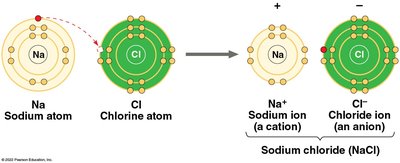
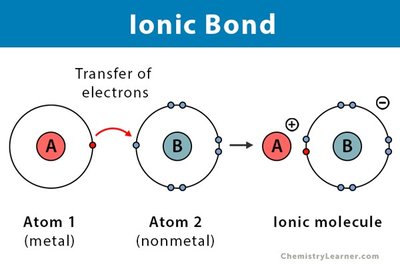
Ionic bonds form when atoms transfer electrons, resulting in oppositely charged ions. A cation is a positively charged ion (lost electron), and an anion is a negatively charged ion (gained electron). The attraction between cations and anions forms ionic compounds, commonly known as salts.
Ionic bond: Attraction between oppositely charged ions.
Cation: Positive ion.
Anion: Negative ion.
Example: Sodium chloride (NaCl).
Weak Chemical Interactions
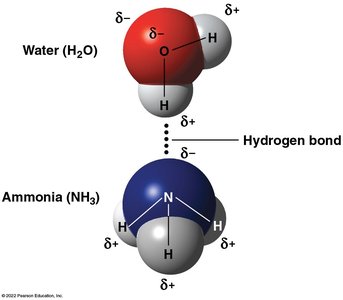
Many biological molecules are held together by weak chemical interactions, such as ionic bonds, hydrogen bonds, and van der Waals interactions. Hydrogen bonds occur when a hydrogen atom covalently bonded to an electronegative atom is attracted to another electronegative atom nearby. Van der Waals interactions are weak attractions that occur when molecules are very close together.
Hydrogen bond: Attraction between hydrogen and electronegative atom.
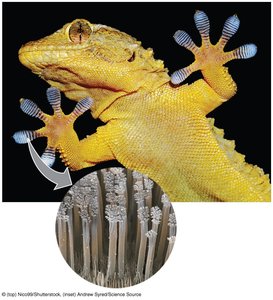
Van der Waals interaction: Weak attraction due to temporary charge asymmetry.
Example: Gecko's ability to walk on walls due to numerous van der Waals interactions.
Chemical Reactions
Making and Breaking Chemical Bonds
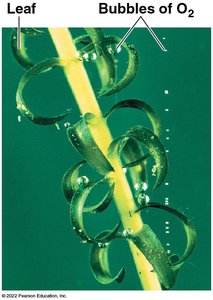
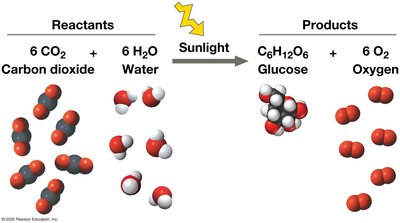
Chemical reactions involve the making and breaking of covalent bonds. The starting molecules are called reactants, and the final molecules are products. An important example is photosynthesis, which converts carbon dioxide and water into glucose and oxygen using sunlight.
Reactant: Starting molecule.
Product: Final molecule.
Photosynthesis equation:
Hydrogen Bonding & Water
Properties of Water
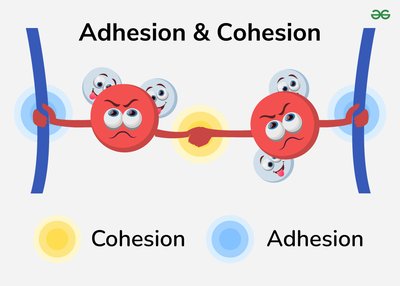
Water is a polar molecule, and hydrogen bonding between water molecules gives rise to several properties essential for life: cohesive behavior, moderation of temperature, expansion upon freezing, and versatility as a solvent.
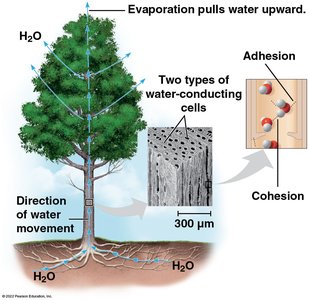
Cohesion: Water molecules stick together.
Adhesion: Water molecules stick to other substances.
Surface tension: Difficulty in breaking the surface of water.
Example: Water transport in plants relies on cohesion and adhesion.
Surface Tension
Surface tension is the measure of how hard it is to break or stretch the surface of a liquid. Water's high surface tension is due to hydrogen bonding among molecules at the surface.
Surface tension: Related to cohesion; allows small organisms to walk on water.
Moderation of Temperature by Water
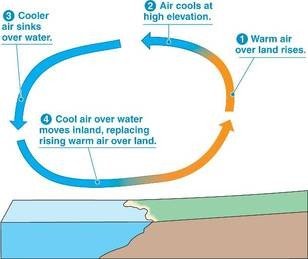
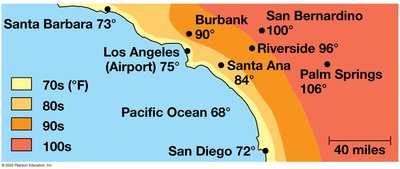
Water can absorb or release large amounts of heat with only slight changes in temperature, helping to moderate Earth's climate and maintain stable conditions for life.
Heat absorption: Water absorbs heat from warmer air.
Heat release: Water releases heat to cooler air.
Floating of Ice on Liquid Water
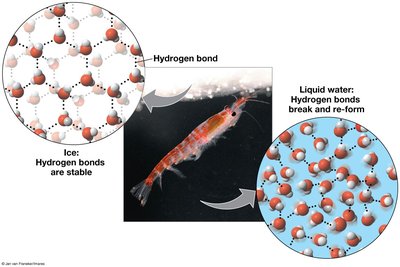
Ice floats because hydrogen bonds in ice are more ordered, making it less dense than liquid water. This property allows aquatic life to survive under ice during winter.
Ice: Less dense than liquid water.
Insulation: Floating ice insulates water below.
Water: The Solvent of Life
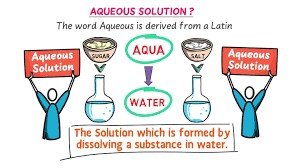
Water is an excellent solvent due to its polarity. It can dissolve ionic and polar compounds, forming aqueous solutions. Substances that dissolve in water are hydrophilic, while those that do not are hydrophobic.
Solution: Homogeneous mixture of substances.
Solvent: Dissolving agent (water).
Solute: Substance dissolved.
Aqueous solution: Water is the solvent.
Hydrophilic: Affinity for water.
Hydrophobic: Repels water.
Acids, Bases, & pH
Acids increase the concentration of hydrogen ions (H+) in water, while bases decrease it. The pH scale measures the concentration of H+ ions, with most biological fluids having a pH between 6 and 8. Buffers help maintain stable pH by accepting or donating H+ ions as needed.
Acid: pH < 7, increases H+ concentration.
Base: pH > 7, decreases H+ concentration.
Buffer: Minimizes changes in pH.
Example: Internal pH of most living cells is close to 7.
Formula:
Additional info: Buffers are crucial for maintaining homeostasis in biological systems.
----------------------------------------
