 Back
BackChapter 2: The Chemical Context of Life – Structured Study Notes
Study Guide - Smart Notes
 Tailored notes based on your materials, expanded with key definitions, examples, and context.
Chapter 2: The Chemical Context of Life
Concept 2.1: Matter Consists of Chemical Elements in Pure Form and in Combinations Called Compounds
Matter is composed of chemical elements, which are substances that cannot be broken down into simpler forms by chemical means. Compounds are substances formed from two or more elements combined in a fixed ratio. The four most abundant elements in living organisms are oxygen, carbon, hydrogen, and nitrogen, making up about 96% of living matter.
Element: A pure substance consisting of only one type of atom.
Compound: A substance formed from two or more elements in a fixed ratio.
Example: Water (H2O) is a compound made of hydrogen and oxygen.
Comparison Table: Element vs. Compound
Element | Compound |
|---|---|
Cannot be broken down chemically | Can be broken down into elements |
Consists of one type of atom | Consists of two or more types of atoms |
Example: Oxygen (O) | Example: Water (H2O) |
Concept 2.2: An Element’s Properties Depend on the Structure of Its Atoms
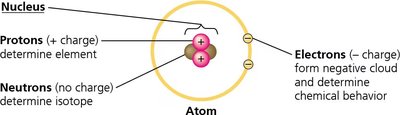
An atom is the smallest unit of an element, consisting of a nucleus (containing protons and neutrons) and electrons orbiting the nucleus. The number of protons determines the atomic number and the identity of the element. The atomic mass is approximately the sum of protons and neutrons, measured in daltons. Isotopes are atoms of the same element with different numbers of neutrons.
Protons (+ charge): Determine the element.
Neutrons (no charge): Determine the isotope.
Electrons (– charge): Determine chemical behavior.
Isotopes: Atoms with the same number of protons but different numbers of neutrons.
Radioactive Isotopes: Unstable isotopes that emit particles and energy.
Electron Shells: Electrons occupy specific energy levels; the outermost shell is called the valence shell.
Orbitals: Three-dimensional spaces where electrons are found.
Example: Neon (Ne) and Argon (Ar) have full valence shells, making them chemically unreactive.
Concept 2.3: The Formation and Function of Molecules and Ionic Compounds Depend on Chemical Bonding Between Atoms
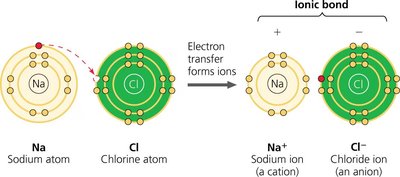
Chemical bonds form when atoms interact to complete their valence shells. The main types of chemical bonds are covalent bonds and ionic bonds. Covalent bonds involve the sharing of electron pairs between atoms, while ionic bonds involve the transfer of electrons from one atom to another, resulting in charged ions.
Covalent Bond: Electrons are shared between atoms.
Single Covalent Bond: One pair of electrons is shared.
Double Covalent Bond: Two pairs of electrons are shared.
Electronegativity: The attraction of an atom for electrons in a covalent bond.
Nonpolar Covalent Bond: Electrons are shared equally.
Polar Covalent Bond: Electrons are shared unequally, creating partial charges.
Ion: An atom or molecule that has gained or lost electrons and has a charge.
Ionic Bond: Attraction between oppositely charged ions.
Weak Interactions: Hydrogen bonds and van der Waals interactions help stabilize large molecules.
Molecular Shape: Determined by the positions of valence orbitals; crucial for biological recognition.
Example: In water (H2O), oxygen is more electronegative, resulting in a polar covalent bond.

Comparison of Bond Types
Bond Type | Electron Sharing | Example |
|---|---|---|
Nonpolar Covalent | Equal sharing | H2 |
Polar Covalent | Unequal sharing | H2O |
Ionic | Electron transfer | NaCl |
Concept 2.4: Chemical Reactions Make and Break Chemical Bonds
Chemical reactions involve the making and breaking of chemical bonds, converting reactants into products. Matter is conserved in these reactions. All chemical reactions are theoretically reversible, and chemical equilibrium is reached when the rates of the forward and reverse reactions are equal.
Reactants: Starting materials in a chemical reaction.
Products: Substances formed as a result of the reaction.
Chemical Equilibrium: The point at which forward and reverse reaction rates are equal.
Example: Adding more reactants to a reaction at equilibrium will shift the equilibrium toward the formation of more products (Le Chatelier's Principle).
Equation:
*Additional info: Le Chatelier's Principle states that a system at equilibrium will adjust to counteract changes in concentration, temperature, or pressure.*
