 Back
BackChapter 2: The Chemical Context of Life – Study Notes
Study Guide - Smart Notes
 Tailored notes based on your materials, expanded with key definitions, examples, and context.
Chapter 2: The Chemical Context of Life
Concept 2.1: Matter, Elements, and Compounds
Matter is the foundation of all biological systems, consisting of elements and compounds. Understanding the chemical context of life is essential for grasping biological processes.
Matter: Anything that takes up space and has mass.
Element: A substance that cannot be broken down into other substances by chemical reactions.
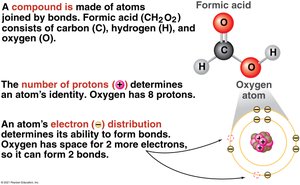
Compound: A substance consisting of two or more elements in a fixed ratio, with properties different from its constituent elements.
Example: Formic acid (CH₂O₂) is a compound made of carbon, hydrogen, and oxygen.
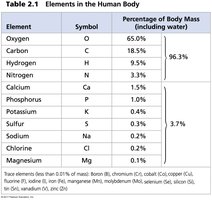
Elements in the Human Body
Elements are classified based on their abundance and function in living organisms. The human body is primarily composed of a few key elements.
Element | Symbol | Percentage of Body Mass (including water) |
|---|---|---|
Oxygen | O | 65.0% |
Carbon | C | 18.5% |
Hydrogen | H | 9.5% |
Nitrogen | N | 3.3% |
Calcium | Ca | 1.5% |
Phosphorus | P | 1.0% |
Potassium | K | 0.4% |
Sulfur | S | 0.3% |
Sodium | Na | 0.2% |
Chlorine | Cl | 0.2% |
Magnesium | Mg | 0.1% |
Concept 2.2: Atomic Structure and Properties
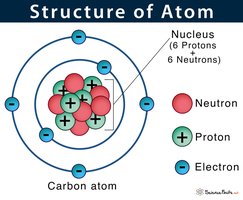
Each element is made of unique atoms, which are the smallest units retaining the properties of the element. Atoms are composed of subatomic particles: protons, neutrons, and electrons.
Proton: Positively charged particle found in the nucleus.
Neutron: Neutral particle found in the nucleus.
Electron: Negatively charged particle orbiting the nucleus.
Atomic Number: Number of protons in the nucleus.
Mass Number: Sum of protons and neutrons in the nucleus.
Atomic Mass: Total mass of the atom, approximated by the mass number.
Isotopes
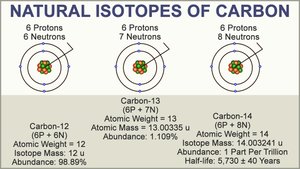
Isotopes are variants of elements with the same number of protons but different numbers of neutrons. Some isotopes are radioactive and decay spontaneously.
Example: Carbon-12, Carbon-13, and Carbon-14 are isotopes of carbon.
Electron Distribution and the Periodic Table
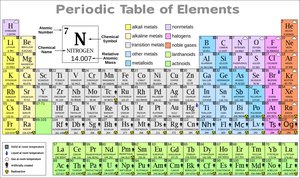
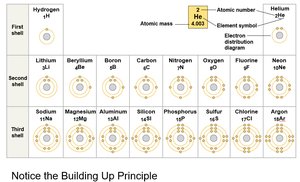
The chemical behavior of an atom is determined by the distribution of electrons in electron shells. The periodic table organizes elements based on their electron configuration.
Valence Electrons: Electrons in the outermost shell, crucial for chemical bonding.
Chemically Inert: Elements with a full valence shell (e.g., noble gases).
Concept 2.3: Chemical Bonds and Molecules
Atoms with incomplete valence shells can share or transfer electrons, forming chemical bonds. These bonds are essential for the structure and function of molecules and compounds.
Covalent Bonds
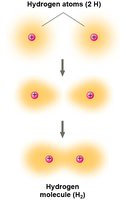
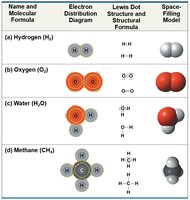
Covalent bonds involve the sharing of valence electrons between atoms. Molecules are formed when two or more atoms are held together by covalent bonds.
Single Bond: Sharing one pair of electrons.
Double Bond: Sharing two pairs of electrons.
Structural Formula: Representation of atoms and bonds (e.g., H—H).
Molecular Formula: Abbreviated notation (e.g., H2).
Electronegativity and Bond Polarity
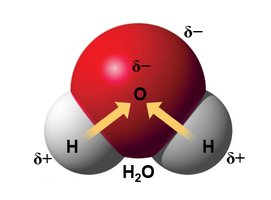
Electronegativity is an atom’s ability to attract electrons in a covalent bond. Unequal sharing leads to polar covalent bonds, resulting in partial charges.
Nonpolar Covalent Bond: Electrons are shared equally.
Polar Covalent Bond: Electrons are shared unequally, creating partial positive and negative charges.
Ionic Bonds
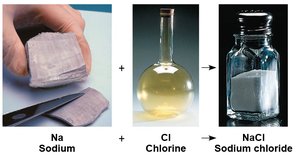
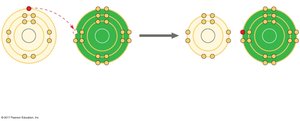
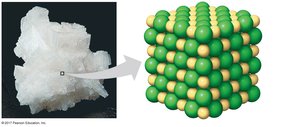
Ionic bonds form when atoms transfer electrons, resulting in charged ions. The attraction between oppositely charged ions forms ionic compounds, such as salts.
Cation: Positively charged ion.
Anion: Negatively charged ion.
Example: Sodium (Na) transfers an electron to chlorine (Cl), forming sodium chloride (NaCl).
Hydrogen Bonds
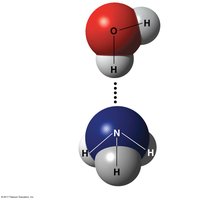
Hydrogen bonds are weak attractions between a hydrogen atom covalently bonded to one electronegative atom and another electronegative atom. These bonds are crucial for the structure of water and biological molecules.
Example: Hydrogen bonding between water (H2O) and ammonia (NH3).
Additional info: All explanations have been expanded for academic clarity and completeness. Images included are directly relevant to the adjacent content, reinforcing key concepts in atomic structure, chemical bonding, and the properties of elements and compounds.
