 Back
Chapter 2: The Chemical Context of Life – Bonding and Water
Study Guide - Smart Notes
 Tailored notes based on your materials, expanded with key definitions, examples, and context.
Bonding and Water: The Chemical Context of Life
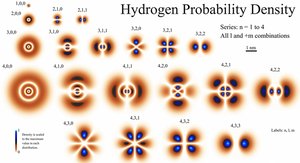
Quantum Mechanical Probability Density of the Electron
The behavior of electrons in atoms is described by quantum mechanics, which predicts the probability of finding an electron in a particular region around the nucleus. For hydrogen, these regions are called orbitals, and their shapes and sizes are determined by quantum numbers.
Orbitals: Regions in space where there is a high probability of finding an electron.
Quantum numbers: Specify the energy level, shape, and orientation of each orbital.
Electron density: Visualized as a cloud, denser where the electron is more likely to be found.
Application: The arrangement of electrons in orbitals determines how atoms interact and bond with each other.
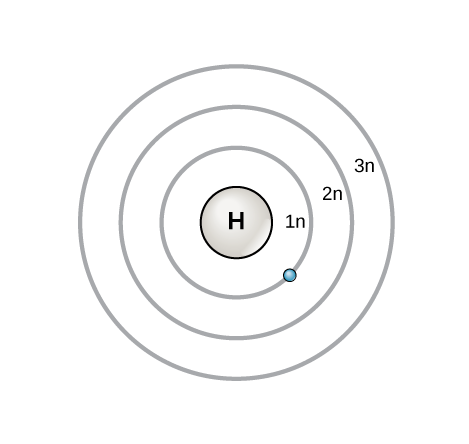
Electron Shells and Energy Levels
Electrons in an atom occupy energy levels or shells, with each shell holding a specific maximum number of electrons. The arrangement of electrons in these shells influences the chemical properties of the atom.
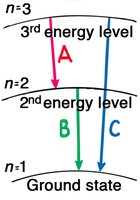
Ground state: The lowest energy state of an atom, with electrons in the closest possible shells.
Excited state: Electrons can absorb energy and move to higher shells temporarily.
Energy transitions: Moving to an outer shell requires energy; moving to an inner shell releases energy.
Biological relevance: Electron transitions are fundamental to processes like photosynthesis and cellular respiration.
Valence Shells and the Elements of Life
The outermost electron shell, or valence shell, determines an atom's chemical reactivity. Atoms are most stable when their valence shells are full, leading to the formation of chemical bonds.
Valence electrons: Electrons in the outermost shell, involved in bonding.
Octet rule: Atoms tend to fill their valence shell with 8 electrons (except for hydrogen and helium, which fill with 2).
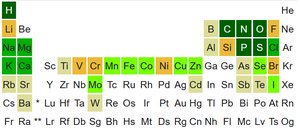
Biological elements: Six elements (C, H, N, O, P, S) make up most biological molecules; others function as ions or cofactors.
Types of Chemical Bonds
Covalent Bonds
Covalent bonds form when two atoms share one or more pairs of valence electrons. These bonds are strong and hold the atoms within a molecule together.
Single bond: One pair of electrons shared (e.g., H–H in H2).
Double bond: Two pairs of electrons shared (e.g., O=O in O2).
Bond rotation: Single bonds allow free rotation; double bonds restrict rotation, locking molecular shape.
Molecular shape: Determined by the number of electron groups and lone pairs around the central atom.
Ionic Bonds
Ionic bonds form when one atom transfers an electron to another, resulting in oppositely charged ions that attract each other.
Cation: Positively charged ion (e.g., Na+).
Anion: Negatively charged ion (e.g., Cl–).
Crystal lattice: Ionic compounds form solid structures; in water, they dissociate into individual ions.
Biological importance: Ionic bonds are weaker in water, allowing ions to participate in cellular processes.
Electronegativity and Bond Polarity
Electronegativity is an atom's ability to attract shared electrons. The difference in electronegativity between two atoms determines the type of bond formed.
Nonpolar covalent bond: Electrons shared equally (difference < 0.4).
Polar covalent bond: Electrons shared unequally (difference 0.4–1.7), creating partial charges (δ– and δ+).
Ionic bond: Electrons transferred (difference > 1.7).
Partial charges: Indicated by δ (delta), meaning partial positive or negative charge.
Van der Waals Interactions
Van der Waals interactions are weak attractions between molecules due to temporary fluctuations in electron distribution, creating transient partial charges.
Importance: Stabilize molecular structures, contribute to membrane fluidity, protein folding, and molecular binding.
Example: Hydrophobic interactions in lipid bilayers and protein cores.
Hydrogen Bonds
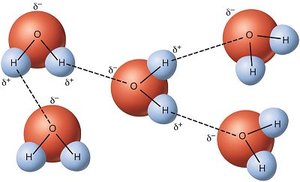
Hydrogen bonds are weak attractions between a hydrogen atom covalently bonded to a highly electronegative atom (N, O, or F) and another electronegative atom.
Role in biology: Hold DNA strands together, stabilize protein structures, and contribute to water's unique properties.
Strength: Individually weak, but collectively strong in large numbers.
Properties of Water
Polarity of Water
Water is a polar molecule, with a partial negative charge near the oxygen atom and partial positive charges near the hydrogen atoms. This polarity allows water to form hydrogen bonds with other molecules.
Cohesion and Surface Tension
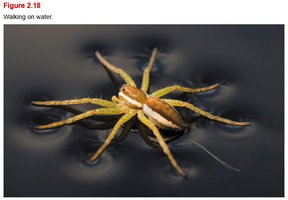
Cohesion is the attraction between water molecules due to hydrogen bonding, resulting in high surface tension. Surface tension allows certain organisms, like insects, to walk on water.
Cohesion: Water molecules stick to each other.
Surface tension: The inward pull at the surface of water due to cohesive forces.
Specific Heat Capacity
Water has a high specific heat capacity, meaning it can absorb or release large amounts of heat with little change in temperature. This property helps buffer organisms and environments against temperature fluctuations.
Definition: The amount of heat required to raise the temperature of 1 gram of a substance by 1°C.
Biological significance: Stabilizes temperatures in cells, organisms, and ecosystems.
Water and Climate Moderation
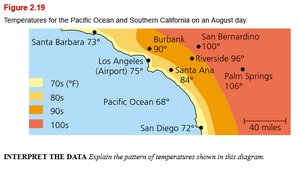
Large bodies of water moderate climate by absorbing heat in warm periods and releasing it during cooler periods. This effect is evident in coastal regions, where temperature fluctuations are less extreme than inland areas.
Example: The Pacific Ocean keeps coastal California cooler in summer and warmer in winter compared to inland areas.


Evaporative Cooling
Evaporative cooling occurs when the fastest-moving (hottest) water molecules escape as vapor, leaving the remaining liquid cooler. This process helps organisms regulate temperature through sweating and transpiration.
Heat of vaporization: The energy required to convert 1 gram of liquid water to vapor at a given temperature.
Biological relevance: Maintains stable internal temperatures in organisms and environments.
Adhesion and Capillarity
Adhesion is the attraction between water molecules and other polar or charged substances. Capillarity (capillary action) results from the combination of cohesion and adhesion, allowing water to move up narrow tubes against gravity.
Examples: Water transport in plant xylem, water movement in soil, absorption by paper towels.
Ice Floats: Density of Water
As water freezes, its molecules form a rigid lattice held by hydrogen bonds, making ice less dense than liquid water. This property allows ice to float, insulating aquatic life during winter.
Density: Ice is about 8% less dense than liquid water.
Ecological impact: Aquatic organisms survive under ice-covered surfaces.
Water as the Solvent of Life
Water is an excellent solvent for polar and ionic substances, enabling the dissolution and transport of nutrients, gases, and waste products in biological systems.
Solution: A homogeneous mixture of solute dissolved in solvent.
Hydration shells: Water molecules surround and isolate ions, allowing them to disperse.
Hydrophobic and Hydrophilic Substances
Substances that interact well with water are hydrophilic (polar or charged), while those that do not are hydrophobic (nonpolar). This distinction is crucial for the structure of cell membranes and protein folding.
Hydrophilic: Sugars, amino acids, salts, protein surfaces.
Hydrophobic: Lipids, waxes, protein cores.
Membranes: Composed of both hydrophilic and hydrophobic regions.
Acids, Bases, and pH
Autoionization of Water
Water molecules can spontaneously dissociate into hydronium (H3O+) and hydroxide (OH–) ions. In pure water, these ions are present in equal concentrations.
Equation:
Concentration in pure water:
Additional info: H+ is often used as shorthand for H3O+ in biochemistry.
pH Scale
pH is a measure of the hydronium ion concentration in a solution, defined as the negative logarithm (base 10) of the concentration.
Formula:
Neutral pH: 7 (pure water)
Acidic: pH < 7
Basic: pH > 7
Each unit change: Tenfold change in hydronium concentration
Biological importance: Small changes in pH can have significant effects on biological systems (e.g., blood pH).
pH | [H3O+] (mol/L) | Relative Hydronium |
|---|---|---|
7 | 10–7 | Neutral |
6 | 10–6 | 10× more acidic |
5 | 10–5 | 100× more acidic |
4 | 10–4 | 1,000× more acidic |
Additional info: Human blood pH is tightly regulated between 7.35 and 7.45; deviations can be life-threatening.
