 Back
Chapter 2: The Chemical Context of Life – General Biology Study Notes
Study Guide - Smart Notes
 Tailored notes based on your materials, expanded with key definitions, examples, and context.
The Chemical Context of Life
Matter and Elements
Life is composed of matter, which obeys the same physical laws as the rest of the universe. Matter is any substance that has mass and occupies space. An element is a pure substance made up of only one type of atom and cannot be broken down into simpler substances. Matter can exist as pure elements or as chemical compounds, which are combinations of atoms.
Key Point: Out of 92 natural elements, only a few are used to build most biological structures.
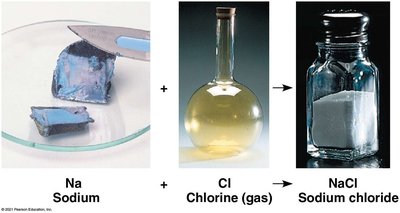
Key Point: Compounds exhibit emergent properties that are distinct from their constituent elements.
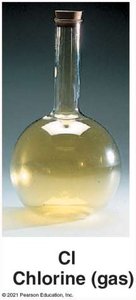
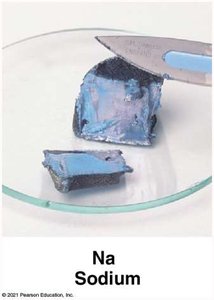
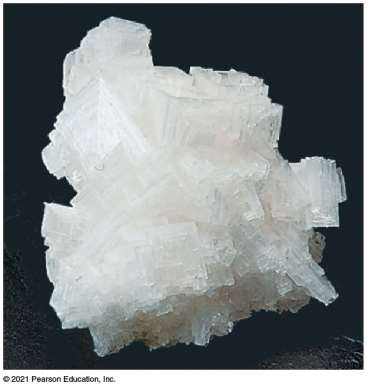
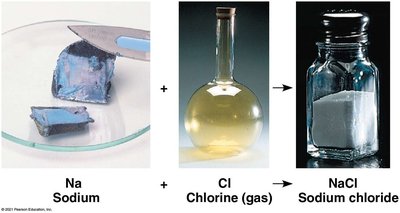
Example: Sodium (Na) is a reactive metal, and chlorine (Cl) is a toxic gas, but together they form sodium chloride (NaCl), a stable compound essential for life.
Essential Elements of Life
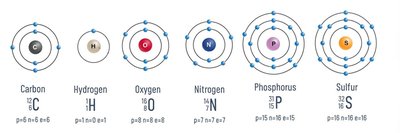
Six primary elements form the fundamental chemical toolkit required for biological life. These are known by the mnemonic CHNOPS: Carbon, Hydrogen, Nitrogen, Oxygen, Phosphorus, and Sulfur. These elements make up about 96% of living matter.
Key Point: The uniform composition of living matter across all species provides evidence for the shared chemical foundations of life.
Key Point: Trace elements are required in minute quantities for critical enzymatic catalysis and physiological regulation.
Atomic Structure
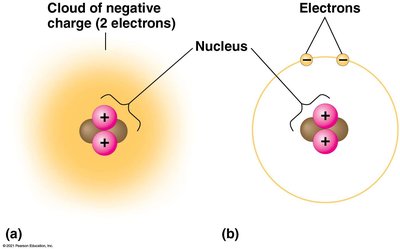
The properties of elements are determined by their subatomic architecture: the number and arrangement of protons, neutrons, and electrons. The proton count defines the element, while variations in neutrons create isotopes with different atomic masses.
Key Point: Isotopes allow scientists to trace biological pathways and date ancient materials.
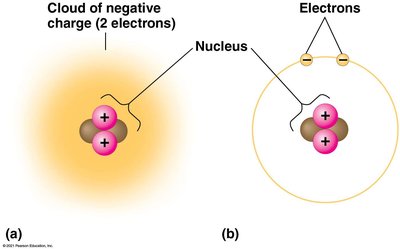
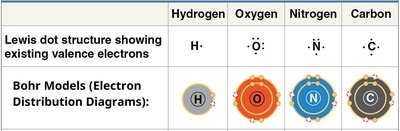
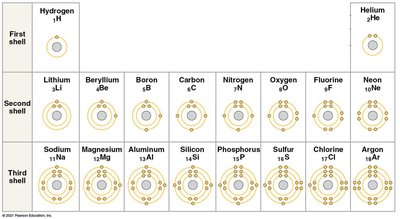
Key Point: Atoms utilize electron distribution diagrams to model their capacity for bonding.
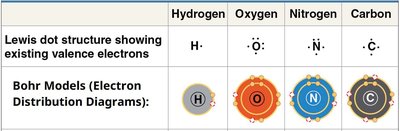
Element | Lewis Dot Structure | Bohr Model |
|---|---|---|
Hydrogen | H· | H |
Oxygen | ·O·· | O |
Nitrogen | ·N··· | N |
Carbon | ·C··· | C |
Energy Levels and Electron Shells
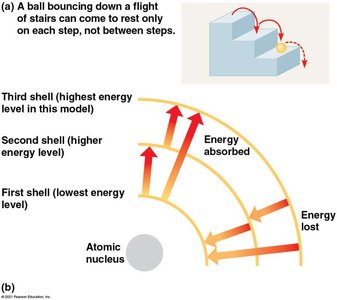
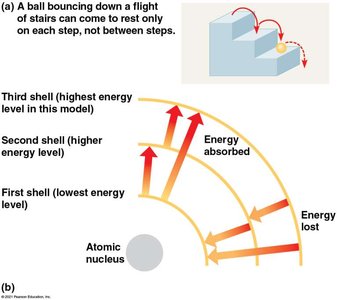
Electrons exist in discrete shells, each representing a distinct level of potential energy. Moving to an outer shell requires energy absorption, while moving to an inner shell releases energy.
Key Point: This energy shift powers chemical reactions required to sustain life.
The Periodic Table and Chemical Behavior
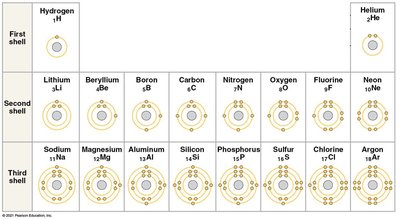
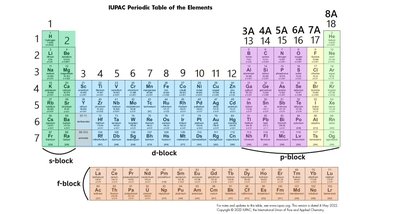
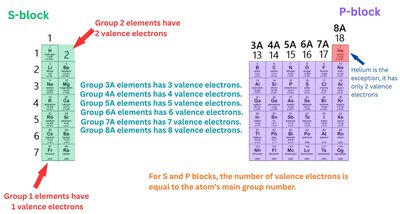
The periodic table organizes atoms based on their electron configuration, allowing prediction of chemical behavior. The occupancy of the valence shell dictates an atom's reactivity.
Key Point: Atoms with incomplete valence shells seek stability by sharing or transferring electrons.
Group | Valence Electrons |
|---|---|
Group 1 | 1 |
Group 2 | 2 |
Group 3A | 3 |
Group 4A | 4 |
Group 5A | 5 |
Group 6A | 6 |
Group 7A | 7 |
Group 8A | 8 |
Molecular and Structural Formulas
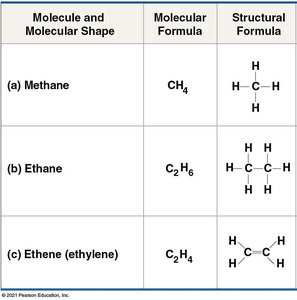
Structural formulas represent the arrangement of atoms within molecules and compounds. A molecular formula provides a "parts list" of atoms, while a structural formula shows the shared valence electrons.
Molecule | Molecular Formula | Structural Formula |
|---|---|---|
Methane | CH4 | H—C—H (tetrahedral) |
Ethane | C2H6 | H—C—C—H |
Ethene (ethylene) | C2H4 | H—C=C—H |
Chemical Bonding
Atoms with incomplete valence shells achieve stability by sharing or transferring electrons, forming molecules. Covalent bonds involve sharing electron pairs, while ionic bonds involve complete transfer of electrons.
Key Point: Covalent bonds can be single, double, or triple, affecting the strength and rigidity of the molecule.
Key Point: Electronegativity is the tendency of an atom to attract shared electrons, leading to polar covalent bonds and partial charges.
Key Point: Hydrogen bonds and Van der Waals interactions are weak, transient attractions that provide structural flexibility.
Key Point: The three-dimensional geometry of molecules dictates their biological function.
Chemical Reactions
Biological systems are dynamic, sustained by the continuous making and breaking of chemical bonds. Chemical reactions involve the rearrangement of matter, transforming reactants into products.
Key Point: Matter is conserved in chemical reactions; atoms are redistributed, not created or destroyed.
Key Point: Most metabolic reactions are reversible, and chemical equilibrium is reached when forward and reverse reaction rates are equal.
Key Point: True metabolic equilibrium is incompatible with life, which depends on non-equilibrium energy exchange.
Clinical Relevance: Trace Elements
Trace element deficiency, such as iodine deficiency, illustrates the fragility of metabolic regulation. The thyroid gland requires iodine to synthesize hormones; deficiency leads to goiter and systemic failure.
Application: Radiometric Dating
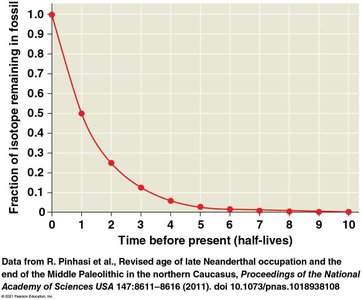
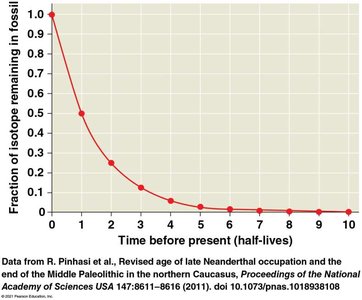
Radioactive isotopes decay at a constant half-life, providing an absolute clock for biological materials. By measuring the ratio of parent to daughter isotopes, scientists use radiometric dating to calculate the age of fossils.
Equation: The fraction of isotope remaining after n half-lives is given by:
Summary Tables
Process | Component | Resulting Function |
|---|---|---|
Structural Foundation | Essential Elements | Constructing 96% of living matter |
Physiological Regulation | Trace Elements | Critical enzymatic catalysis |
Functional Emergence | Compound formation | New biological roles via atom arrangement |
Process | Component | Resulting Function |
|---|---|---|
Atomic Identity | Protons | Defines element |
Mass Variation | Isotopes | Fossil dating, metabolic tracing |
Energy Storage | Electron shells | Absorb/release energy |
Chemical Reactivity | Valence electrons | Bond formation |
Process | Component | Resulting Function |
|---|---|---|
Electron Sharing | Covalent Bonds | Molecular scaffolding |
Charge Transfer | Ionic Bonds | Stable compounds |
Dynamic Flexibility | Hydrogen Bonds | Protein folding, DNA stability |
Molecular Recognition | 3D Shape | Specific interactions |
Process | Component | Resulting Function |
|---|---|---|
Matter Redistribution | Reactants and Products | Transform chemical energy |
Metabolic Control | Reversibility | Bidirectional reactions |
Dynamic Balance | Equilibrium | No net change in concentrations |
Additional info: These notes expand on the original lecture slides by providing definitions, examples, and tables for clarity and completeness, suitable for General Biology college students.
