 Back
Chapter 2: The Chemical Context of Life – Study Notes
Study Guide - Smart Notes
 Tailored notes based on your materials, expanded with key definitions, examples, and context.
Chapter 2: The Chemical Context of Life
The Basics of Chemistry in Biology
Understanding the chemical context of life is essential for studying biology. All living organisms are composed of matter, which is made up of elements and atoms. The structure and interactions of these atoms determine the properties and functions of biological molecules.
Element: A substance that cannot be broken down into other substances by chemical means. Examples include carbon (C), hydrogen (H), oxygen (O), and nitrogen (N).
Atom: The smallest unit of an element that retains its chemical properties.
Compound: A substance consisting of two or more elements combined in a fixed ratio (e.g., H2O).
The Elements of Life
Of the 92 naturally occurring elements, about 20–25% are essential to life. Four elements—carbon, hydrogen, oxygen, and nitrogen—make up about 96% of living matter. The remaining 4% consists of elements such as phosphorus, sulfur, calcium, and potassium. Trace elements are required in minute quantities but are vital for proper biological function.
Atomic Structure and Subatomic Particles
The properties of an element depend on the structure of its atoms. Atoms are composed of three types of subatomic particles:
Protons: Positively charged particles found in the nucleus; determine the element's identity.
Neutrons: Electrically neutral particles found in the nucleus; determine the isotope of the element.
Electrons: Negatively charged particles found in a cloud around the nucleus; determine chemical behavior and reactivity.
Atomic Number, Mass Number, and Isotopes
The atomic number is the number of protons in an atom and defines the element. The mass number is the sum of protons and neutrons. The atomic mass (measured in Daltons or atomic mass units, amu) is approximately equal to the mass number.
All atoms of an element have the same number of protons, but may have different numbers of neutrons (isotopes).
Isotopes: Atoms of the same element with different numbers of neutrons. Some isotopes are radioactive and decay spontaneously, releasing energy.
Electron Energy Levels and Shells
Electrons occupy specific energy levels or shells around the nucleus. The chemical behavior of an atom is largely determined by the distribution of electrons, especially those in the outermost shell (valence shell).
Electrons in higher shells have more potential energy.
Atoms are most stable when their valence shell is full.
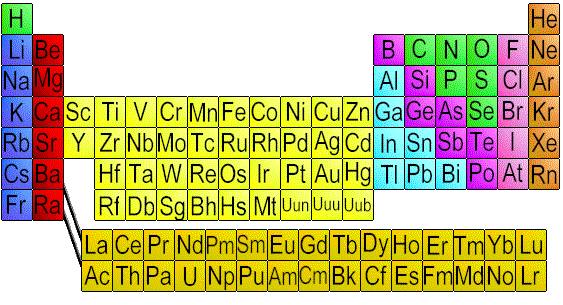
Electron Distribution and the Periodic Table
The periodic table arranges elements by increasing atomic number and shows patterns in electron distribution. Rows (periods) indicate the number of electron shells, while columns (groups) indicate the number of electrons in the outermost shell.
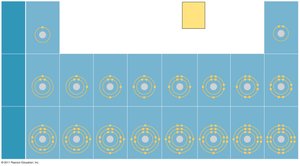
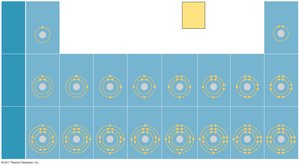
Valence Electrons and Reactivity
Valence electrons are the electrons in the outermost shell. Atoms with incomplete valence shells are chemically reactive and tend to form bonds to achieve full valence shells. The number of valence electrons determines an atom's bonding capacity (valence).
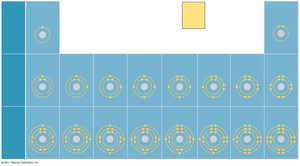
Electron Orbitals
Orbitals are three-dimensional regions around the nucleus where electrons are likely to be found. Each orbital can hold up to two electrons. Orbitals are filled from lowest to highest energy (1s, 2s, 2p, etc.).
Electron Distribution Diagrams and Lewis Dot Structures
Electron distribution diagrams show all electrons in all shells, while Lewis dot structures show only valence electrons. These representations help predict how atoms will bond.
Chemical Bonds
Atoms with incomplete valence shells can share or transfer electrons to achieve stability. There are four main types of chemical bonds:
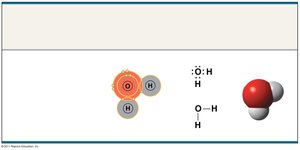
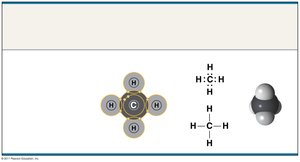
Covalent Bonds: Sharing of valence electrons between atoms. Can be single, double, or triple bonds depending on the number of shared electron pairs.
Ionic Bonds: Transfer of electrons from one atom to another, resulting in attraction between oppositely charged ions (cations and anions).
Hydrogen Bonds: Weak attractions between a hydrogen atom covalently bonded to an electronegative atom (like O or N) and another electronegative atom.
Van der Waals Interactions: Weak, transient attractions between molecules due to temporary dipoles.
Comparison of Chemical Bonds
Bond Type | Mechanism | Strength | Example |
|---|---|---|---|
Covalent | Sharing of electrons | Strong | H2O, CH4 |
Ionic | Transfer of electrons | Strong (dry), Weak (in water) | NaCl |
Hydrogen | Attraction between H and electronegative atom | Weak | Between water molecules |
Van der Waals | Transient dipole interactions | Very weak (individually) | Gecko feet adhesion |
Covalent Bonds and Molecular Structure
Covalent bonds can be represented by structural formulas (lines for shared pairs) or molecular formulas (element symbols and numbers). The shape of a molecule is determined by the arrangement of its atoms and the orbitals involved in bonding. Molecular shape is crucial for biological function and molecular recognition.
Electronegativity and Polarity
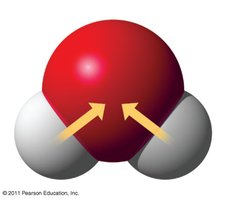
Electronegativity is an atom's attraction for electrons in a covalent bond. When atoms have different electronegativities, electrons are shared unequally, resulting in polar covalent bonds (e.g., H2O). Equal sharing produces nonpolar covalent bonds (e.g., O2).
Ionic Bonds and Salts
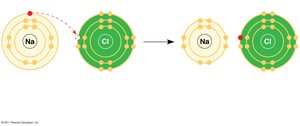
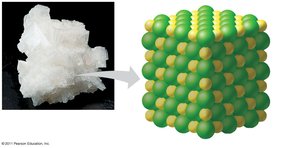
Ionic bonds form when electrons are transferred from one atom to another, creating ions. These ions are held together by electrostatic attraction. Ionic compounds (salts) exist in fixed ratios and form crystalline structures.
Hydrogen Bonds
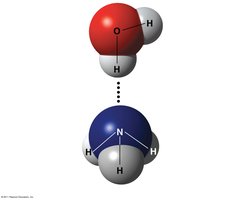
Hydrogen bonds are weak attractions that play a critical role in the structure and properties of water, DNA, and proteins. They occur when a hydrogen atom covalently bonded to an electronegative atom is attracted to another electronegative atom.
Van der Waals Interactions
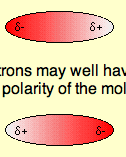
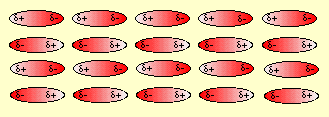
Van der Waals interactions are weak attractions that occur between nonpolar molecules due to temporary shifts in electron distribution. Although individually weak, collectively they can be significant in stabilizing large biological molecules.
Molecular Shape and Biological Function
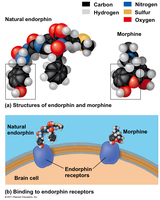
The shape of a molecule determines its function in biological systems. Molecules with similar shapes can have similar biological effects, and molecular recognition is often based on shape complementarity.
Practice and Application
Calculate the number of protons, neutrons, and electrons (including valence electrons) from atomic number and atomic mass.
Distinguish between subatomic particles and their roles.
Describe an atom’s valence and how it relates to reactivity.
Compare and contrast the four types of chemical bonds.
Describe how molecular shape relates to function.
Given a structural formula, determine if the molecule makes chemical sense and explain why.
