Back
Chapter 2: The Chemical Context of Life – Study Notes
Study Guide - Smart Notes
 Tailored notes based on your materials, expanded with key definitions, examples, and context.
Chapter 2: The Chemical Context of Life
Matter and Elements
Matter is anything that has mass and occupies space. All matter is composed of chemical elements, which can exist in pure form or as compounds. Understanding the nature of elements and compounds is fundamental to biology.
Element: A substance that cannot be broken down into other substances by chemical reactions.
Compound: A substance consisting of two or more elements combined in a fixed ratio.
Life requires about 25 chemical elements, with carbon (C), oxygen (O), hydrogen (H), and nitrogen (N) making up 96% of living matter. The remaining 4% includes phosphorus (P), sulfur (S), calcium (Ca), and potassium (K).
Atomic Structure
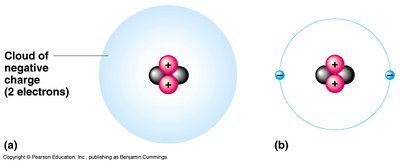
The structure of an atom determines the behavior of an element. Atoms are composed of subatomic particles: protons, neutrons, and electrons.
Atom: The smallest unit of matter that retains the properties of an element.
Proton: Positively charged particle found in the nucleus.
Neutron: Electrically neutral particle found in the nucleus.
Electron: Negatively charged particle orbiting the nucleus.
Atomic number: Number of protons in the nucleus (unique to each element).
Mass number: Sum of protons and neutrons in the nucleus.
Atomic weight: Approximate mass of an atom, close to the mass number.
Isotopes and Radioactivity
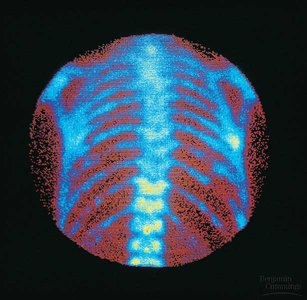
Atoms of the same element with different numbers of neutrons are called isotopes. Some isotopes are stable, while others are radioactive and decay spontaneously, emitting particles and energy.
Isotope: Atoms of the same element with different numbers of neutrons.
Radioactive isotope: An isotope whose nucleus decays spontaneously, giving off particles and energy.
Energy Levels and Electron Shells
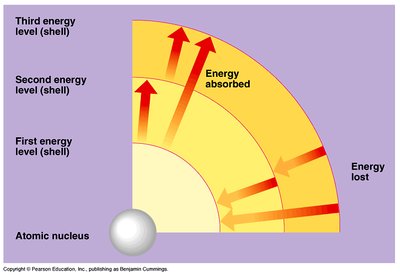
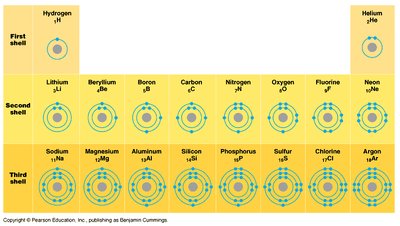
Electrons have potential energy due to their position relative to the nucleus. The different states of potential energy that electrons can have are called energy levels or electron shells.
Potential energy: Energy that matter possesses because of its location or structure.
Electron shell: An energy level representing the distance of an electron from the nucleus.
Electrons can move between shells by absorbing or losing energy.
Electron Configuration and the Periodic Table
The arrangement of electrons in shells determines the chemical properties of an element. The periodic table organizes elements according to their electron configurations.
Valence shell: The outermost electron shell, which determines an atom's chemical behavior.
Valence electrons: Electrons in the outermost shell.
Electron Orbitals
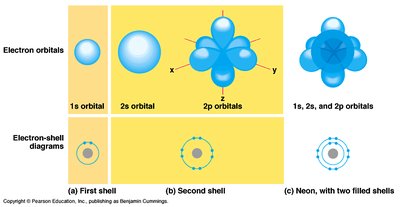
Electrons occupy complex three-dimensional spaces called orbitals. Each orbital can hold up to two electrons, and the arrangement of orbitals influences chemical bonding.
Orbital: A three-dimensional region around the nucleus where an electron is likely to be found.
Electrons fill separate orbitals within the valence shell before pairing up.
Chemical Bonds and Molecules
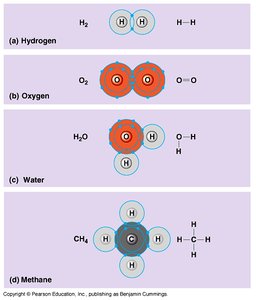
Atoms with incomplete valence shells can share or transfer electrons, resulting in chemical bonds that hold atoms together in molecules.
Chemical bond: An attraction between two atoms resulting from sharing or transferring valence electrons.
Covalent bond: Sharing of a pair of valence electrons by two atoms.
Structural formula: Representation of a molecule showing how atoms are bonded (e.g., H–H).
Molecular formula: Indicates the number and types of atoms in a molecule (e.g., H2).
Double covalent bond: Two pairs of shared electrons (e.g., O=O).
Types of Covalent Bonds
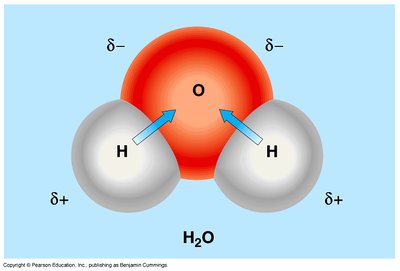
Covalent bonds can be nonpolar or polar, depending on how equally electrons are shared between atoms.
Nonpolar covalent bond: Electrons are shared equally between atoms.
Polar covalent bond: Electrons are shared unequally, resulting in partial charges on atoms.
Ionic Bonds
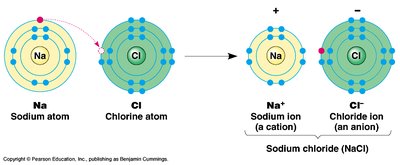
Ionic bonds form when one atom transfers an electron to another, resulting in oppositely charged ions that attract each other.
Ionic bond: Attraction between oppositely charged ions formed by electron transfer.
Cation: Positively charged ion.
Anion: Negatively charged ion.
Weak Chemical Bonds
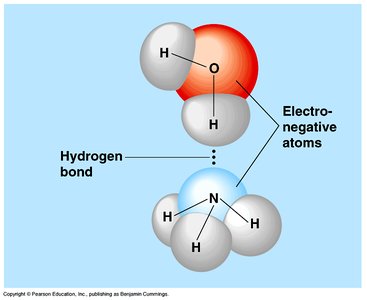
Weak interactions, such as hydrogen bonds and van der Waals interactions, play important roles in the chemistry of life.
Hydrogen bond: Attraction between a hydrogen atom covalently bonded to a strongly electronegative atom and another electronegative atom.
Van der Waals interactions: Weak attractions due to transient local partial charges.
Molecular Shape and Function
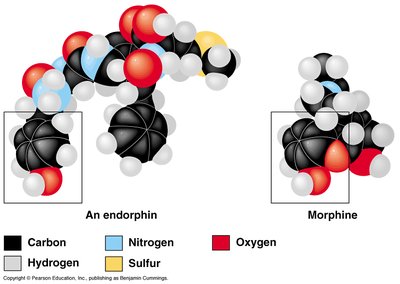
The three-dimensional shape of a molecule is crucial for its biological function. Shape is determined by the arrangement of electron orbitals and the types of bonds formed.
Molecules with similar shapes can have similar biological effects.
Chemical Reactions
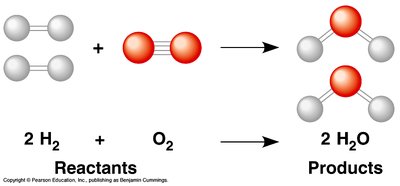
Chemical reactions involve the making and breaking of chemical bonds. The starting substances are called reactants, and the resulting substances are products.
Reactants: Starting materials in a chemical reaction.
Products: Substances formed as a result of a chemical reaction.
Example: The reaction of hydrogen and oxygen to form water.