 Back
Chapter 2: The Chemical Context of Life – Study Notes
Study Guide - Smart Notes
 Tailored notes based on your materials, expanded with key definitions, examples, and context.
The Chemical Context of Life
Atoms and Matter
All living and non-living things are composed of matter, which is anything that has mass and occupies space. Matter exists primarily in three states: solid, liquid, and gas. The fundamental unit of matter is the atom, which cannot be broken down by chemical reactions. Each type of atom is a chemical element, and there are 92 naturally occurring elements. When two or more different elements bond together, they form a compound with unique properties.
Compounds
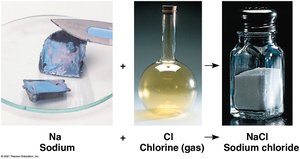
Compounds are substances consisting of two or more different elements combined in a fixed ratio. Compounds have emergent properties distinct from their constituent elements. For example, sodium (a reactive metal) and chlorine (a poisonous gas) combine to form sodium chloride (table salt), which is edible and essential for life.
The Elements of Life
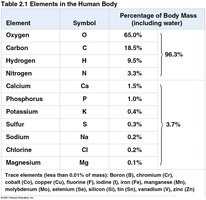
Of the 92 natural elements, about 20–25% are essential for life. Four elements—carbon (C), hydrogen (H), oxygen (O), and nitrogen (N)—make up about 96% of living matter. Most of the remaining 4% consists of calcium (Ca), phosphorus (P), potassium (K), and sulfur (S). Trace elements are required in minute quantities but are vital for biological processes.
Element | Symbol | Percentage of Body Mass |
|---|---|---|
Oxygen | O | 65.0% |
Carbon | C | 18.5% |
Hydrogen | H | 9.5% |
Nitrogen | N | 3.3% |
Calcium | Ca | 1.5% |
Phosphorus | P | 1.0% |
Potassium | K | 0.4% |
Sulfur | S | 0.3% |
Sodium | Na | 0.2% |
Chlorine | Cl | 0.2% |
Magnesium | Mg | 0.1% |
Atomic Structure
Subatomic Particles
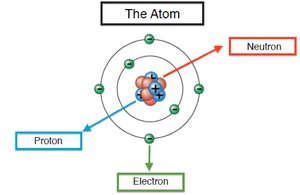
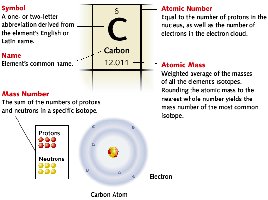
Atoms are composed of three types of subatomic particles:
Protons: Positively charged, found in the nucleus, mass ≈ 1 dalton
Neutrons: Neutral, found in the nucleus, mass ≈ 1 dalton
Electrons: Negatively charged, found in orbitals around the nucleus, mass ≈ 1/2000 dalton
Atomic Number, Mass Number, and Isotopes
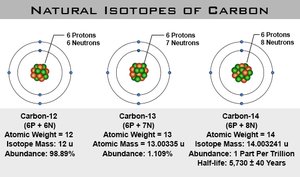
The atomic number is the number of protons in an atom and defines the element. The mass number is the sum of protons and neutrons. Isotopes are atoms of the same element with different numbers of neutrons. Some isotopes are radioactive and decay over time, a property used in radiometric dating and as tracers in biology.
Electrons and Energy Levels
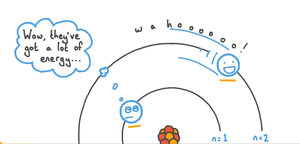
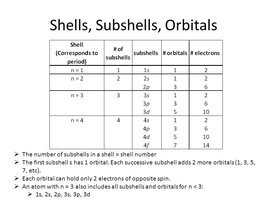
Electrons occupy energy levels or shells around the nucleus. The further an electron is from the nucleus, the more potential energy it has. Electrons fill the lowest available energy levels first.
Electron Orbitals, Shells, and Subshells
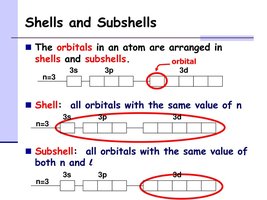
Orbitals are regions where electrons are likely to be found. Each orbital can hold up to two electrons. Orbitals are grouped into shells (energy levels), which are further divided into subshells. The arrangement of electrons in shells and subshells determines the chemical properties of an atom.
Valence Electrons and the Periodic Table
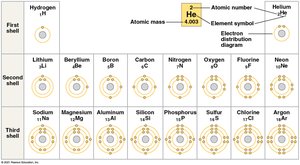
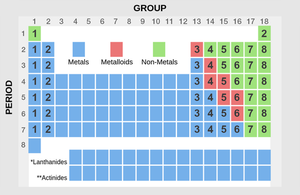
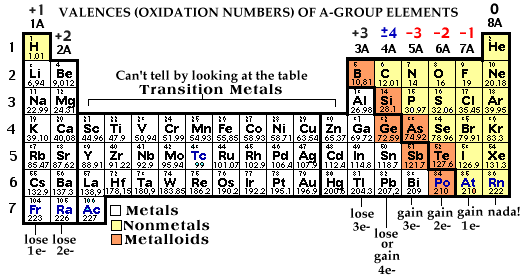
Valence electrons are electrons in the outermost shell and are responsible for an atom's chemical behavior. Atoms with the same number of valence electrons have similar properties. The periodic table is organized to reflect these similarities.
The Octet Rule
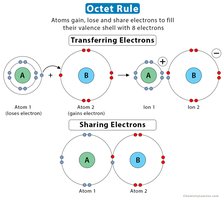
Atoms tend to gain, lose, or share electrons to achieve a full outer shell, usually with eight electrons (the octet rule). This drives the formation of chemical bonds. Hydrogen and helium are exceptions, as their outer shell is full with two electrons.
Chemical Bonds and Molecules
Formation of Molecules and Compounds
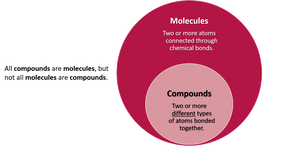
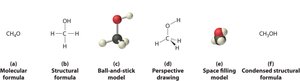
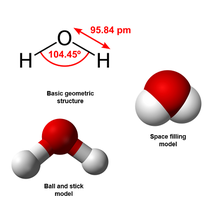
Atoms combine to form molecules and compounds by sharing or transferring electrons. The chemical bond is the force that holds atoms together. The molecular formula shows the types and numbers of atoms in a molecule (e.g., H2O).
Representations of Molecules
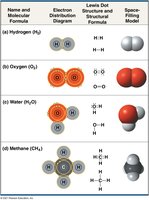
Molecules can be represented in several ways, including molecular formulas, structural formulas, ball-and-stick models, and space-filling models. These representations help visualize the arrangement of atoms and bonds.
Types of Chemical Bonds
Covalent bonds: Atoms share electrons; can be polar or nonpolar
Ionic bonds: Electrons are transferred from one atom to another, creating ions
Hydrogen bonds: Weak attractions between partially charged regions of molecules
Van der Waals interactions: Weak, temporary attractions due to transient dipoles
Covalent Bonds
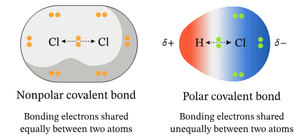
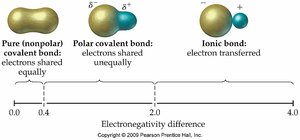
Covalent bonds form when two nonmetals share one or more pairs of electrons. These bonds are strong and can be either polar (unequal sharing of electrons) or nonpolar (equal sharing of electrons).
Polar Covalent Bonds
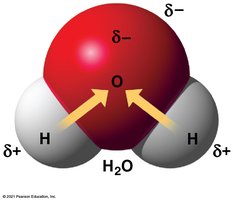
Form between atoms with different electronegativities. The shared electrons are closer to the more electronegative atom, creating a dipole (partial charges). Water (H2O) is a classic example.
Nonpolar Covalent Bonds
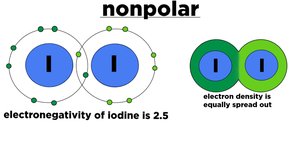
Form between atoms with similar electronegativities, resulting in equal sharing of electrons. These molecules do not have partial charges and are often hydrophobic.
Comparison: Nonpolar vs Polar Covalent Bonds
Ionic Bonds
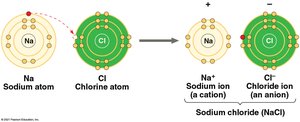
An ion is an atom or molecule that has gained or lost electrons, acquiring a charge. Cations are positively charged; anions are negatively charged. Ionic bonds form between cations and anions due to electrostatic attraction, typically between metals and nonmetals (e.g., NaCl).
Hydrogen Bonds
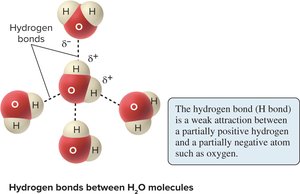
Hydrogen bonds are weak attractions between a partially positive hydrogen atom and a partially negative atom (often oxygen or nitrogen). Individually weak, but collectively strong, hydrogen bonds are crucial in biological molecules like DNA and water.
Van der Waals Interactions
These are weak, transient attractions between molecules due to temporary dipoles caused by uneven electron distribution. While individually weak, their cumulative effect can be significant in large molecules.
Electronegativity
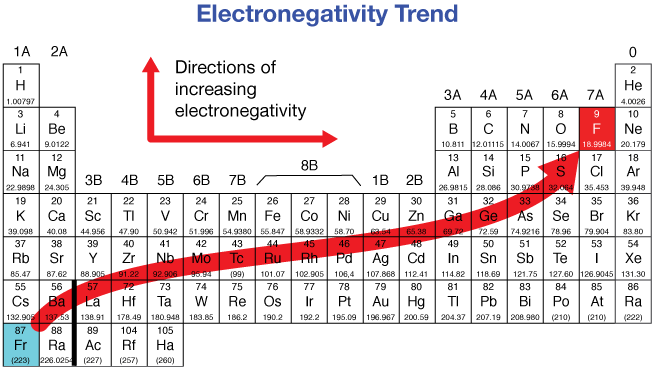
Electronegativity is an atom's ability to attract electrons in a covalent bond. Differences in electronegativity determine bond type: nonpolar covalent (small difference), polar covalent (moderate difference), or ionic (large difference).
Molecular Structure and Function
The shape of a molecule is critical to its function, influencing the types of interactions it can form. For example, the bent shape of water molecules allows for hydrogen bonding, which is essential for many of water's unique properties.
Chemical Reactions
Chemical reactions involve the making and breaking of chemical bonds, resulting in the transformation of substances (reactants) into new substances (products). Reactions require energy, often use enzymes as catalysts in living organisms, and eventually reach equilibrium. All chemical reactions are reversible, and matter is conserved (the number and type of atoms remain constant).
Example: Combustion of methane:
