 Back
Chapter 2: The Chemical Context of Life – Study Notes
Study Guide - Smart Notes
 Tailored notes based on your materials, expanded with key definitions, examples, and context.
Chapter 2: The Chemical Context of Life
Introduction
Understanding the chemical basis of life is essential for studying biology. This chapter explores the elements that make up living organisms, the structure of atoms, and the types of chemical bonds that enable biological molecules to form and interact.
The Elements of Life
The Big Four Elements
Living organisms are primarily composed of four elements: Oxygen (O), Carbon (C), Hydrogen (H), and Nitrogen (N). These elements make up about 96% of the human body mass.
Oxygen (O): Essential for cellular respiration and water formation.
Carbon (C): The backbone of all organic molecules.
Hydrogen (H): Found in water and most organic compounds.
Nitrogen (N): Key component of proteins and nucleic acids.
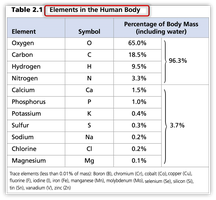
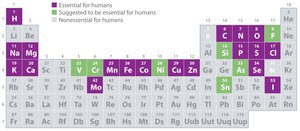
Trace elements are required in minute amounts but are vital for proper physiological function (e.g., iron, zinc, iodine).
Atoms and Subatomic Particles
Atomic Structure
An atom is the smallest unit of matter that retains the properties of an element. Atoms are composed of three types of subatomic particles:
Protons: Positively charged, found in the nucleus.
Neutrons: No charge, found in the nucleus.
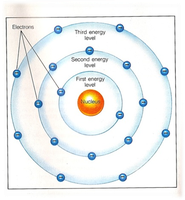
Electrons: Negatively charged, orbit the nucleus in electron shells.
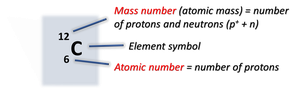
The atomic number is the number of protons in an atom and defines the element. The mass number is the sum of protons and neutrons.
Isotopes
Isotopes are atoms of the same element with different numbers of neutrons. For example, carbon can have 6, 7, or 8 neutrons (C-12, C-13, C-14).
Electron Arrangement and Energy Levels
Electron Shells and Valence Electrons
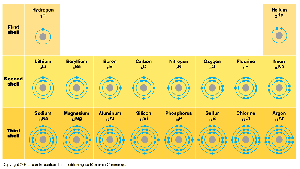
Electrons occupy specific energy levels called electron shells. The outermost shell is the valence shell, and its electrons (valence electrons) determine an atom's chemical behavior.
Atoms are most stable when their valence shell is full (usually 2 or 8 electrons).
Atoms with incomplete valence shells tend to form bonds to achieve stability.
Chemical Bonds
Ionic Bonds
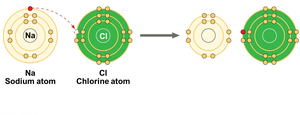
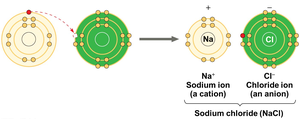
Ionic bonds form when one atom transfers electrons to another, resulting in oppositely charged ions that attract each other. The atom that loses electrons becomes a cation (positive), and the one that gains electrons becomes an anion (negative).
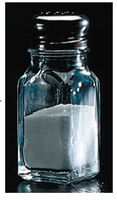
Example: Sodium (Na) transfers an electron to chlorine (Cl), forming Na+ and Cl-, which combine to make sodium chloride (NaCl, table salt).
Covalent Bonds
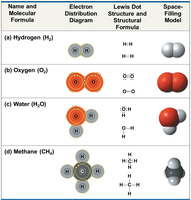
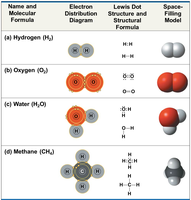
Covalent bonds involve the sharing of one or more pairs of valence electrons between atoms. These bonds are strong and form the backbone of biological molecules.
Single bond: Sharing one pair of electrons.
Double bond: Sharing two pairs of electrons.
The electronegativity of an atom is its attraction for shared electrons. Differences in electronegativity lead to:
Nonpolar covalent bonds: Electrons are shared equally (e.g., H2, CH4).
Polar covalent bonds: Electrons are shared unequally, creating partial charges (e.g., H2O).
Polarity and Hydrogen Bonds
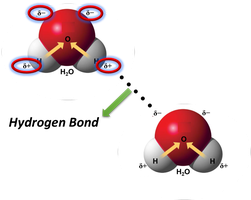
In a polar covalent bond, one atom (like oxygen in water) is more electronegative and pulls electrons closer, resulting in partial charges (δ- and δ+).
Hydrogen bonds form between a hydrogen atom with a partial positive charge and an electronegative atom (usually oxygen or nitrogen) with a partial negative charge. These bonds are individually weak but collectively strong and are crucial for the structure of DNA and proteins.
Van der Waals Interactions
Van der Waals interactions are weak attractions that occur when transient, uneven electron distributions create temporary dipoles in molecules. While individually weak, these interactions can be significant when many occur together, such as in the ability of a gecko to climb walls.

Chemical Reactions
Reactants and Products
A chemical reaction involves the breaking and forming of chemical bonds, rearranging atoms into new substances. The starting materials are reactants, and the resulting substances are products.
Matter is not created or destroyed in chemical reactions (Law of Conservation of Mass).
Cells constantly rearrange molecules through chemical reactions to sustain life.
Example: The reaction of hydrogen and oxygen to form water:
Key Terms and Concepts
Atom: Smallest unit of an element, composed of protons, neutrons, and electrons.
Isotope: Atoms of the same element with different numbers of neutrons.
Ionic bond: Attraction between oppositely charged ions.
Covalent bond: Sharing of electron pairs between atoms.
Electronegativity: Atom's ability to attract shared electrons.
Hydrogen bond: Weak attraction between a hydrogen atom and an electronegative atom.
Van der Waals interaction: Weak attraction due to transient local charges.
Reactant: Starting substance in a chemical reaction.
Product: Substance formed as a result of a chemical reaction.
Summary Table: Elements in the Human Body
Element | Symbol | Percentage of Body Mass (including water) |
|---|---|---|
Oxygen | O | 65.0% |
Carbon | C | 18.5% |
Hydrogen | H | 9.5% |
Nitrogen | N | 3.3% |
Calcium | Ca | 1.5% |
Phosphorus | P | 1.0% |
Potassium | K | 0.4% |
Sulfur | S | 0.3% |
Sodium | Na | 0.2% |
Chlorine | Cl | 0.2% |
Magnesium | Mg | 0.1% |
Additional info: Trace elements are present in amounts less than 0.01% of body mass but are essential for health (e.g., iron, zinc, copper).
