 Back
Chapter 2: The Chemical Context of Life – General Biology Study Notes
Study Guide - Smart Notes
 Tailored notes based on your materials, expanded with key definitions, examples, and context.
The Chemical Context of Life
A Chemical Connection to Biology
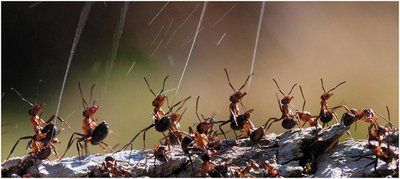
Biology is fundamentally connected to chemistry, as all living organisms and their environments are governed by the laws of physics and chemistry. For example, ants use formic acid as a chemical defense against predators and microbial parasites, demonstrating how chemical compounds play a role in biological interactions.
Key Points:
Organisms interact with their environment using chemical compounds.
Formic acid is used by ants for protection and communication.
Example: Wood ants (Formica rufa) shoot formic acid to deter predators.
Concept 2.1: Matter, Elements, and Compounds
All living things are composed of matter, which is anything that takes up space and has mass. Matter is made up of elements, and combinations of elements form compounds with unique properties.
Key Points:
Element: A substance that cannot be broken down by chemical reactions.
Compound: A substance consisting of two or more elements in a fixed ratio.
Emergent Properties: Compounds have characteristics different from their constituent elements.
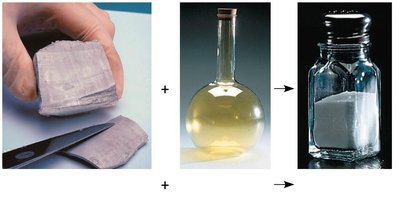
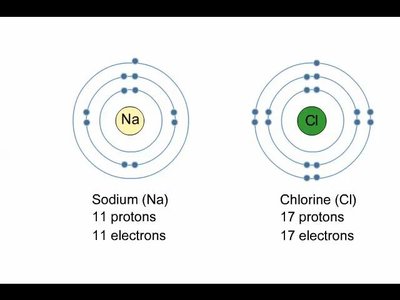
Example: Sodium (a metal) and chlorine (a poisonous gas) combine to form sodium chloride (table salt), an edible compound.
The Elements of Life
Only a subset of the 92 naturally occurring elements are essential for life. The majority of living matter is composed of a few key elements, while others are required in trace amounts.
Element | Symbol | Percentage of Body Mass (including water) |
|---|---|---|
Oxygen | O | 65.0% |
Carbon | C | 18.5% |
Hydrogen | H | 9.5% |
Nitrogen | N | 3.3% |
Calcium | Ca | 1.5% |
Phosphorus | P | 1.0% |
Potassium | K | 0.4% |
Sulfur | S | 0.3% |
Sodium | Na | 0.2% |
Chlorine | Cl | 0.2% |
Magnesium | Mg | 0.1% |
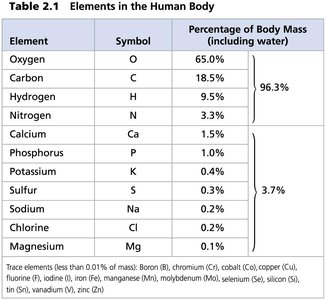
Essential elements: Carbon, hydrogen, oxygen, and nitrogen make up 96% of living matter.
Trace elements: Required in minute quantities (e.g., iron, iodine).
Toxic elements: Some elements, like arsenic, are toxic to organisms.
Case Study: Evolution of Tolerance to Toxic Elements
Some organisms have adapted to environments containing toxic elements, such as serpentine soils rich in chromium, nickel, and cobalt. These adaptations allow certain plant communities to thrive where others cannot.
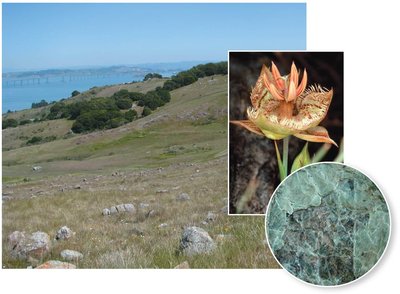


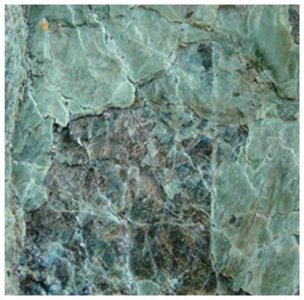
Serpentine: A mineral containing elevated concentrations of toxic elements.
Adaptation: Some plants, like the Tiburon mariposa lily, are adapted to serpentine soils.
Concept 2.2: Atomic Structure and Properties
The properties of elements depend on the structure of their atoms. Atoms are composed of subatomic particles: protons, neutrons, and electrons.
Protons: Positive charge; determine the element's identity.
Neutrons: No charge; contribute to atomic mass and isotope variation.
Electrons: Negative charge; determine chemical behavior.
Atomic number: Number of protons in the nucleus.
Mass number: Sum of protons and neutrons.
Atomic mass: Approximated by mass number.
Isotopes
Isotopes are atoms of the same element with different numbers of neutrons. Some isotopes are stable, while others are radioactive and decay spontaneously.
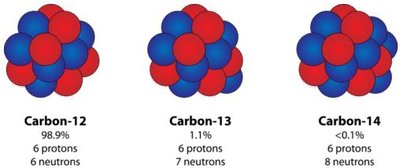
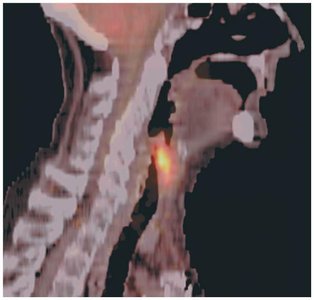
Radioactive isotopes: Used as tracers in medicine and for radiometric dating.
Example: Carbon-14 is used to date fossils.
Radioactive Tracers and Radiometric Dating
Radioactive isotopes can be used to track atoms through metabolism and to date fossils by measuring the ratio of parent to daughter isotopes.
Half-life: The time it takes for 50% of a parent isotope to decay.
Application: Radiometric dating uses isotope ratios to estimate the age of rocks and fossils.
Energy Levels and Electron Distribution
Electrons occupy specific energy levels, or shells, around the atomic nucleus. The distribution of electrons determines an atom's chemical properties.
Potential energy: Energy due to location or structure.
Valence electrons: Electrons in the outermost shell; determine reactivity.
Periodic table: Shows electron distribution for each element.
Electron Orbitals
Orbitals are three-dimensional spaces where electrons are found 90% of the time. Each shell contains a specific number of orbitals.
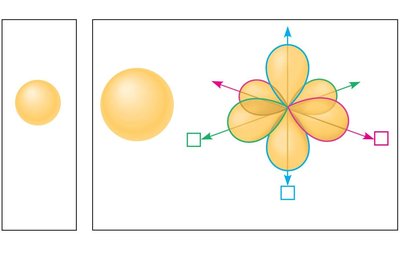
s orbital: Spherical shape.
p orbital: Dumbbell shape.
Maximum occupancy: No more than 2 electrons per orbital.
Concept 2.3: Chemical Bonding
Atoms with incomplete valence shells can share or transfer electrons, forming chemical bonds. The main types of bonds are covalent and ionic.
Covalent Bonds
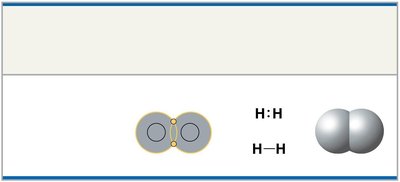
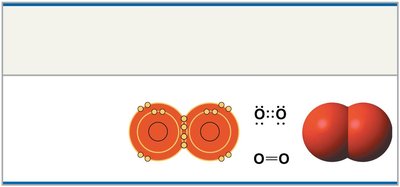
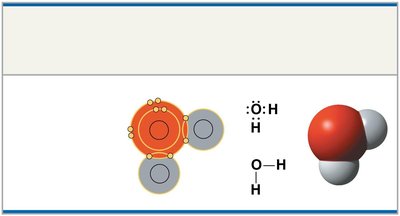
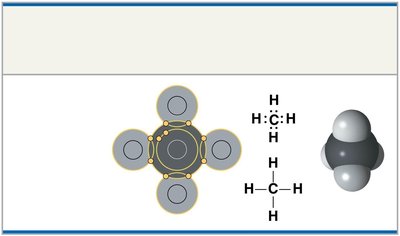
Covalent bonds involve the sharing of valence electrons between atoms. Molecules are formed when two or more atoms are held together by covalent bonds.
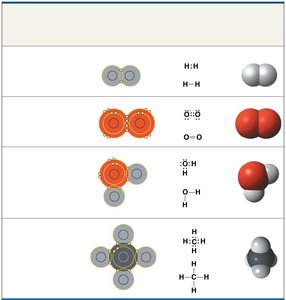
Single bond: Sharing one pair of electrons.
Double bond: Sharing two pairs of electrons.
Structural formula: Representation of atoms and bonds (e.g., H—H).
Molecular formula: Abbreviated notation (e.g., H2).
Electronegativity and Bond Polarity
Electronegativity is an atom's ability to attract electrons in a covalent bond. Nonpolar covalent bonds share electrons equally, while polar covalent bonds share electrons unequally, resulting in partial charges.
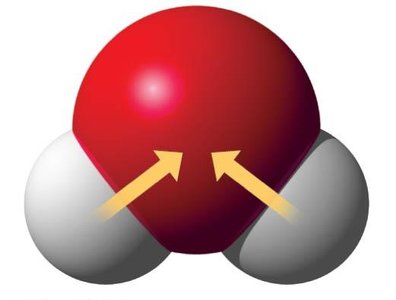
Nonpolar bond: Equal sharing (e.g., H2).
Polar bond: Unequal sharing (e.g., H2O).
Ionic Bonds
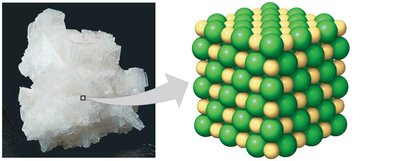
Ionic bonds form when electrons are transferred from one atom to another, resulting in charged ions. The attraction between oppositely charged ions forms an ionic bond.
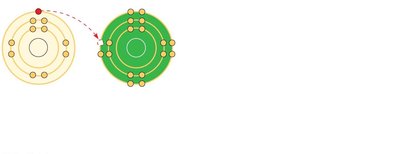
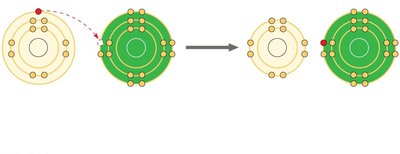
Cation: Positively charged ion (e.g., Na+).
Anion: Negatively charged ion (e.g., Cl−).
Ionic compound: Formed by ionic bonds (e.g., NaCl).
Weak Chemical Interactions
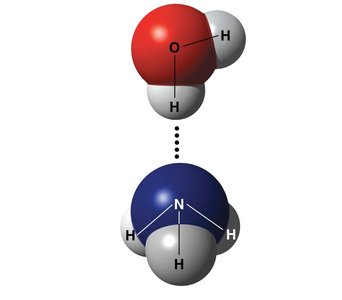
Weak bonds, such as hydrogen bonds and van der Waals interactions, play important roles in maintaining the structure and function of biological molecules.
Hydrogen bond: Attraction between a hydrogen atom covalently bonded to an electronegative atom and another electronegative atom.
Van der Waals interactions: Weak attractions due to transient local charges.
Molecular Shape and Function
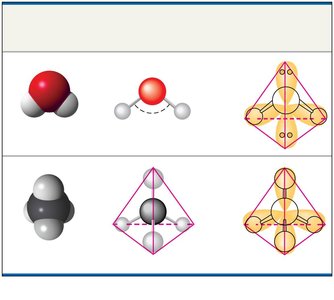
The shape of a molecule is determined by the positions of its atoms' orbitals and is crucial for its biological function. Hybridization of orbitals creates specific molecular shapes, such as tetrahedrons.
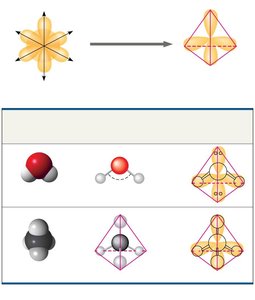
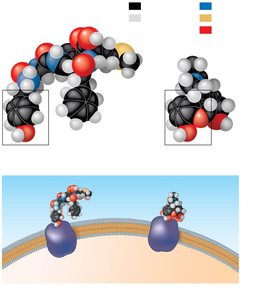
Molecular recognition: Shape determines how molecules interact (e.g., opiates and endorphins binding to brain receptors).
Concept 2.4: Chemical Reactions
Chemical reactions involve the making and breaking of chemical bonds. Reactants are transformed into products, and all reactions are reversible.
Reactants: Starting molecules.
Products: Final molecules.
Example: Photosynthesis: $6\ CO_2 + 6\ H_2O \rightarrow C_6H_{12}O_6 + 6\ O_2$
Chemical equilibrium: Forward and reverse reactions occur at the same rate.
Summary
The chemical context of life is foundational to understanding biology. Elements, compounds, atomic structure, chemical bonding, and molecular shape all contribute to the diversity and complexity of living systems. Mastery of these concepts is essential for further study in biology.
