 Back
Chapter 2: The Chemical Context of Life – Study Notes
Study Guide - Smart Notes
 Tailored notes based on your materials, expanded with key definitions, examples, and context.
Chapter 2: The Chemical Context of Life
Concept 2.1: Matter and Elements
Matter is anything that takes up space and has mass. All matter is composed of elements, which are substances that cannot be broken down into other substances by chemical reactions. Elements exist in three physical states: solid, liquid, and gas.
Matter: Anything with mass and volume.
Mass: The amount of material in an object.
Element: A pure substance consisting of one type of atom; cannot be broken down by chemical means.
Atom: The smallest unit of an element that retains its properties.
There are 92 naturally occurring elements, each represented by a symbol on the periodic table.
Four elements make up about 96% of living matter: Oxygen (O), Carbon (C), Hydrogen (H), and Nitrogen (N).
Trace elements: Required in small amounts for survival (e.g., iron, iodine).
Concept 2.1: Compounds
A compound is a substance consisting of two or more different elements combined in a fixed ratio. Compounds often have properties distinct from their constituent elements.
Compound: Substance formed from two or more elements in a fixed ratio (e.g., NaCl, H2O).
Emergent properties: Compounds have characteristics different from their component elements.
Concept 2.2: Atomic Structure and Properties
The properties of an element depend on the structure of its atoms, which are composed of three types of subatomic particles: protons, neutrons, and electrons.
Proton: Positive charge (+1); number defines the atomic number.
Neutron: No charge; number can vary (isotopes).
Electron: Negative charge (–1); found in electron cloud around nucleus.
Atomic number: Number of protons in the nucleus (unique to each element).
Mass number: Sum of protons and neutrons (always a whole number).
Isotopes: Atoms of the same element with different numbers of neutrons.
Atomic mass: Weighted average of all isotopes (not always a whole number).
Finding neutrons: Subtract atomic number from mass number.
Application: Radioactive isotopes are used in medicine as tracers to follow biological processes.
Concept 2.2: Electrons and Energy Levels
Electrons occupy energy levels called electron shells. The arrangement of electrons determines how atoms interact and bond with each other.
Electrons are attracted to the nucleus by the positive charge of protons.
The valence shell is the outermost electron shell; electrons here are involved in bonding.
Energy is required to move electrons to higher energy levels; energy is released when they fall back to lower levels.
Potential energy: Stored energy due to position; electrons farther from the nucleus have more potential energy.
Concept 2.3: Chemical Bonds and Interactions
The form and function of molecules and compounds depend on the types of chemical bonds between atoms. The main types are ionic and covalent bonds, with additional weak interactions between molecules.
Ionic Bonds
Ionic bond: Attraction between oppositely charged ions (cation and anion).
Formed when one atom donates an electron to another, creating charged ions (e.g., NaCl).
Cation: Positively charged ion (lost electron).
Anion: Negatively charged ion (gained electron).
Covalent Bonds
Covalent bond: Sharing of valence electron pairs between atoms.
Single bond: One pair of shared electrons.
Double bond: Two pairs of shared electrons.
Polar covalent bond: Unequal sharing of electrons; creates partial charges (e.g., H2O).
Non-polar covalent bond: Equal sharing of electrons; no partial charges (e.g., O2).
Weak Chemical Interactions
Occur between molecules, not within them; important for biological structure and function.
Hydrogen bonds: Attraction between a hydrogen atom with a partial positive charge and an electronegative atom with a partial negative charge (e.g., between water molecules).
Van der Waals interactions: Weak attractions due to temporary shifts in electron distribution; significant when molecules are close together (e.g., gecko climbing walls).
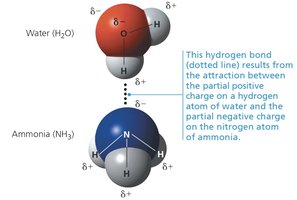
Figure: Hydrogen bonds form between the partial positive charge on hydrogen in one molecule and the partial negative charge on an electronegative atom (e.g., nitrogen or oxygen) in another molecule. This is crucial for the structure of water, proteins, and DNA.
Compounds vs. Molecules
Compound: Two or more different elements chemically bonded (ionic or covalent).
Molecule: Two or more atoms bonded covalently (can be same or different elements).
Examples: NaCl (compound), H2O (compound and molecule), O2 (molecule only).
Concept 2.4: Chemical Reactions
Chemical reactions involve the making and breaking of chemical bonds, resulting in the rearrangement of atoms. No atoms are created or destroyed, only rearranged.
Reactants: Starting materials; bonds are broken.
Products: Ending materials; new bonds are formed.
Chemical equation: Uses arrows to show direction of reaction.
Single arrow: Irreversible reaction.
Double arrow: Reversible reaction.
Chemical equilibrium: Forward and reverse reactions occur at the same rate; concentrations of reactants and products remain constant (not necessarily equal).
How to Find Valence Electrons
Locate the element on the periodic table.
Find the group number (1, 2, 13–17); the last digit is the number of valence electrons.
Group 18 (noble gases) have a full octet (8 valence electrons).
Summary Table: Key Terms and Concepts
Term | Definition | Example |
|---|---|---|
Matter | Anything with mass and volume | Water, air, rocks |
Element | Pure substance of one type of atom | Oxygen (O), Carbon (C) |
Compound | Two or more elements in fixed ratio | NaCl, H2O |
Isotope | Atoms with same protons, different neutrons | Carbon-12, Carbon-14 |
Ionic bond | Attraction between oppositely charged ions | NaCl |
Covalent bond | Sharing of electron pairs | H2O, O2 |
Hydrogen bond | Attraction between partial charges on molecules | Between water molecules |
Van der Waals | Weak, temporary attractions | Gecko climbing walls |
Chemical reaction | Making/breaking of bonds | Photosynthesis |
Key Equations
Finding neutrons:
Additional info: These notes are based on the "Campbell Biology" textbook and are suitable for introductory college-level biology students. They cover all major concepts from Chapter 2, including atomic structure, chemical bonding, and the basics of chemical reactions.
