 Back
Chapter 2: The Chemical Context of Life – Study Notes
Study Guide - Smart Notes
 Tailored notes based on your materials, expanded with key definitions, examples, and context.
Chapter 2: The Chemical Context of Life
Concept 2.1: Elements and Compounds
All living organisms are composed of matter, which is anything that occupies space and has mass. The study of elements and compounds forms the foundation for understanding biological processes.
Matter: Anything that takes up space and has mass.
Element: A substance that cannot be broken down into other substances by chemical reactions (e.g., Carbon (C), Nitrogen (N), Sodium (Na)).
Compound: A substance consisting of two or more elements in a fixed ratio (e.g., NaCl, H2O).
The Elements of Life:
About 20–25% of the 92 naturally occurring elements are essential to life.
Carbon (C), Hydrogen (H), Oxygen (O), and Nitrogen (N) make up about 96% of living matter (often abbreviated as CHON or HONC).
Most of the remaining 4% consists of calcium, phosphorus, potassium, and sulfur.
Trace elements are required in minute quantities (e.g., iodine is necessary to prevent goiter).
Concept 2.2: An Element’s Properties Depend on the Structure of Its Atoms
Atoms are the smallest units of matter that retain the properties of an element. The structure of atoms determines the chemical behavior of elements.
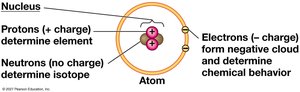
Atom: Composed of subatomic particles: protons (positive charge), neutrons (no charge), and electrons (negative charge).
Protons and neutrons are located in the nucleus; electrons form a cloud around the nucleus.
Proton and neutron mass are nearly identical and measured in Daltons.
Electrons do not follow fixed orbits but occupy regions called orbitals.
Atomic Number and Atomic Mass
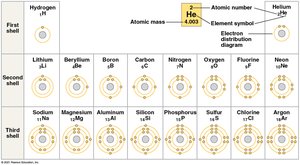
Atomic number: Number of protons in the nucleus (unique to each element).
Mass number: Total number of protons and neutrons in the nucleus.
Atomic mass: Approximated by the mass number; includes protons, neutrons, and electrons.
Notation: Mass number as superscript, atomic number as subscript to the left of the element symbol (e.g., ).
Isotopes
Isotopes: Atoms of the same element with different numbers of neutrons (e.g., C-12, C-13, C-14).
Radioactive isotopes: Decay spontaneously, emitting particles and energy.
Applications: Dating fossils, tracing atoms in metabolic processes, diagnosing medical disorders.
The Energy Levels of Electrons
Energy: The capacity to cause change.
Potential energy: Energy due to location or structure (e.g., a bike on a hill).
Electrons have different potential energies, organized in energy levels or electron shells.
Electron Distribution and Chemical Properties
The chemical behavior of an atom is determined by the distribution of electrons in its shells.
The periodic table arranges elements by electron configuration.
Valence Electrons and Valence
Valence electrons: Electrons in the outermost shell; determine chemical reactivity.
Valence: The number of electrons an atom needs to fill its outer shell (or the number of bonds it can form).
Elements with a full valence shell are chemically inert.
Electron Orbitals
Orbital: A three-dimensional space where an electron is found 90% of the time.
Concept 2.3: The Formation and Function of Molecules Depend on Chemical Bonding Between Atoms
Atoms with incomplete valence shells can share or transfer electrons, forming chemical bonds that hold atoms together in molecules and compounds.
Covalent Bonds
Covalent bond: Strong bond formed by sharing pairs of valence electrons.
Single bond: Sharing one pair of electrons; double bond: sharing two pairs.
Covalent bonds can occur between atoms of the same or different elements.
Structural formula: Shows arrangement of atoms (e.g., H–H).
Molecular formula: Shows number of atoms (e.g., H2).
Electronegativity and Types of Covalent Bonds
Electronegativity: An atom’s attraction for electrons in a covalent bond.
Non-polar covalent bond: Electrons shared equally.
Polar covalent bond: Electrons shared unequally, resulting in partial charges.
Ionic Bonds
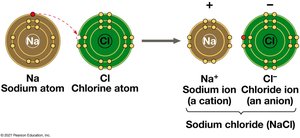
Ionic bond: Attraction between oppositely charged ions formed by electron transfer.
Cation: Positively charged ion; anion: negatively charged ion.
Example: Sodium (Na) transfers an electron to chlorine (Cl), forming Na+ and Cl–, which combine to form NaCl.
Weak Chemical Bonds
Most strong bonds in organisms are covalent, but weak bonds are also important.
Weak bonds reinforce shapes of large molecules and help molecules adhere to each other; they are reversible.
Hydrogen Bonds
Hydrogen bond: Forms when a hydrogen atom covalently bonded to one electronegative atom is attracted to another electronegative atom (usually oxygen or nitrogen).
Van der Waals Interactions
Weak attractions between molecules due to temporary, asymmetrical electron distributions.
Molecular Shape and Function
A molecule’s shape is determined by the positions of its atoms’ valence orbitals and is crucial to its function.
Molecules with similar shapes can have similar biological effects (e.g., morphine and endorphins bind the same brain receptors).
Concept 2.4: Chemical Reactions Make and Break Chemical Bonds
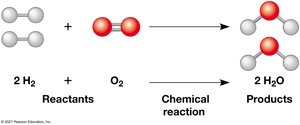
Chemical reactions involve the making and breaking of chemical bonds, transforming reactants into products.
Reactants: Starting molecules in a chemical reaction.
Products: Final molecules produced by the reaction.
Chemical equation: Represents the transformation (e.g., for photosynthesis).
All chemical reactions are reversible; equilibrium is reached when forward and reverse reaction rates are equal.
Example:
Bond Type | Strength | Example |
|---|---|---|
Covalent | Strong | H2O, O2 |
Ionic | Moderate | NaCl |
Hydrogen | Weak | Between water molecules |
Van der Waals | Very weak | Between nonpolar molecules |
Additional info: The above table classifies the main types of chemical bonds by their relative strength and provides examples relevant to biological systems.
