 Back
Chapter 2: The Chemical Foundations of Life – Study Notes
Study Guide - Smart Notes
 Tailored notes based on your materials, expanded with key definitions, examples, and context.
Chapter 2: The Chemical Foundations of Life
Introduction to Matter and Elements
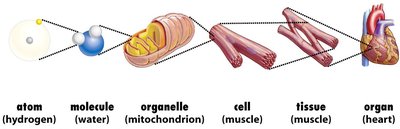
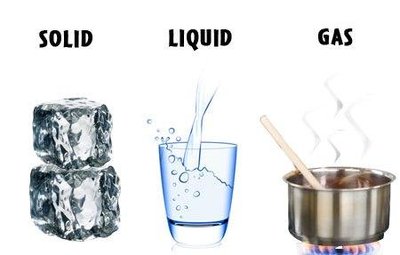
Understanding the chemical basis of life is essential for studying biology. All living and non-living things are composed of matter, which exists in three physical states: solid, liquid, and gas. Matter is made up of elements, which are substances that cannot be broken down into simpler forms by chemical means.
Matter: Anything that occupies space and has mass.
Element: A pure substance consisting of only one type of atom, defined by its number of protons.
Atom: The smallest unit of an element that retains its chemical properties.
Atoms: Structure and Subatomic Particles
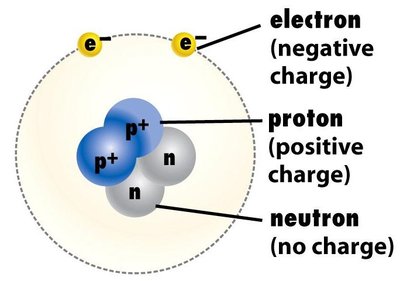
Atoms are composed of three types of subatomic particles: protons, neutrons, and electrons. The arrangement and number of these particles determine the atom’s identity and properties.
Proton: Positively charged particle found in the nucleus.
Neutron: Neutral particle found in the nucleus.
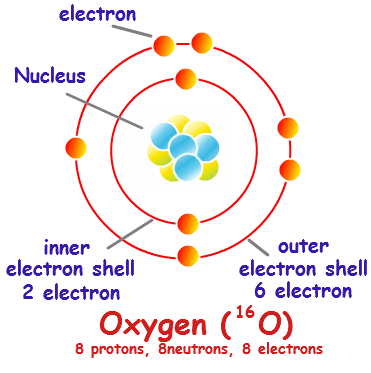
Electron: Negatively charged particle orbiting the nucleus in energy shells.
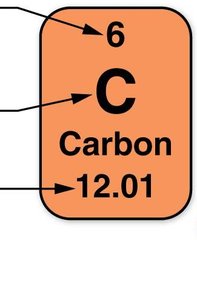
Atomic Number: Number of protons in the nucleus; defines the element.
Atomic Mass: Sum of protons and neutrons in the nucleus.
Elements and the Periodic Table
The periodic table organizes elements by increasing atomic number and similar chemical properties. Each element is represented by a symbol, atomic number, and atomic mass.
Elements in the same column (group) have similar chemical properties due to similar valence electron configurations.
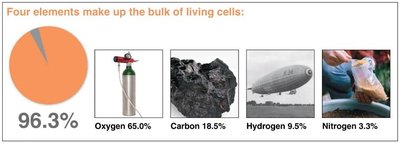
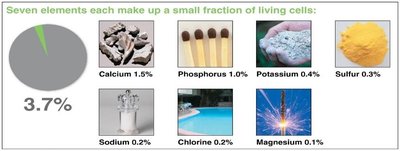
Major elements in living organisms: Oxygen (O), Carbon (C), Hydrogen (H), Nitrogen (N).
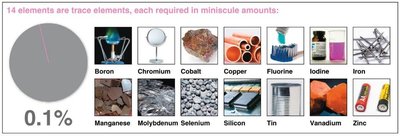
Trace elements are required in small amounts for proper biological function.
Electron Arrangement and Chemical Bonds
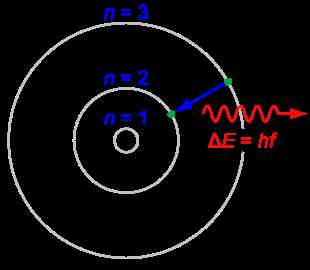
Electrons are arranged in energy shells around the nucleus. The chemical behavior of an atom is largely determined by the number of electrons in its outermost shell (valence shell). Atoms form chemical bonds to achieve stable electron configurations, often following the octet rule (eight electrons in the outer shell).
Bohr Model: Visualizes electrons in discrete energy levels or shells.
Octet Rule: Atoms are most stable when they have eight electrons in their valence shell.
Ions: Atoms that have gained or lost electrons, acquiring a charge.
Types of Chemical Bonds
Atoms interact to form molecules through different types of chemical bonds:
Ionic Bonds: Formed when electrons are transferred from one atom to another, resulting in oppositely charged ions that attract each other.
Covalent Bonds: Formed when two atoms share one or more pairs of electrons. Can be nonpolar (equal sharing) or polar (unequal sharing).
Hydrogen Bonds: Weak attractions between a partially positive hydrogen atom and a partially negative atom (often oxygen or nitrogen) in another molecule.
Ions and Their Biological Importance
Ions play critical roles in biological systems, including nerve impulse transmission, muscle contraction, and enzyme function. Common biologically important ions include:
Ca2+: Bone and teeth structure, signaling
Na+ and K+: Nerve impulses, water balance
Fe2+: Oxygen transport in hemoglobin
HCO3-: pH buffering in blood
Isotopes and Radioactivity
Isotopes are atoms of the same element with different numbers of neutrons. Some isotopes are unstable (radioactive) and decay over time, releasing energy. Radioactive isotopes have important applications in dating fossils (e.g., carbon-14 dating) and as tracers in medical imaging (e.g., PET scans).
Half-life: The time required for half of a radioactive isotope to decay.
Tracer: A radioactive isotope used to track chemical processes in organisms.
Properties of Water Essential for Life
Water is the most abundant molecule in living organisms and has unique properties that support life:
Cohesion: Water molecules stick together via hydrogen bonds, contributing to surface tension.
Adhesion: Water molecules stick to other substances, aiding in capillary action.
Ice Floats: Solid water is less dense than liquid water, allowing ice to float and insulate aquatic life.
Excellent Solvent: Water dissolves many substances due to its polarity, facilitating chemical reactions in cells.
High Specific Heat: Water resists temperature changes, stabilizing environments and organisms.
Acids, Bases, pH, and Buffers
The pH scale measures the concentration of hydrogen ions (H+) in a solution. Biological systems require a stable pH for proper function, maintained by buffers.
Acid: Substance that increases H+ concentration (pH < 7).
Base: Substance that decreases H+ concentration (pH > 7).
Buffer: Substance that minimizes changes in pH by absorbing or releasing H+ ions.
Equation for pH:
Carbon: The Backbone of Life
Carbon is the central element in organic molecules due to its ability to form four covalent bonds, allowing for a diversity of stable structures, including chains and rings. Functional groups attached to carbon skeletons determine the chemical properties and reactivity of organic molecules.
Hydrocarbons: Molecules consisting only of carbon and hydrogen; nonpolar and energy-rich.
Functional Groups: Specific groups of atoms that confer particular chemical properties (e.g., hydroxyl, carboxyl, amino, methyl).
Isomers and Enantiomers
Isomers are molecules with the same chemical formula but different structures or spatial arrangements, leading to different properties.
Structural Isomers: Differ in the covalent arrangement of atoms.
Geometric Isomers: Differ in spatial arrangement around a double bond.
Enantiomers: Mirror-image isomers; only one form is biologically active in most organisms.
Summary Table: Major Chemical Bonds in Biology
Bond Type | Mechanism | Relative Strength | Biological Example |
|---|---|---|---|
Ionic | Electron transfer | Moderate | NaCl (table salt) |
Covalent | Electron sharing | Strongest | H2O, DNA backbone |
Hydrogen | Attraction between partial charges | Weak (individually) | Between water molecules, DNA base pairs |
Additional info: The study of chemistry is foundational for understanding biological processes, as all life is governed by chemical interactions at the atomic and molecular levels.
