 Back
BackChapter 23: Evolutionary Processes – Structured Study Notes
Study Guide - Smart Notes
 Tailored notes based on your materials, expanded with key definitions, examples, and context.
Evolutionary Processes
Introduction to Evolutionary Processes
Evolution is defined as a change in allele frequencies within a population over time. Four primary mechanisms drive evolutionary change, each with distinct effects on genetic variation and fitness:
Natural selection: Increases the frequency of alleles that enhance reproductive success in a specific environment.
Genetic drift: Causes random changes in allele frequencies.
Gene flow: Occurs when individuals migrate between populations and breed, altering allele frequencies.
Mutation: Continuously introduces new alleles into the population.
Any change in allele frequency constitutes evolution, and populations can evolve even without natural selection. Each process has unique consequences for genetic variation and fitness.
The Hardy–Weinberg Principle
Null Hypothesis in Population Genetics
The Hardy–Weinberg principle provides a mathematical null hypothesis for studying evolutionary processes. It predicts genotype and allele frequencies in a population under specific assumptions, allowing researchers to detect deviations caused by evolutionary mechanisms.
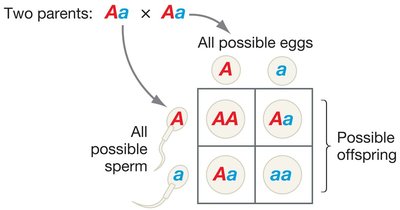
Gene pool concept: All alleles from gametes in a generation are pooled and combine randomly.
Allele frequencies: For a gene with two alleles, frequencies are represented by p and q, where p + q = 1.
Genotype frequencies: Three possible genotypes (AA, Aa, aa) with predicted frequencies:
for AA, for Aa, for aa
The sum of genotype frequencies equals 1:


Assumptions of the Hardy–Weinberg Principle
The Hardy–Weinberg model is based on five key assumptions:
Random mating: No mate choice; gametes combine randomly.
No natural selection: All individuals contribute equally to the gene pool.
No genetic drift: Allele frequencies do not change by chance (large population size).
No gene flow: No new alleles added or lost from the gene pool.
No mutation: No new alleles introduced.
Case Study: Hardy–Weinberg Equilibrium in Butterfly Populations
Researchers analyzed two populations of endangered butterflies to determine if the Pgi gene (controlling flight metabolism) was under selection. The gene has two alleles: A and C. The analysis involves four steps:
Estimate genotype frequencies.
Calculate observed allele frequencies.
Use observed allele frequencies to calculate expected genotype frequencies.
Statistically compare observed and expected values.

Population 1 conformed to Hardy–Weinberg predictions, indicating equilibrium. Population 2 did not, suggesting evolution at the Pgi gene.
Nonrandom Mating
Inbreeding and Its Effects
Inbreeding, the most studied form of nonrandom mating, occurs between relatives and is especially pronounced in self-fertilizing plants. Inbreeding increases homozygosity and decreases heterozygosity in each generation, but does not change allele frequencies overall.
Self-fertilization: Homozygous parents produce all homozygous offspring; heterozygous parents produce both homozygous and heterozygous offspring.
Inbreeding depression: Decline in average fitness due to increased homozygosity and decreased heterozygosity.


Inbreeding can accelerate the elimination of deleterious alleles by natural selection, but is not an evolutionary process itself.
Sexual Selection
Sexual selection is a form of nonrandom mating where organisms choose mates based on physical or behavioral traits. Unlike inbreeding, sexual selection changes allele frequencies and increases fitness, making it a form of natural selection.
Natural Selection
Mechanism and Patterns
Natural selection occurs when heritable variation leads to differential survival and reproduction. Individuals with advantageous phenotypes produce more offspring, causing associated alleles to increase in frequency. Selection can occur in several modes:
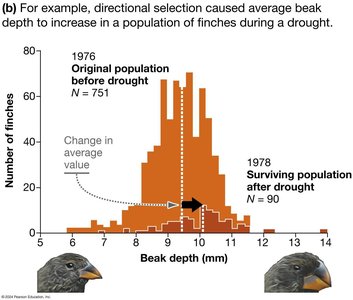
Directional selection: Changes the average value of a trait in one direction; reduces genetic diversity.
Stabilizing selection: Reduces variation in a trait; maintains average value.
Disruptive selection: Favors extreme phenotypes; increases variation.
Balancing selection: Maintains variation; no single allele has a distinct advantage.


Summary Table: Modes of Selection
Mode of Selection | Effect on Phenotype | Example | Effect on Genetic Variation |
|---|---|---|---|
Directional selection | Favors one extreme phenotype, changing average phenotype in one direction | Beak depth in finches during drought | Reduced |
Stabilizing selection | Favors phenotypes near the middle, maintaining average phenotype | Human babies of average size | Reduced |
Disruptive selection | Favors extreme phenotypes at both ends | Whitefish with low or high gill rakers | Increased |
Balancing selection | No single phenotype is favored at all times | Guppies with rare color patterns | Maintained |
Genetic Drift
Definition and Effects
Genetic drift is the random change in allele frequencies due to chance, especially pronounced in small populations. It can lead to the loss or fixation of alleles, reducing genetic variation and often decreasing average fitness.
Founder effect: Occurs when a new population is established by a small group, leading to different allele frequencies.
Bottleneck effect: Sudden reduction in population size causes a loss of alleles and changes in allele frequencies.


Gene Flow
Movement of Alleles Between Populations
Gene flow is the movement of alleles between populations through migration and breeding. It tends to equalize allele frequencies between populations, reducing genetic differences. Gene flow can increase or decrease fitness depending on the context.
Mutation
Source of Genetic Variation
Mutation is the ultimate source of genetic variation, creating new alleles and restoring diversity lost through other mechanisms. Mutations can be point mutations, chromosome-level changes, or lateral gene transfer. Most mutations are random with respect to fitness and often deleterious, but some can be beneficial or neutral.
Point mutations: Change in a single base pair.
Chromosome-level mutations: Changes in chromosome number or composition.
Lateral gene transfer: Genes transferred between species.
Summary Table: Evolutionary Processes
Process | Definition/Description | Effect on Genetic Variation | Effect on Average Fitness |
|---|---|---|---|
Natural selection | Certain alleles are favored and increase in frequency | Can maintain, increase, or reduce | Adaptations increase fitness |
Genetic drift | Random changes in allele frequencies; most important in small populations | Reduces via loss or fixation | Usually reduces fitness |
Gene flow | Movement of alleles between populations | May increase or decrease | May increase, decrease, or have no effect |
Mutation | Random production of new alleles | Increases by producing new alleles | Most mutations lower fitness |
Take-Home Messages
Mutation is the ultimate source of genetic variation; only mutation creates new alleles.
Mutations are random with respect to fitness.
If mutation did not occur, evolution would eventually stop.
Mutation alone is usually inconsequential in changing allele frequencies at a particular gene.
All four evolutionary mechanisms violate Hardy–Weinberg assumptions and contribute to biological diversity.
