 Back
Chapter 23: Study Notes
Study Guide - Smart Notes
 Tailored notes based on your materials, expanded with key definitions, examples, and context.
Chapter 23: The Evolution of Populations
Introduction
This chapter explores how populations evolve over time, focusing on the mechanisms that drive changes in allele frequencies. Understanding these processes is fundamental to evolutionary biology and helps explain the diversity of life on Earth.
The Smallest Unit of Evolution
Populations, Not Individuals, Evolve
Natural selection acts on individuals, but only populations evolve over generations.
Evolution is defined as a change in allele frequencies within a population over time (microevolution).
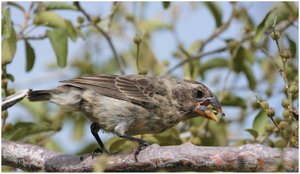
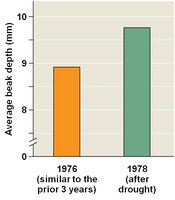
Example: During a drought on Daphne Major Island, large-beaked finches were more likely to survive and reproduce, leading to an increase in average beak size in the population.
Mechanisms of Allele Frequency Change
Natural Selection: Differential survival and reproduction of individuals due to differences in phenotype.
Genetic Drift: Random changes in allele frequencies, especially in small populations.
Gene Flow: Movement of alleles between populations through migration of individuals or gametes.
Only natural selection consistently leads to adaptive evolution.
Genetic Variation Makes Evolution Possible
Sources of Genetic Variation
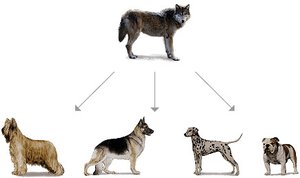
Genetic variation arises from differences in genes or other DNA segments among individuals.
Variation in heritable traits is essential for evolution by natural selection.
Phenotype is influenced by both genotype and environmental factors.
Some traits are determined by a single gene (discrete variation), while others are polygenic and show continuous variation.
Measuring Genetic Variation
Gene variability: Measured as average heterozygosity (percent of loci that are heterozygous).
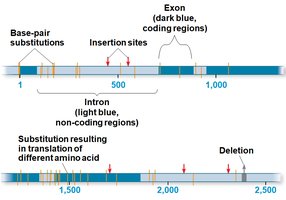
Nucleotide variability: Measured by comparing DNA sequences among individuals.
Most genetic differences occur in noncoding regions (introns); changes in coding regions (exons) are less common and often do not affect protein function due to redundancy in the genetic code.
Environmental Influence on Phenotype
Some phenotypic variation is due to environmental factors, not genetic differences.
Only genetically determined variation can be acted upon by natural selection.
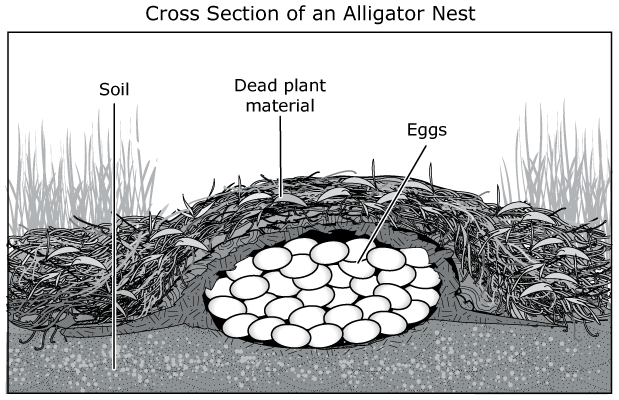
Example: The temperature at which alligator eggs develop determines their sex (environmental sex determination).
Formation of New Alleles
Mutation: A change in the nucleotide sequence of DNA; the ultimate source of new alleles.
Gene duplication: Can create new genetic material for evolution.
Sexual reproduction: Shuffles existing alleles into new combinations through crossing over, independent assortment, and fertilization.
Only mutations in gamete-producing cells are heritable.
Most mutations are neutral or harmful; beneficial mutations are rare but important for adaptation.

The Hardy-Weinberg Principle
Gene Pools and Allele Frequencies
A gene pool consists of all alleles at all loci in a population.
A locus is fixed if all individuals are homozygous for the same allele.
Allele frequencies can be calculated using the formula: where p is the frequency of one allele and q is the frequency of the other.
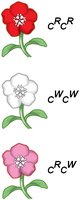
Example: In wildflowers with incomplete dominance, red, white, and pink flowers represent different genotypes.
The Hardy-Weinberg Equation
Describes the expected genetic makeup of a non-evolving population.
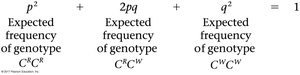
Genotype frequencies are given by: where:
= frequency of homozygous dominant genotype
= frequency of heterozygous genotype
= frequency of homozygous recessive genotype
Applying Hardy-Weinberg: Example Problems
Given allele frequencies, you can predict genotype frequencies and vice versa.
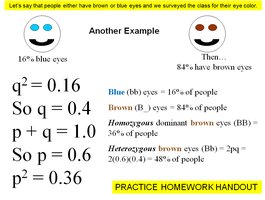
Example: If 16% of a population has blue eyes (recessive), , so and .
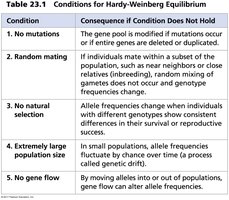
Conditions for Hardy-Weinberg Equilibrium
No mutations
Random mating
No natural selection
Extremely large population size
No gene flow
Application: Phenylketonuria (PKU)
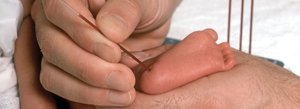
PKU is a genetic disorder caused by a rare allele.
Assuming Hardy-Weinberg equilibrium, the frequency of carriers and affected individuals can be calculated from population data.
Example: If PKU occurs in 1 out of 10,000 births, , , , and carrier frequency (about 2%).
Mechanisms That Alter Allele Frequencies
Natural Selection
Alleles that enhance survival or reproduction increase in frequency over time.
Example: Resistance to DDT in fruit flies increased after widespread use of the pesticide.
Genetic Drift
Random fluctuations in allele frequencies, especially in small populations.
Can lead to loss of genetic variation and fixation of harmful alleles.
Founder Effect: When a few individuals start a new population, allele frequencies may differ from the original population.
Bottleneck Effect: A drastic reduction in population size can alter allele frequencies and reduce genetic diversity.
Gene Flow
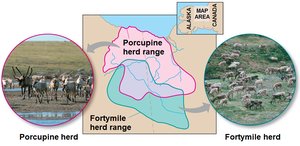
Movement of alleles between populations through migration or transfer of gametes (e.g., pollen).
Can reduce differences between populations and introduce new alleles.
Example: Spread of insecticide resistance alleles in mosquito populations.
Natural Selection and Adaptive Evolution
Relative Fitness
Relative fitness is the contribution an individual makes to the gene pool of the next generation compared to others.
Natural selection increases the frequency of alleles that confer higher relative fitness.
Modes of Selection
Directional selection: Favors individuals at one extreme of the phenotypic range.
Disruptive selection: Favors individuals at both extremes.
Stabilizing selection: Favors intermediate variants and acts against extremes.
Sexual Selection
Individuals with certain traits are more likely to obtain mates.
Can result in sexual dimorphism (differences between sexes in secondary sexual characteristics).
Intra-sexual selection: Competition among one sex for mates.
Inter-sexual selection: Mate choice, often by females.
The "good genes" hypothesis suggests that certain traits signal genetic quality.
Balancing Selection
Maintains stable frequencies of two or more phenotypes.
Frequency-dependent selection: Fitness of a phenotype depends on its frequency in the population.
Heterozygote advantage: Heterozygotes have higher fitness than either homozygote (e.g., sickle-cell allele and malaria resistance).
Limits of Natural Selection
Selection can only act on existing variation.
Evolution is limited by historical constraints.
Adaptations are often compromises.
Chance, natural selection, and the environment interact to shape evolution.
