 Back
Chapter 23 outline
Study Guide - Smart Notes
 Tailored notes based on your materials, expanded with key definitions, examples, and context.
Chapter 23: The Evolution of Populations
Overview: The Smallest Unit of Evolution
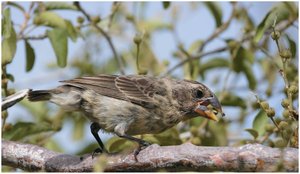
Evolution, in the Darwinian sense, refers to changes in populations over time, not individual organisms. Natural selection acts on individuals, but its evolutionary impact is seen in the population as a whole. The example of the medium ground finch (Geospiza fortis) on the Galápagos Islands illustrates this concept: after a drought, finches with larger beaks survived, leading to a population with larger average beak size.
Key Point: Evolution occurs at the population level, not the individual level.
Key Point: Microevolution is defined as a change in allele frequencies in a population over time.
Key Point: Three mechanisms cause allele frequency changes: natural selection, genetic drift, and gene flow.
Key Point: Natural selection is the only mechanism that consistently leads to adaptive evolution.
Example: Medium ground finches evolved larger beaks after a drought due to natural selection favoring those able to crack large seeds.
Concept 23.1: Genetic Variation Makes Evolution Possible
Genetic variation is the foundation of evolution. Darwin recognized the importance of heritable variation, and Mendel's model of inheritance explained how traits are passed on. Variation occurs within and between populations, and only the genetic component of variation has evolutionary consequences.
Key Point: Genetic variation arises from differences in genes or DNA segments among individuals.
Key Point: Phenotypic variation can be discrete (single gene, distinct phenotypes) or quantitative (polygenic, continuous variation).
Key Point: Genetic variation is measured by average heterozygosity (percent of gene loci that are heterozygous) and nucleotide variability (mean difference in DNA sequences).
Key Point: Geographic variation, including clines, reflects genetic differences between populations due to environmental factors and genetic drift.
Key Point: New alleles and genes originate by mutation, gene duplication, and sexual reproduction.
Key Point: Most mutations are neutral or harmful, but some can be beneficial and increase fitness.
Key Point: Diploidy and balanced polymorphisms (e.g., heterozygote advantage) help preserve genetic variation.
Example: Sickle-cell allele persists in populations where malaria is common due to heterozygote advantage.
Additional info: Mutation rates are higher in microorganisms and viruses, leading to rapid genetic variation. Sexual reproduction shuffles alleles through crossing over, independent assortment, and fertilization.
Concept 23.2: The Hardy-Weinberg Equation Can Be Used to Test Whether a Population Is Evolving
The Hardy-Weinberg principle provides a mathematical model for a non-evolving population. It describes allele and genotype frequencies that remain constant from generation to generation unless acted upon by evolutionary forces.
Key Point: A population's gene pool is defined by its allele frequencies.
Key Point: Hardy-Weinberg equilibrium occurs when allele and genotype frequencies remain constant.
Key Point: The Hardy-Weinberg equation: (where p and q are allele frequencies).
Key Point: Five conditions for Hardy-Weinberg equilibrium: no mutations, random mating, no natural selection, large population size, no gene flow.
Example: Estimating carrier frequency for phenylketonuria (PKU) in the U.S. population using Hardy-Weinberg equation.
Additional info: Real populations rarely meet all five conditions, so evolution is common. However, some loci may be in equilibrium while others evolve.
Concept 23.3: Natural Selection, Genetic Drift, and Gene Flow Can Alter Allele Frequencies in a Population
Three main mechanisms directly alter allele frequencies: natural selection, genetic drift, and gene flow. Each mechanism has distinct effects on genetic variation and adaptation.
Key Point: Natural selection favors alleles that increase fitness, leading to adaptive evolution.
Key Point: Genetic drift is significant in small populations and results from chance events, leading to random changes in allele frequencies, loss of variation, and fixation of harmful alleles.
Key Point: Bottleneck effect and founder effect are two forms of genetic drift.
Key Point: Gene flow is the transfer of alleles between populations, reducing differences and potentially affecting adaptation.
Example: Conservation efforts for the greater prairie chicken involved introducing new alleles to counter genetic drift.
Additional info: Gene flow is increasingly important in human populations due to increased mobility and interbreeding.
Concept 23.4: Natural Selection Is the Only Mechanism That Consistently Causes Adaptive Evolution
Natural selection is a blend of chance (mutation) and sorting (favoring certain alleles). It is the only mechanism that consistently leads to adaptation. Reproductive success depends on relative fitness, and selection acts on the whole organism.
Key Point: Three modes of selection: directional (shifts trait distribution), disruptive (favors extremes), stabilizing (favors intermediates).
Key Point: Sexual selection leads to sexual dimorphism and can involve intrasexual (competition) or intersexual (mate choice) selection.
Key Point: Balancing selection maintains stable frequencies of multiple phenotypes, including heterozygote advantage and frequency-dependent selection.
Key Point: Natural selection cannot produce perfect organisms due to constraints: selection acts on existing variation, historical limitations, adaptation compromises, and chance/environment interactions.
Example: Sickle-cell heterozygotes are resistant to malaria, maintaining the allele in populations where malaria is prevalent.
Additional info: Imperfections in organisms are evidence of evolutionary processes and constraints.
