 Back
Chapter 23: The Evolution of Populations – Study Notes
Study Guide - Smart Notes
 Tailored notes based on your materials, expanded with key definitions, examples, and context.
Chapter 23: The Evolution of Populations
The Smallest Unit of Evolution
Evolution is a process that occurs at the population level, not in individual organisms. While natural selection acts on individuals, only populations evolve over generations as allele frequencies change.
Population: A group of individuals of the same species that interbreed and produce fertile offspring.
Microevolution: A change in allele frequencies in a population over generations.
Three main mechanisms cause allele frequency change:
Natural selection
Genetic drift
Gene flow
Only natural selection consistently leads to adaptive evolution.
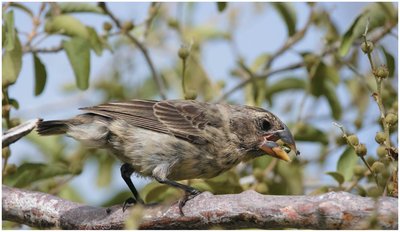
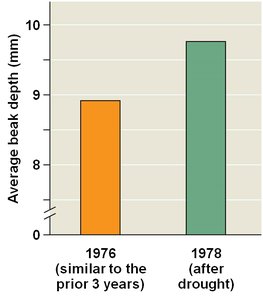
Example: During a drought on Daphne Major Island, large-beaked finches survived better, leading to an increase in average beak depth in the population.
Genetic Variation Makes Evolution Possible
Genetic variation among individuals is essential for evolution by natural selection. This variation arises from differences in genes or other DNA segments and can be measured in several ways.
Phenotype: The observable traits of an organism, resulting from the interaction of its genotype and environment.
Some traits are determined by a single gene (either-or basis), while others are polygenic and vary along a continuum.
Gene variability: Measured as average heterozygosity (percent of loci that are heterozygous).
Nucleotide variability: Measured by comparing DNA sequences between individuals.
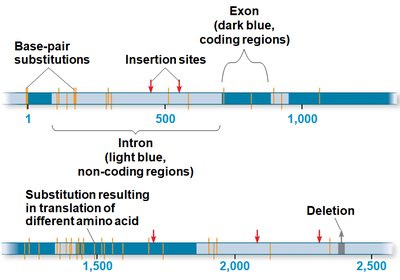
Most genetic differences occur in noncoding regions (introns); variations in coding regions (exons) rarely change protein sequences due to redundancy in the genetic code.
Environmental Influence on Phenotype
Not all phenotypic variation is genetic; some is due to environmental factors. Only genetically determined variation can have evolutionary consequences.
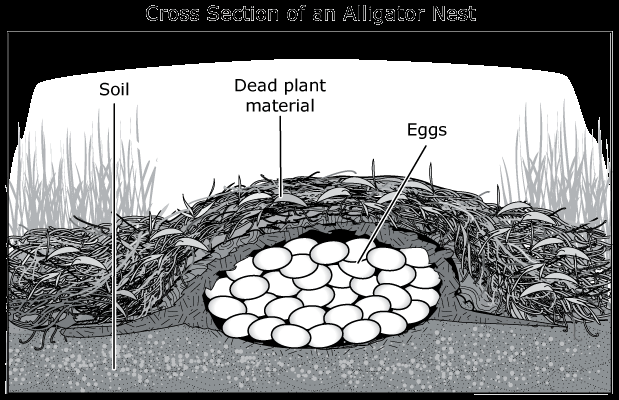
Example: The temperature at which alligator eggs develop determines their sex.
Sources of Genetic Variation
Genetic variation arises through mutation, gene duplication, and sexual reproduction.
Mutation: A change in the nucleotide sequence of DNA. Only mutations in gamete-producing cells are heritable.
Gene duplication: Can increase genome size and allow new functions to evolve.
Sexual reproduction: Shuffles existing alleles through crossing over, independent assortment, and fertilization.
Most mutations are neutral or harmful; beneficial mutations are rare but important for evolution.

Gene Pools and Allele Frequencies
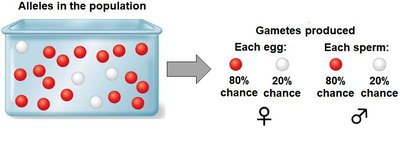
The gene pool of a population includes all alleles at all loci. The frequency of alleles can be calculated and is used to study evolutionary change.
Allele frequency: The proportion of a specific allele among all alleles at a locus in a population.
For two alleles, p (dominant) and q (recessive):
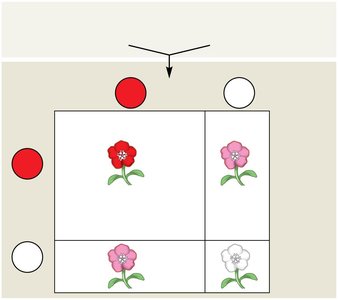
Genotype frequencies can be predicted using the Hardy-Weinberg equation.
The Hardy-Weinberg Principle
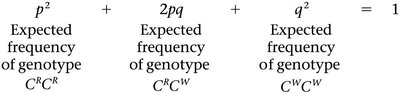
The Hardy-Weinberg equation describes the genetic makeup expected for a population that is not evolving. It provides a null model for detecting evolutionary change.
Equation:
p2: Frequency of homozygous dominant genotype
2pq: Frequency of heterozygous genotype
q2: Frequency of homozygous recessive genotype
Conditions for Hardy-Weinberg Equilibrium
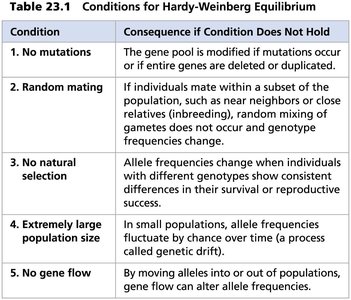
For a population to remain in Hardy-Weinberg equilibrium (no evolution), five conditions must be met:
Condition | Consequence if Condition Does Not Hold |
|---|---|
No mutations | Gene pool is modified if mutations occur or if genes are deleted/duplicated. |
Random mating | Non-random mating changes genotype frequencies. |
No natural selection | Allele frequencies change if genotypes differ in survival/reproductive success. |
Extremely large population size | Small populations experience genetic drift. |
No gene flow | Gene flow alters allele frequencies by moving alleles in/out of populations. |
Mechanisms of Evolutionary Change
Three major factors alter allele frequencies and drive evolution:
Natural Selection: Differential survival and reproduction increase the frequency of advantageous alleles.
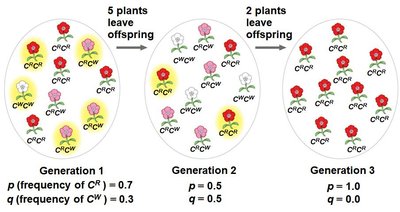
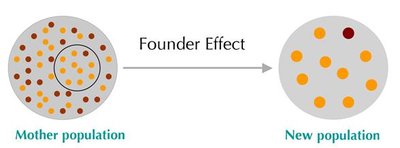
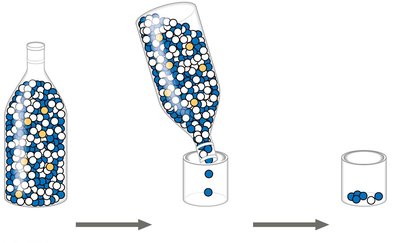
Genetic Drift: Random changes in allele frequencies, especially in small populations. Includes the founder effect and bottleneck effect.
Gene Flow: Movement of alleles between populations, which can reduce differences between populations.
Natural Selection and Adaptive Evolution
Natural selection is the only mechanism that consistently leads to adaptive evolution, increasing the frequency of traits that enhance survival and reproduction.
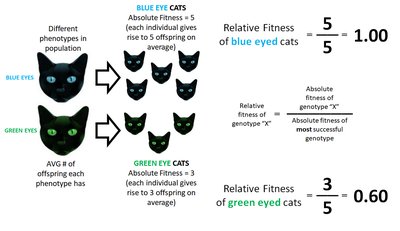
Relative fitness: The contribution of a genotype to the next generation compared to others.
Selection can be directional, disruptive, or stabilizing.
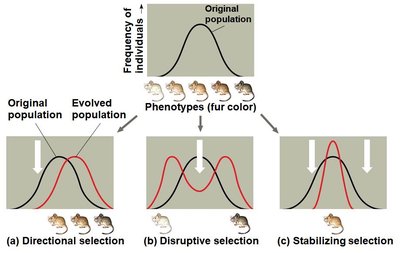
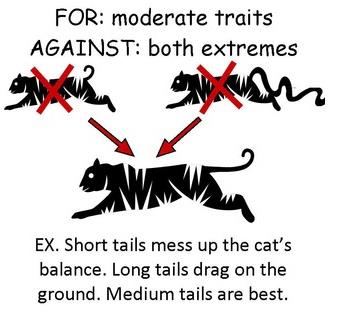
Sexual Selection and Balancing Selection
Sexual selection favors traits that increase mating success, often leading to sexual dimorphism. Balancing selection maintains genetic diversity in populations.
Intra-sexual selection: Competition among one sex for mates.
Inter-sexual selection: Mate choice, often by females.
Balancing selection: Includes frequency-dependent selection and heterozygote advantage.
Heterozygote advantage: Heterozygotes have higher fitness than either homozygote (e.g., sickle-cell allele and malaria resistance).
Limits to Natural Selection
Natural selection cannot produce perfect organisms due to several constraints:
Acts only on existing variation
Limited by historical constraints
Adaptations are often compromises
Chance, natural selection, and the environment interact
