Back
Chapter 23: The Evolution of Populations – Study Notes
Study Guide - Smart Notes
 Tailored notes based on your materials, expanded with key definitions, examples, and context.
Chapter 23: The Evolution of Populations
Introduction to Population Evolution
Evolution at the population level involves changes in allele frequencies over generations. This chapter explores the mechanisms that drive these changes, the importance of genetic variation, and how evolutionary processes shape populations.
Mechanisms of Evolution in Populations
Natural Selection and Population Change
Natural selection acts on individuals, but only populations evolve over time.
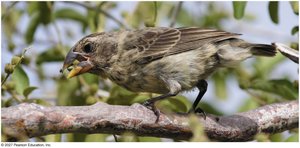
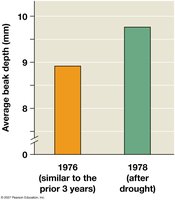
Example: The medium ground finch (Geospiza fortis) on Daphne Major survived a drought due to larger beak size, which allowed access to available seeds. The population's average beak depth increased in the next generation, demonstrating evolution at the population level.
Mechanisms Causing Evolution
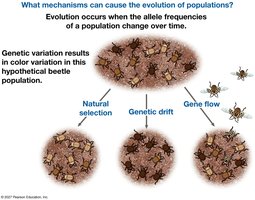
Microevolution: Change in allele frequencies in a population over generations.
Three main mechanisms:
Natural selection: Adaptation to the environment.
Genetic drift: Chance events alter allele frequencies.
Gene flow: Transfer of alleles between populations.
Genetic Variation: The Foundation of Evolution
Sources and Types of Genetic Variation
Genetic variation refers to differences in genes or DNA sequences among individuals.
Phenotype is the product of genotype and environmental influences.
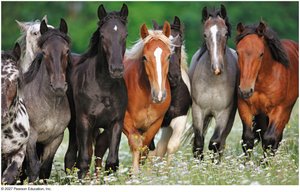
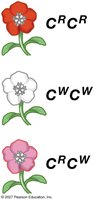
Variation can be discrete (single gene, e.g., flower color) or quantitative (multiple genes, e.g., height in humans).
Phenotypic Plasticity
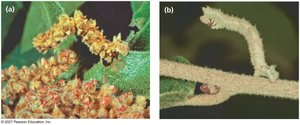
Phenotypic plasticity: The ability of one genotype to produce different phenotypes under different environmental conditions.
Only heritable genetic variation contributes to evolutionary change.
Sources of Genetic Variation
Mutation: The ultimate source of new alleles; can be caused by DNA replication errors, radiation, or chemicals.
Gene duplication: Can produce new genes.
Sexual reproduction: Produces new combinations of alleles through crossing over, independent assortment, and fertilization.
The Hardy–Weinberg Principle
Gene Pools and Allele Frequencies
A population is a group of individuals of the same species that interbreed.
The gene pool includes all copies of every allele at every locus in all members of the population.
A locus is fixed if all individuals are homozygous for the same allele.
Calculating Allele and Genotype Frequencies
For diploid organisms, total alleles at a locus = number of individuals × 2.
Allele frequencies are represented as p (dominant) and q (recessive), with p + q = 1.
The Hardy–Weinberg Model
Describes a population that is not evolving at a particular locus.
Genotype frequencies remain constant if certain conditions are met (no mutation, random mating, no gene flow, infinite population size, no selection).
Genotype frequencies can be calculated using:
= frequency of homozygous dominant
= frequency of heterozygotes
= frequency of homozygous recessive
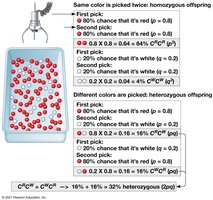
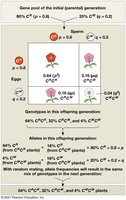
Conditions for Hardy–Weinberg Equilibrium
Condition | Description |
|---|---|
No mutations | The gene pool is not modified by mutations. |
Random mating | Individuals mate randomly with respect to the gene in question. |
No natural selection | All genotypes have equal chances of survival and reproduction. |
Extremely large population size | Genetic drift is negligible. |
No gene flow | No migration of individuals or gametes between populations. |
Applying the Hardy–Weinberg Equation
Used to test whether evolution is occurring and to estimate carrier frequencies for genetic diseases.
Example: Phenylketonuria (PKU) frequency in the U.S. population.
Mechanisms That Alter Allele Frequencies
Natural Selection
Based on differential survival and reproduction due to heritable variation.
Leads to adaptive evolution: traits that enhance survival or reproduction increase in frequency.
Genetic Drift
Random fluctuations in allele frequencies, especially significant in small populations.
Can lead to loss of genetic variation and fixation of harmful alleles.
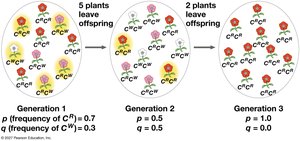
The Founder Effect
Occurs when a few individuals become isolated and establish a new population with different allele frequencies.
The Bottleneck Effect
Drastic reduction in population size due to environmental change; surviving gene pool may not reflect the original population.
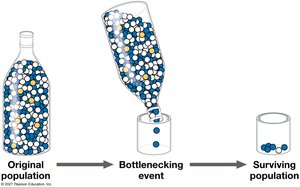
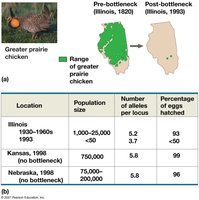
Case Study: Greater Prairie Chicken
Population bottleneck led to reduced genetic variation and lower hatching rates.
Gene flow from neighboring populations restored genetic diversity and improved hatching rates.
Gene Flow
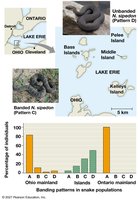
Movement of alleles among populations via migration of individuals or gametes.
Reduces genetic differences between populations and can affect adaptation to local environments.
Natural Selection and Adaptive Evolution
Relative Fitness
Relative fitness: Contribution of an individual to the next generation's gene pool compared to others.
Selection acts on phenotypes, indirectly affecting genotypes.
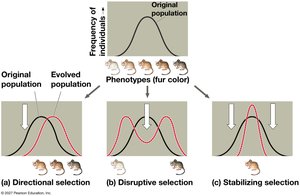
Modes of Selection
Directional selection: Favors individuals at one extreme.
Disruptive selection: Favors individuals at both extremes.
Stabilizing selection: Favors intermediate variants.
Examples of Adaptive Evolution
Octopuses changing color for camouflage.
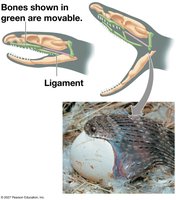
Snakes with movable jaws swallowing large prey.
Sexual Selection and Balancing Selection
Sexual Selection
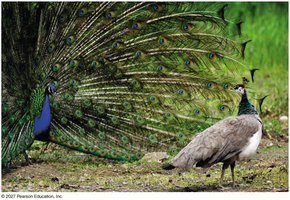
Individuals with certain traits are more likely to obtain mates.
Can result in sexual dimorphism: differences in secondary sexual characteristics between sexes.
Types of Sexual Selection
Intrasexual selection: Competition among one sex for mates.
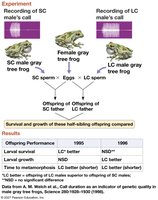
Intersexual selection: Mate choice, often by females, based on traits indicating genetic quality.
Balancing Selection
Maintains two or more phenotypic forms in a population.
Includes frequency-dependent selection and heterozygote advantage.
Frequency-Dependent Selection
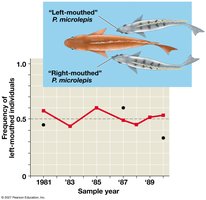
Fitness of a phenotype depends on its frequency relative to other phenotypes.
Example: Scale-eating fish with right- or left-mouthed morphs.
Heterozygote Advantage
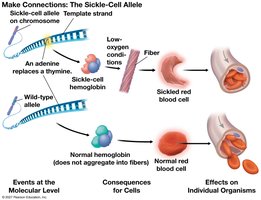
Heterozygotes have higher fitness than homozygotes, maintaining genetic diversity.
Example: Sickle-cell allele provides malaria resistance in heterozygotes.
Limits of Natural Selection
Selection can only act on existing variation.
Evolution is limited by historical constraints.
Adaptations are often compromises.
Chance, natural selection, and the environment interact to shape populations.
Application of Hardy–Weinberg Equilibrium