 Back
Chapter 23: The Evolution of Populations – Study Notes
Study Guide - Smart Notes
 Tailored notes based on your materials, expanded with key definitions, examples, and context.
The Evolution of Populations
Introduction to Population Evolution
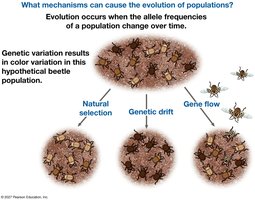
Population evolution is a central concept in biology, describing how groups of organisms change genetically over time. Evolution occurs when the allele frequencies within a population shift, often due to environmental pressures or random events.
Population: A group of individuals of the same species living in the same area and interbreeding.
Evolution: Change in allele frequencies in a population over generations.
Microevolution: Small-scale changes in allele frequencies within a population.
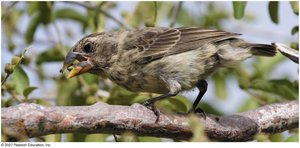
Mechanisms of Population Evolution
Three primary mechanisms drive the evolution of populations: natural selection, genetic drift, and gene flow. Each mechanism alters allele frequencies in distinct ways.
Natural Selection: Individuals with advantageous traits survive and reproduce more successfully.
Genetic Drift: Random events cause unpredictable changes in allele frequencies, especially in small populations.
Gene Flow: Movement of alleles between populations through migration or gamete transfer.
Genetic Variation
Sources and Importance of Genetic Variation
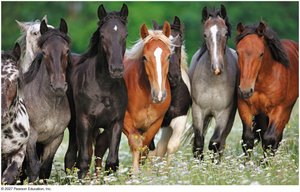
Genetic variation is essential for evolution, providing the raw material for natural selection. It arises from differences in DNA sequences among individuals and can be influenced by environmental factors.
Phenotype: The observable traits of an organism, resulting from genotype and environment.
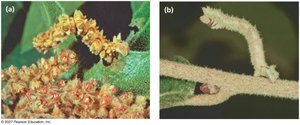
Phenotypic Plasticity: The ability of a genotype to produce different phenotypes under varying environmental conditions.
Only genetic variation can be inherited and acted upon by natural selection.
Generation of Genetic Variation
Genetic variation originates through mutation, gene duplication, and sexual reproduction. Sexual reproduction increases variation by recombining alleles.
Mutation: Changes in DNA sequence that create new alleles.
Gene Duplication: Extra copies of genes can evolve new functions.
Sexual Reproduction: Generates new allele combinations via crossing over, independent assortment, and fertilization.
Gene Pools and Allele Frequencies
Gene Pool Concepts
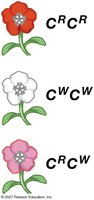
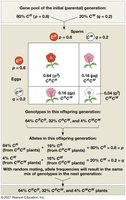
The gene pool encompasses all alleles at every locus in a population. Allele and genotype frequencies can be calculated to understand genetic structure.
Locus: The specific location of a gene on a chromosome.
Fixed Locus: All individuals are homozygous for the same allele.
Allele frequencies are calculated for diploid organisms as twice the number of individuals.
The Hardy–Weinberg Model
The Hardy–Weinberg model predicts the genetic makeup of a population not undergoing evolution. It provides a baseline for detecting evolutionary change.
Hardy–Weinberg Equilibrium: Genotype and allele frequencies remain constant if no evolution occurs.
Equation: (allele frequencies), (genotype frequencies)
Violations of equilibrium assumptions indicate evolution.
Mechanisms Altering Allele Frequencies
Natural Selection
Natural selection is the only mechanism that consistently leads to adaptive evolution. It favors individuals with traits that enhance survival and reproduction.
Relative Fitness: The contribution of an individual to the next generation compared to others.
Selection acts on phenotypes, indirectly affecting genotypes.
Genetic Drift
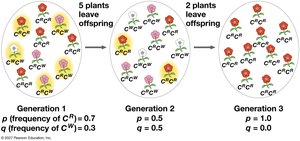
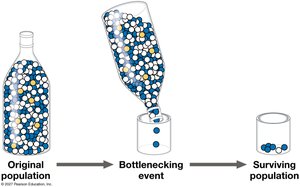
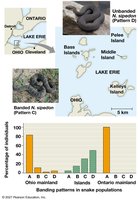
Genetic drift is a random process that can significantly impact small populations, leading to loss of genetic variation and fixation of alleles.
Founder Effect: Occurs when a few individuals establish a new population with different allele frequencies.
Bottleneck Effect: Drastic reduction in population size alters allele frequencies.
Gene Flow
Gene flow involves the movement of alleles between populations, often reducing genetic differences and sometimes increasing fitness.
Alleles can move via migration or gamete transfer (e.g., pollen).
Gene flow can spread beneficial alleles, such as insecticide resistance in mosquitoes.
Modes of Natural Selection
Types of Selection
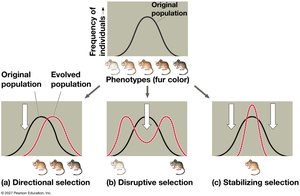
Natural selection can alter trait distributions in three main ways:
Directional Selection: Favors individuals at one extreme.
Disruptive Selection: Favors individuals at both extremes.
Stabilizing Selection: Favors intermediate phenotypes.
Sexual Selection and Frequency-Dependent Selection
Sexual Selection
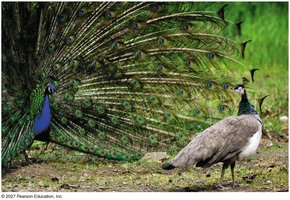
Sexual selection is a form of natural selection where individuals with certain traits are more likely to obtain mates. It can lead to sexual dimorphism.
Intrasexual Selection: Competition among one sex for mates.
Intersexual Selection: Mate choice, often by females.
Good Genes Hypothesis: Females select mates with traits indicating genetic quality.
Frequency-Dependent Selection
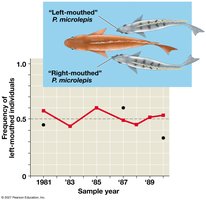
Frequency-dependent selection occurs when the fitness of a phenotype depends on its frequency in the population. This can maintain genetic diversity.
Example: Left- and right-mouthed fish, where the frequency of each morph fluctuates over time.
Heterozygote Advantage and Sickle-Cell Disease
Heterozygote Advantage
Heterozygote advantage occurs when individuals with two different alleles at a locus have higher fitness than homozygotes. This maintains genetic diversity.
Example: Sickle-cell allele is maintained in populations where malaria is common due to heterozygote advantage.
Heterozygotes are more resistant to malaria, while homozygotes for the sickle-cell allele suffer from sickle-cell disease.
Limits of Natural Selection
Why Natural Selection Cannot Fashion Perfect Organisms
Natural selection is constrained by several factors, preventing the evolution of perfect organisms.
Selection acts only on existing variation.
Evolution is limited by historical constraints.
Adaptations are often compromises.
Chance, natural selection, and environment interact.
