 Back
BackChapter 23: The Evolution of Populations – Study Notes
Study Guide - Smart Notes
 Tailored notes based on your materials, expanded with key definitions, examples, and context.
Chapter 23: The Evolution of Populations
Introduction to Population Evolution
Evolution is a fundamental concept in biology, describing how populations—not individuals—change genetically over time. Natural selection acts on individuals, but only populations evolve as allele frequencies shift across generations.
Population: A group of interbreeding individuals of the same species in a localized area.
Microevolution: Change in allele frequencies in a population over generations.
Key mechanisms: Natural selection, genetic drift, and gene flow.
Adaptive evolution: Only natural selection consistently leads to adaptation.
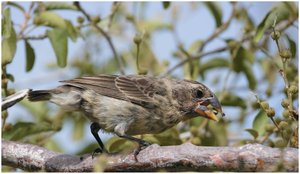
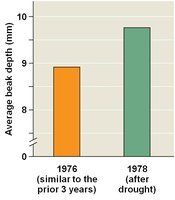
Genetic Variation: The Foundation of Evolution
Genetic variation among individuals is essential for evolution. It arises from differences in genes or other DNA segments and is reflected in phenotypic diversity.
Phenotype: The observable traits of an organism, resulting from genotype and environmental influences.
Gene variability: Measured by average heterozygosity (percent of loci that are heterozygous).
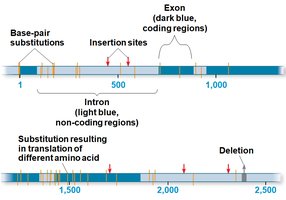
Nucleotide variability: Differences in DNA sequences between individuals, mostly in noncoding regions.
Heritable variation: Only genetically determined variation can drive evolution.
Environmental Influence on Phenotype
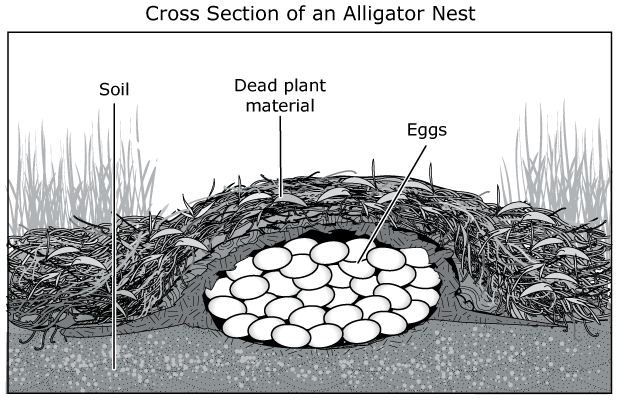
Not all phenotypic variation is genetic; environmental factors can also play a significant role. For example, temperature can determine the sex of alligator hatchlings.
Environmental determination: Some traits are influenced by external conditions rather than genes.
Evolutionary consequence: Only genetic variation is subject to evolutionary change.
Sources of Genetic Variation
Genetic variation arises through mutation, gene duplication, and sexual reproduction.
Mutation: A change in the nucleotide sequence of DNA, creating new alleles.
Gene duplication: Increases genome size and allows new functions to evolve.
Sexual reproduction: Shuffles alleles via crossing over, independent assortment, and fertilization.
Point mutation: Change in a single nucleotide; often neutral, sometimes harmful or beneficial.

Gene Pools and Allele Frequencies
The gene pool of a population consists of all alleles at all loci. Allele frequencies can be calculated and are fundamental to understanding population genetics.
Gene pool: All alleles for all loci in a population.
Allele frequency: Proportion of a specific allele among all alleles at a locus.
Fixed locus: All individuals are homozygous for the same allele.
Incomplete dominance: Heterozygotes show a blend of traits.
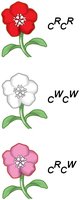
Calculating Allele Frequencies
For diploid organisms, allele frequencies are calculated based on genotype counts. The sum of all allele frequencies at a locus equals 1.
Formula: (where p = frequency of dominant allele, q = frequency of recessive allele)
Example: Wildflower population with red, pink, and white flowers.
The Hardy-Weinberg Principle
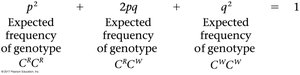
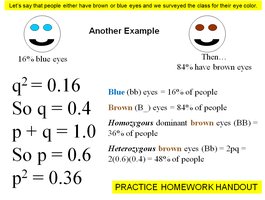
The Hardy-Weinberg equation predicts genotype frequencies in a non-evolving population. It serves as a null model for detecting evolutionary change.
Equation:
Genotype frequencies: = homozygous dominant, = heterozygous, = homozygous recessive
Equilibrium: Allele and genotype frequencies remain constant if no evolutionary forces act.
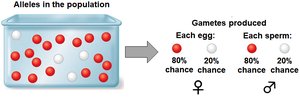
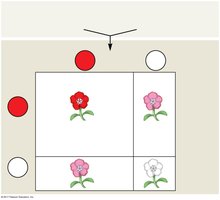
Conditions for Hardy-Weinberg Equilibrium
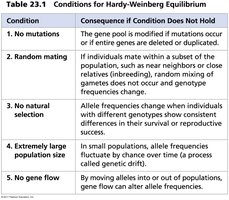
Five conditions must be met for a population to be in Hardy-Weinberg equilibrium. If any are violated, evolution may occur.
No mutations
Random mating
No natural selection
Extremely large population size
No gene flow
Condition | Consequence if Condition Does Not Hold |
|---|---|
No mutations | Gene pool is modified if mutations occur or if entire genes are deleted or duplicated. |
Random mating | Nonrandom mating changes genotype frequencies. |
No natural selection | Allele frequencies change if different genotypes show differences in survival or reproductive success. |
Extremely large population size | Genetic drift can cause allele frequencies to fluctuate in small populations. |
No gene flow | Gene flow alters allele frequencies by moving alleles into or out of populations. |
Application: PKU Example
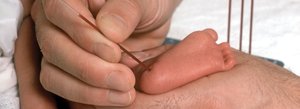
Phenylketonuria (PKU) is a genetic disorder used to illustrate Hardy-Weinberg equilibrium in human populations.
PKU frequency: 1 in 10,000 births ()
Allele frequencies: ,
Carrier frequency: (about 2% of the population)
Mechanisms of Evolutionary Change
Three major factors alter allele frequencies and drive evolution: natural selection, genetic drift, and gene flow.
Natural selection: Differential survival and reproduction favor certain alleles.
Genetic drift: Random changes in allele frequencies, especially in small populations.
Gene flow: Movement of alleles between populations via migration or gamete transfer.
Genetic Drift: Founder and Bottleneck Effects
Genetic drift can significantly impact small populations, leading to random changes in allele frequencies.
Founder effect: A few individuals establish a new population with different allele frequencies.
Bottleneck effect: Sudden reduction in population size alters the gene pool.
Consequences: Loss of genetic variation, fixation of harmful alleles.
Gene Flow
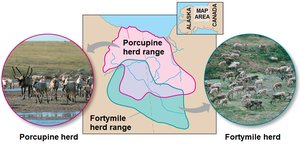
Gene flow involves the transfer of alleles between populations, which can reduce genetic differences and increase population fitness.
Example: Spread of insecticide resistance alleles in mosquito populations.
Natural Selection and Adaptive Evolution
Natural selection is the only mechanism that consistently leads to adaptive evolution, increasing the frequency of beneficial alleles.
Relative fitness: The contribution of an individual to the next generation compared to others.
Modes of selection: Directional, disruptive, and stabilizing selection.
Modes of Selection
Directional selection: Favors one extreme phenotype.
Disruptive selection: Favors both extreme phenotypes.
Stabilizing selection: Favors intermediate phenotypes.
Sexual Selection and Balancing Selection
Sexual selection leads to differences between sexes (sexual dimorphism) and can drive evolution of traits related to mate acquisition. Balancing selection maintains genetic diversity in populations.
Intra-sexual selection: Competition among individuals of one sex.
Inter-sexual selection: Mate choice by individuals of one sex.
Balancing selection: Includes frequency-dependent selection and heterozygote advantage.
Heterozygote advantage: Heterozygotes have higher fitness (e.g., sickle-cell allele confers malaria resistance).
Limits of Natural Selection
Natural selection cannot produce perfect organisms due to constraints such as existing variation, historical limitations, and environmental changes. Adaptations are often compromises shaped by multiple factors.
Additional info: These notes provide a comprehensive overview of population genetics, mechanisms of evolution, and the application of Hardy-Weinberg equilibrium, suitable for exam preparation in a college-level biology course.
