 Back
Chapter 3: Carbon and the Molecular Diversity of Life - Study Notes
Study Guide - Smart Notes
 Tailored notes based on your materials, expanded with key definitions, examples, and context.
Chapter 3: Carbon and the Molecular Diversity of Life
Principles of Chemical Bonding in Organic Molecules
Organic molecules are primarily composed of carbon atoms, which form the backbone of biological macromolecules. The versatility of carbon bonding allows for a wide variety of molecular structures and functions.
Covalent bonds are the primary type of bond in organic molecules, enabling stable and diverse structures.
Carbon can form single, double, or triple bonds with other atoms, including hydrogen, oxygen, and nitrogen.
Organic molecules differ from inorganic molecules by containing carbon-hydrogen bonds and often forming large, complex structures.
Example: Methane (CH4) is a simple organic molecule, while water (H2O) is inorganic.
Carbon Skeletons and Structural Diversity
The arrangement of carbon atoms in a molecule determines its shape and function. Carbon skeletons can vary in length, branching, presence of double bonds, and ring structures.
Length: Carbon chains can be short or long, affecting molecular properties.
Branching: Branched chains create more complex molecules.
Double bonds: Introduce rigidity and affect reactivity.
Rings: Cyclic structures are common in biological molecules (e.g., glucose).
Isomers
Isomers are molecules with the same chemical formula but different structural arrangements, leading to distinct properties.
Structural Isomers: Differ in the arrangement of the carbon backbone.
Enantiomers: Mirror-image isomers; important in pharmaceuticals due to different biological activity.
Example: L- and D-glucose are enantiomers with different roles in metabolism.
Functional Groups
Functional groups are specific groups of atoms attached to carbon skeletons that confer unique chemical properties to molecules.
Common functional groups: Hydroxyl (-OH), carboxyl (-COOH), amino (-NH2), phosphate (-PO4).
Functional groups determine reactivity and interactions in biological systems.
Polymers: Building and Breaking
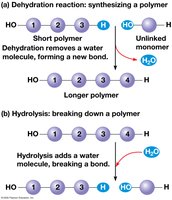
Polymers are large molecules made of repeating monomer units. Their synthesis and degradation involve specific chemical reactions.
Dehydration reaction: Builds polymers by removing a water molecule, forming a new bond.
Hydrolysis reaction: Breaks polymers by adding a water molecule, breaking a bond.
Macromolecules: Overview
Biological macromolecules include carbohydrates, proteins, nucleic acids, and lipids. Each has unique monomers, structures, and functions.
Carbohydrates: Polysaccharides like starch, glycogen, cellulose, and chitin.
Proteins: Made of amino acid monomers; structure determines function.
Nucleic acids: DNA and RNA, composed of nucleotide monomers.
Lipids: Fats, phospholipids, and steroids; hydrophobic and energy-rich.
Polysaccharides
Polysaccharides are complex carbohydrates formed by linking monosaccharides.
Starch: Energy storage in plants.
Glycogen: Energy storage in animals.
Cellulose: Structural component in plant cell walls.
Chitin: Structural component in fungal cell walls and arthropod exoskeletons.
Amino Acids and Protein Structure
Proteins are polymers of amino acids, which have a central carbon, amino group, carboxyl group, and variable R-group.
Primary structure: Sequence of amino acids (covalent bonds).
Secondary structure: Alpha helices and beta sheets (hydrogen bonds).
Tertiary structure: 3D folding (all bond types, including disulfide bridges).
Denaturation: Loss of structure due to heat, pH, or salt, disrupting hydrogen bonds.
Nucleotides and Nucleic Acids
Nucleic acids are polymers of nucleotides, each consisting of a phosphate group, sugar, and nitrogenous base.
DNA: Deoxyribose sugar; bases A, T, C, G; double-stranded helix.
RNA: Ribose sugar; bases A, U, C, G; single-stranded.
Backbone formed by phosphate and sugar; bases provide genetic information.
Lipids
Lipids are hydrophobic molecules important for energy storage, membrane structure, and signaling.
Fats (Triglycerides): 1 glycerol + 3 fatty acids; long-term energy storage.
Phospholipids: 1 glycerol + 2 fatty acids + 1 phosphate; form cell membrane bilayers.
Steroids: Four fused rings; include cholesterol and hormones.
Enzymes and Metabolic Pathways
Enzymes are proteins that catalyze biochemical reactions, lowering activation energy and increasing reaction rates.
Enzymes are specific to substrates and are essential for metabolic pathways.
Structure determines function; denaturation impairs activity.
Example: Amylase catalyzes the breakdown of starch into glucose.
