 Back
Chapter 3: Carbon and the Molecular Diversity of Life – Study Notes
Study Guide - Smart Notes
 Tailored notes based on your materials, expanded with key definitions, examples, and context.
Overview: Carbon Compounds and Life
Importance of Carbon in Biology
Living organisms are primarily composed of chemicals based on the element carbon. Carbon's unique ability to form four covalent bonds allows it to create large, complex, and diverse molecules, which are essential for life. Compounds containing carbon are known as organic compounds.
Four main classes of biological molecules: Carbohydrates, Lipids, Proteins, Nucleic acids
Macromolecules: Carbohydrates, proteins, and nucleic acids can form large molecules called macromolecules.
The Formation of Bonds with Carbon
Valence and Covalent Bonding
The valence of an atom is the number of covalent bonds it can form. Carbon, with four valence electrons, can form four covalent bonds with a variety of atoms, enabling the construction of complex molecules. Carbon atoms can also bond to each other, forming chains that serve as the skeletons of most organic molecules.
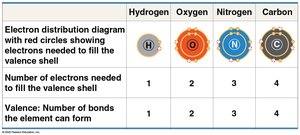
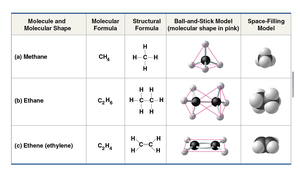
Molecular Diversity Arising from Variation in Carbon Skeletons
Carbon Skeletons
Carbon chains, or skeletons, vary in length and shape (straight, branched, or ringed), contributing to the diversity of organic molecules.
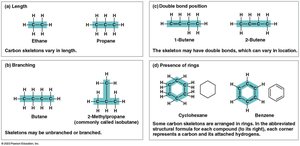
Hydrocarbons
Definition and Properties
Hydrocarbons are organic molecules consisting only of carbon and hydrogen. They are found in many biological molecules, such as fats, and can undergo reactions that release significant amounts of energy.
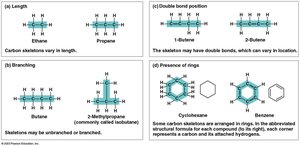
Isomers
Types of Isomers
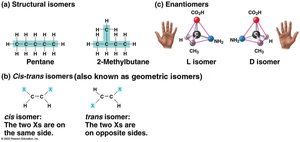
Isomers are compounds with the same molecular formula but different structures and properties. The main types include:
Structural isomers: Differ in the covalent arrangements of their atoms.
Cis-trans (geometric) isomers: Differ in spatial arrangement due to inflexible double bonds.
Enantiomers: Mirror images of each other, differing in spatial arrangement around an asymmetric carbon.
The Chemical Groups Most Important to Life
Functional Groups
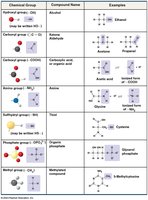
Functional groups are specific groups of atoms within molecules that are responsible for the characteristic chemical reactions of those molecules. Seven functional groups are especially important in biological chemistry:
Hydroxyl group (–OH)
Carbonyl group (C=O)
Carboxyl group (–COOH)
Amino group (–NH2)
Sulfhydryl group (–SH)
Phosphate group (–OPO32–)
Methyl group (–CH3)
ATP: An Important Source of Energy for Cellular Processes
Structure and Function of ATP
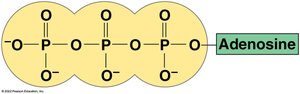
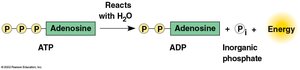
Adenosine triphosphate (ATP) is an organic phosphate molecule that stores and releases energy for cellular processes. ATP consists of adenosine attached to three phosphate groups. Hydrolysis of ATP releases energy that can be used by the cell.
Macromolecules: Polymers and Monomers
Polymers and Monomers
Polymers are long molecules made of repeating units called monomers. Many biological macromolecules are polymers, including carbohydrates, proteins, and nucleic acids.
Synthesis and Breakdown of Polymers
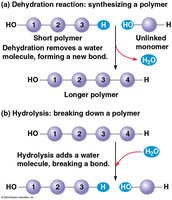
Dehydration reaction: Joins two monomers by removing a water molecule.
Hydrolysis: Breaks a polymer into monomers by adding a water molecule.
Both processes are catalyzed by enzymes.
Carbohydrates: Fuel and Building Material
Types of Carbohydrates
Carbohydrates include sugars and polymers of sugars. The simplest carbohydrates are monosaccharides (simple sugars), while carbohydrate macromolecules are polysaccharides (polymers of sugars).
Monosaccharides
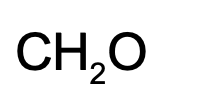
General formula:
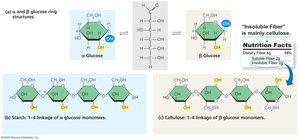
Glucose is the most common monosaccharide.
Classified by the number of carbons and the position of the carbonyl group.
Disaccharides and Glycosidic Linkages
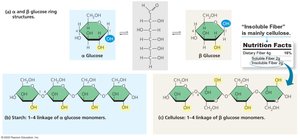
A disaccharide forms when two monosaccharides are joined by a glycosidic linkage (a covalent bond formed by a dehydration reaction).
Polysaccharides: Storage and Structural Roles
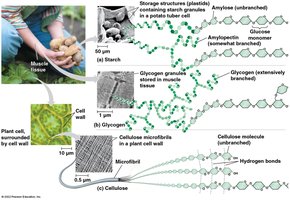
Polysaccharides serve as storage (e.g., starch in plants, glycogen in animals) or structural materials (e.g., cellulose in plants, chitin in arthropods and fungi). The structure and function depend on the sugar monomers and the positions of glycosidic linkages.
Lipids: A Diverse Group of Hydrophobic Molecules
General Properties
Lipids are hydrophobic molecules that do not form true polymers. They include fats, phospholipids, and steroids. Lipids are hydrophobic because they consist mostly of hydrocarbons, which form nonpolar covalent bonds.
Fats
Constructed from glycerol and fatty acids.
Fatty acids can be saturated (no double bonds, solid at room temperature) or unsaturated (one or more double bonds, liquid at room temperature).
Major function: energy storage.
Phospholipids
Composed of two fatty acids, a phosphate group, and glycerol.
Form the main structure of cell membranes (phospholipid bilayer).
Steroids
Characterized by a carbon skeleton with four fused rings.
Cholesterol is an important steroid in animal cell membranes.
Proteins: Diversity of Structure and Function
Functions of Proteins
Proteins perform a wide range of functions, including defense, storage, transport, cellular communication, movement, and structural support. They are polymers of amino acids, called polypeptides.
Amino Acids and Polypeptides
Amino acids have a central carbon, an amino group, a carboxyl group, a hydrogen atom, and a variable R group (side chain).
Amino acids are linked by peptide bonds to form polypeptides.
Each polypeptide has a unique sequence and directionality (N-terminus to C-terminus).
Levels of Protein Structure
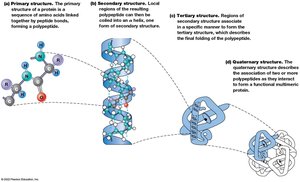
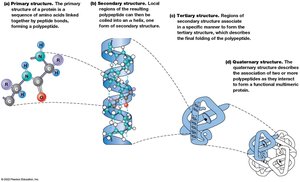
Primary structure: Sequence of amino acids.
Secondary structure: Coils and folds (e.g., alpha helix, beta sheet) due to hydrogen bonding.
Tertiary structure: Overall 3D shape due to interactions among R groups (hydrophobic interactions, disulfide bridges, etc.).
Quaternary structure: Association of multiple polypeptide chains.
Protein Structure and Disease
A change in primary structure can affect protein function. For example, sickle-cell disease results from a single amino acid substitution in hemoglobin, altering red blood cell shape and function.
Denaturation
Physical and chemical conditions (pH, salt, temperature) can cause proteins to lose their native structure, a process called denaturation. Denatured proteins are biologically inactive.
Nucleic Acids: Storage and Transmission of Hereditary Information
DNA and RNA
Nucleic acids store, transmit, and help express hereditary information. The two main types are deoxyribonucleic acid (DNA) and ribonucleic acid (RNA). Genes, made of DNA, program the amino acid sequence of polypeptides. DNA directs its own replication and the synthesis of messenger RNA (mRNA), which in turn directs protein synthesis (gene expression).
