 Back
BackChapter 3: The Molecules of Cells – Structure and Function of Biological Molecules
Study Guide - Smart Notes
 Tailored notes based on your materials, expanded with key definitions, examples, and context.
Chapter 3: The Molecules of Cells
Big Ideas Overview
This chapter explores the molecular foundations of life, focusing on the structure and function of organic compounds, carbohydrates, lipids, proteins, and nucleic acids. Understanding these molecules is essential for grasping cellular processes and biological diversity.
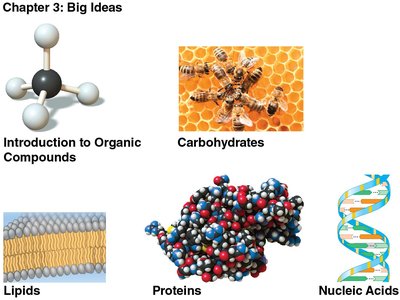
Introduction to Organic Compounds
Life’s Molecular Diversity and Carbon
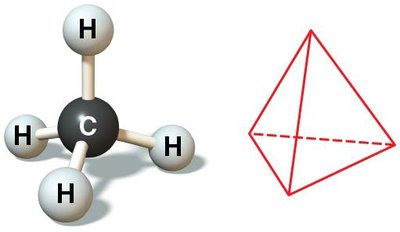
Organic compounds are molecules primarily composed of carbon atoms. Carbon's unique ability to form four covalent bonds allows for the creation of large, complex, and diverse molecules essential for life.
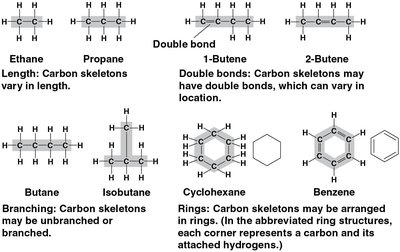
Carbon Skeletons: Carbon chains form the backbone of most organic molecules, varying in length, branching, and ring formation.
Isomers: Molecules with the same molecular formula but different structures, leading to different properties.
Hydrocarbons: Compounds consisting only of carbon and hydrogen.
Key Chemical Groups in Biological Molecules
Functional Groups and Their Properties
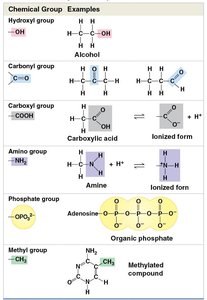
The chemical behavior of organic molecules is determined by their functional groups. These groups confer specific properties and reactivity, often making molecules hydrophilic and biologically active.
Hydroxyl group (–OH): Found in alcohols; increases solubility in water.
Carbonyl group (–C=O): Found in sugars; can be at the end (aldehyde) or within (ketone) a carbon skeleton.
Carboxyl group (–COOH): Found in carboxylic acids; acts as an acid.
Amino group (–NH2): Found in amino acids; acts as a base.
Phosphate group (–OPO32–): Found in nucleotides and ATP; involved in energy transfer.
Methyl group (–CH3): Affects gene expression and molecular shape.
Chemical Group | Example |
|---|---|
Hydroxyl | Alcohol (–OH) |
Carbonyl | Aldehyde/Ketone (–C=O) |
Carboxyl | Carboxylic acid (–COOH) |
Amino | Amine (–NH2) |
Phosphate | Organic phosphate (–OPO32–) |
Methyl | Methylated compound (–CH3) |
Building Large Biological Molecules
Polymers and Monomers
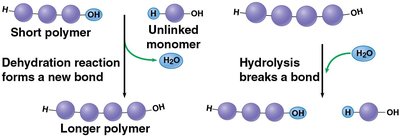
Cells construct macromolecules (polymers) from smaller units (monomers) through dehydration reactions, and break them down by hydrolysis. Enzymes catalyze these processes.
Dehydration Reaction: Joins monomers by removing water.
Hydrolysis: Breaks polymers into monomers by adding water.
Carbohydrates
Monosaccharides, Disaccharides, and Polysaccharides
Carbohydrates are essential for energy storage and structural support. They range from simple sugars (monosaccharides) to complex polymers (polysaccharides).
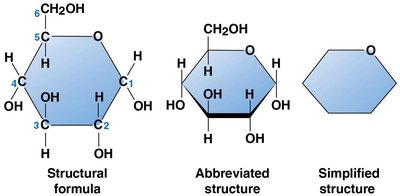
Monosaccharides: Simple sugars (e.g., glucose, fructose) with the general formula CnH2nOn.
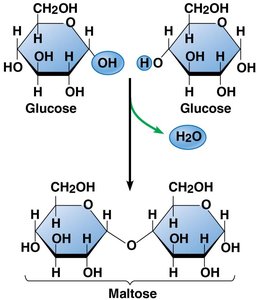
Disaccharides: Formed by joining two monosaccharides via dehydration (e.g., maltose).
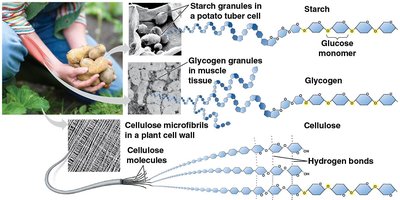
Polysaccharides: Long chains of monosaccharides; include starch (plants), glycogen (animals), cellulose (plants), and chitin (fungi, insects).
Lipids
Fats, Phospholipids, and Steroids
Lipids are hydrophobic molecules important for energy storage, membrane structure, and signaling. They include fats, phospholipids, and steroids.
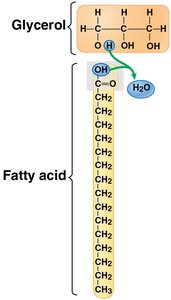
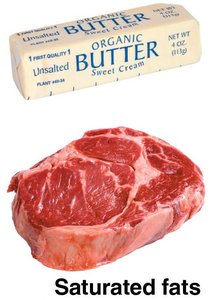
Fats (Triglycerides): Composed of glycerol and three fatty acids. Saturated fats have no double bonds; unsaturated fats have one or more double bonds.
Phospholipids: Major component of cell membranes, with hydrophilic heads and hydrophobic tails.
Steroids: Include cholesterol and hormones; characterized by four fused rings.

Proteins
Structure and Function
Proteins are versatile macromolecules involved in catalysis, transport, defense, signaling, structure, and movement. Their function depends on their shape, which is determined by four levels of structure.
Primary structure: Sequence of amino acids.
Secondary structure: Coiling (α-helix) or folding (β-sheet) stabilized by hydrogen bonds.
Tertiary structure: Three-dimensional shape formed by interactions among R groups.
Quaternary structure: Association of multiple polypeptide chains.
Denaturation: Loss of protein shape and function due to environmental changes.
Nucleic Acids
DNA and RNA Structure and Function
Nucleic acids are polymers of nucleotides, which store and transmit genetic information. DNA is a double helix, while RNA is usually single-stranded.
Nucleotide: Consists of a sugar, phosphate group, and nitrogenous base.
DNA: Double-stranded; stores hereditary information.
RNA: Single-stranded; involved in protein synthesis.
Human Evolution Connection: Lactose Tolerance
Genetic Adaptation to Diet
Lactose tolerance in adults is a result of genetic mutations that allow continued expression of the lactase enzyme. This adaptation is linked to the domestication of dairy animals and has evolved independently in several human populations.
Summary Table: Biological Molecules and Their Functions
Molecule | Monomer | Function |
|---|---|---|
Carbohydrates | Monosaccharide | Energy storage, structure |
Lipids | Fatty acid, glycerol | Energy storage, membranes, signaling |
Proteins | Amino acid | Catalysis, structure, transport, defense |
Nucleic Acids | Nucleotide | Genetic information, protein synthesis |
