 Back
Chapter 3 study guide
Study Guide - Smart Notes
 Tailored notes based on your materials, expanded with key definitions, examples, and context.
The Molecules of Cells
Introduction
Biological molecules are essential for the daily functions of living organisms. For example, the enzyme lactase is required to digest dairy products, and its absence leads to lactose intolerance. This highlights the importance of enzymes and other biological molecules in metabolism and nutrition.
Organic Compounds and Carbon
Life’s Molecular Diversity Is Based on the Properties of Carbon
Carbon is the foundation of organic molecules due to its ability to form four covalent bonds, allowing for a wide variety of structures such as chains, rings, and branched molecules. This versatility enables the formation of complex molecules necessary for life.
Isomers: Molecules with the same molecular formula but different structures, resulting in different functions.
Hydrocarbons: Compounds composed only of carbon and hydrogen.
Example: Methamphetamine exists as two isomers; one is a drug, the other a medication. The difference in structure leads to different effects in the body.
A Few Chemical Groups are Key to the Functioning of Biological Molecules
The properties of organic compounds depend on the size and shape of their carbon backbone and the functional groups attached. Functional groups are specific clusters of atoms that confer distinct chemical properties.
Hydroxyl (–OH): Polar, helps molecules dissolve in water.
Carbonyl (C=O): Found in sugars, includes aldehydes and ketones.
Carboxyl (–COOH): Acidic, donates H+.
Amino (–NH2): Basic, accepts H+.
Sulfhydryl (–SH): Stabilizes protein structure.
Phosphate (–PO4): Energy transfer, DNA/RNA structure.
Methyl (–CH3): Affects shape and function.
Example: Testosterone and estradiol differ only in their functional groups, resulting in different biological effects.
Macromolecules and Polymers
Cells Make Large Molecules from a Limited Set of Small Molecules
Cells build macromolecules (polymers) from smaller units called monomers. The diversity of biological molecules arises from the arrangement and combination of these monomers.
Dehydration reaction: Joins monomers by removing water.
Hydrolysis: Breaks polymers into monomers by adding water.
Enzymes: Catalyze these reactions.
Carbohydrates
Monosaccharides are the Simplest Carbohydrates
Carbohydrates range from simple sugars (monosaccharides) to complex polysaccharides. Monosaccharides, such as glucose and fructose, provide quick energy and serve as building blocks for larger carbohydrates.
General formula: Multiple of CH2O
Functional groups: Hydroxyl and carbonyl
Two Monosaccharides Are Linked to Form a Disaccharide
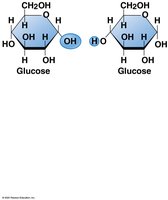
Disaccharides are formed when two monosaccharides join via a dehydration reaction, producing a molecule such as sucrose or lactose.
Example: Glucose + Glucose → Maltose
Polysaccharides Are Long Chains of Sugar Units
Polysaccharides are large carbohydrates made of many monosaccharides linked together. They serve as energy storage (starch, glycogen) or structural support (cellulose, chitin).
Starch: Storage in plants
Glycogen: Storage in animals
Cellulose: Structural in plant cell walls
Chitin: Structural in fungi and arthropods
Lipids
Fats Are Lipids That Are Mostly Energy-Storage Molecules
Lipids are hydrophobic molecules, including fats, oils, phospholipids, and steroids. Fats (triglycerides) consist of glycerol and three fatty acids. Saturated fats have no double bonds; unsaturated fats have one or more double bonds.
Hydrogenation: Converts unsaturated fats to saturated fats, producing trans fats.
Trans fats: Associated with health risks.
Phospholipids and Steroids Are Important Lipids with a Variety of Functions
Phospholipids form cell membranes, while steroids (such as cholesterol and hormones) play roles in signaling and membrane structure.
Phospholipid bilayer: Structure of cell membranes
Steroids: Four fused carbon rings
Proteins
Proteins Have a Wide Range of Functions and Structures
Proteins are diverse molecules involved in nearly every cellular function, including catalysis, transport, defense, signaling, structure, and movement.
Enzymes: Speed up reactions
Transport proteins: Move substances
Antibodies: Defense
Hormones: Signaling
Receptors: Communication
Contractile proteins: Movement
Structural proteins: Support
Storage proteins: Reserve nutrients
Proteins Are Made from Amino Acids Linked by Peptide Bonds
Proteins are polymers of amino acids, each with a central carbon, amino group, carboxyl group, hydrogen atom, and variable R group. Peptide bonds join amino acids in dehydration reactions, forming polypeptides.
Hydrolysis: Breaks peptide bonds during digestion
A Protein’s Functional Shape Results from Four Levels of Structure
Protein function depends on its shape, which is determined by four structural levels:
Primary: Amino acid sequence
Secondary: Coiling/folding (hydrogen bonds)
Tertiary: 3D shape (R group interactions)
Quaternary: Multiple polypeptides
Denaturation: Loss of shape and function due to environmental changes.
Nucleic Acids
The Nucleic Acids DNA and RNA Are Information-Rich Polymers of Nucleotides
Nucleic acids (DNA and RNA) are polymers of nucleotides, each containing a sugar, phosphate group, and nitrogenous base. DNA is a double helix; RNA is single-stranded. These molecules store and transmit genetic information.
DNA: Deoxyribose sugar, bases A, T, C, G
RNA: Ribose sugar, bases A, U, C, G
Lactose Tolerance Is a Recent Event in Human Evolution
Lactose tolerance evolved in populations with a history of dairy farming. Genetic mutations allowed continued production of lactase, providing a nutritional advantage and increasing the frequency of these traits through natural selection.
Summary Table: Important Chemical Groups of Organic Compounds
Functional Group | Structure | Function/Property |
|---|---|---|
Hydroxyl | –OH | Polar, increases solubility |
Carbonyl | C=O | Found in sugars, aldehydes, ketones |
Carboxyl | –COOH | Acidic, donates H+ |
Amino | –NH2 | Basic, accepts H+ |
Sulfhydryl | –SH | Stabilizes protein structure |
Phosphate | –PO4 | Energy transfer, DNA/RNA structure |
Methyl | –CH3 | Gene regulation, affects shape |
Key Equations and Concepts
Dehydration Reaction:
Hydrolysis:
Health and Nutrition Connections
Trans Fats and Health Risks
Trans fats are formed by partial hydrogenation of unsaturated fats. They increase LDL cholesterol, decrease HDL cholesterol, promote inflammation, and raise the risk of heart disease more than saturated fats.
"Empty Calories" in Sugars
Added sugars provide energy but lack essential nutrients, leading to the term "empty calories." High sugar intake is correlated with adverse health effects.
Inheritance and Evolution
Chemical Structure of Nucleic Acids and Inheritance
DNA stores genetic information in sequences of nucleotides. Genes are segments of DNA that code for proteins. During reproduction, DNA is copied and passed to offspring, enabling inheritance.
Evolution of Lactose Tolerance
Lactose tolerance is an example of human evolution in response to cultural practices. Genetic mutations for lactase persistence were favored in populations with dairy farming, illustrating natural selection.
Protein Structure and Function
Chemical Structure of Proteins
Proteins are polymers of amino acids, each with a unique R group. The sequence and arrangement of amino acids determine the protein's structure and function. Peptide bonds link amino acids, and the protein folds into a specific shape necessary for its activity.
Importance of Proteins to Cells
Proteins are the main working molecules in cells, performing catalysis, structural support, transport, signaling, defense, movement, and storage.
----------------------------------------
