 Back
BackChapter 3: Water and Life – Properties, Biological Roles, and Chemical Context
Study Guide - Smart Notes
 Tailored notes based on your materials, expanded with key definitions, examples, and context.
Water and Life
Chemical and Physical Properties of Water
Water is a unique molecule whose chemical and physical properties are essential for life. Its structure and interactions give rise to several emergent properties that support biological systems.
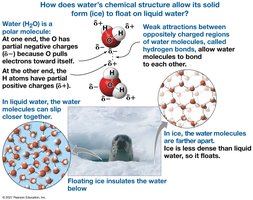
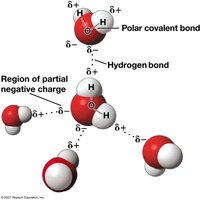
Polarity: Water (H2O) is a polar molecule, meaning it has partial positive and negative charges due to the unequal sharing of electrons between oxygen and hydrogen atoms.
Hydrogen Bonding: Weak attractions between oppositely charged regions of water molecules, called hydrogen bonds, allow water molecules to bond to each other.
High Specific Heat: Water can absorb or release large amounts of heat with only slight changes in temperature, due to hydrogen bonding.
Heat of Vaporization: Water requires significant energy to change from liquid to gas, which allows for evaporative cooling.
Expansion Upon Freezing: Ice is less dense than liquid water because water molecules are farther apart in the solid state, allowing ice to float.
Versatility as a Solvent: Water can dissolve a wide variety of substances, making it the solvent of life.
Emergent Properties of Water
Four emergent properties of water contribute to Earth's suitability for life:
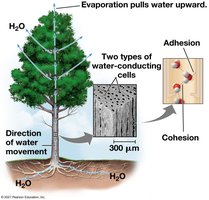
Cohesive Behavior: Hydrogen bonds hold water molecules together, resulting in cohesion and high surface tension. This is important for water transport in plants.
Ability to Moderate Temperature: Water absorbs heat from warmer air and releases stored heat to cooler air, stabilizing environmental and organismal temperatures.
Expansion Upon Freezing: Ice floats on water, insulating aquatic environments and protecting life below.
Versatility as a Solvent: Water dissolves many substances, facilitating chemical reactions in biological systems.
Cohesion and Adhesion
Cohesion refers to the attraction between water molecules, while adhesion is the attraction between water and other substances, such as plant cell walls. These properties enable water to move against gravity in plants.
Moderation of Temperature
Water's high specific heat allows it to resist temperature changes, which is crucial for maintaining stable environments. The specific heat of water is 1 cal/(g·1°C).
Heat is absorbed when hydrogen bonds break.
Heat is released when hydrogen bonds form.
Large bodies of water moderate climate by absorbing heat during the day and releasing it at night.
Evaporative Cooling
Evaporation is the transformation of water from liquid to gas. The heat of vaporization is the energy required for this process. As water evaporates, the surface cools, stabilizing temperatures in organisms and environments.
Water: The Solvent of Life
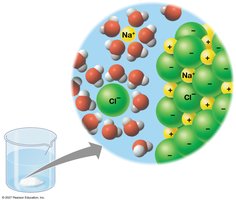
Water's polarity allows it to dissolve many substances, forming aqueous solutions. The solvent is the dissolving agent, and the solute is the substance dissolved.
Hydration Shell: Water molecules surround ions or polar molecules, separating and dissolving them.
Hydrophilic Substances: Have affinity for water and dissolve easily.
Hydrophobic Substances: Do not dissolve in water; often nonpolar, such as oils.
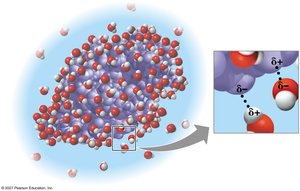
Solute Concentration in Aqueous Solutions
Chemical reactions in organisms often occur in aqueous solutions. Solute concentration is measured in moles (mol), where 1 mol = 6.02 × 10²³ molecules (Avogadro's number). Molarity (M) is the number of moles of solute per liter of solution.
Acidic and Basic Conditions Affect Living Organisms
Water molecules can dissociate into ions, affecting pH and biological processes.
Acid: Increases H+ concentration in solution.
Base: Reduces H+ concentration.
Strong acids and bases: Dissociate completely in water.
Weak acids and bases: Reversibly release and accept hydrogen ions.
The pH Scale
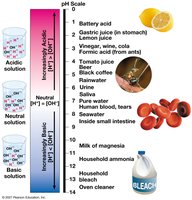
The pH scale measures the concentration of hydrogen ions in solution. It is defined as:
For neutral solutions at 25°C: , so pH = 7.
Acidic solutions: pH < 7
Basic solutions: pH > 7
Most biological fluids: pH 6–8
Buffers
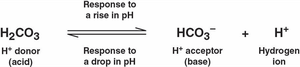
Buffers are substances that minimize changes in pH by combining reversibly with H+ ions. Most buffers consist of a weak acid and its corresponding base.
Example: Carbonic acid (H2CO3) acts as a buffer in blood.
Reaction:
Summary Table: Properties of Water and Their Biological Importance
Property | Description | Biological Importance |
|---|---|---|
Polarity | Unequal sharing of electrons creates partial charges | Allows formation of hydrogen bonds |
Hydrogen Bonding | Weak attraction between water molecules | Leads to cohesion, adhesion, high specific heat |
High Specific Heat | Resists temperature change | Stabilizes environments and organisms |
Heat of Vaporization | Energy required to convert liquid to gas | Evaporative cooling regulates temperature |
Expansion Upon Freezing | Ice is less dense than water | Ice floats, insulating aquatic life |
Solvent Versatility | Dissolves many substances | Facilitates biochemical reactions |
Key Equations
(at 25°C)
Molarity:
Additional info:
Water's role as a solvent is critical for cellular processes, nutrient transport, and waste removal.
Buffer systems are vital for maintaining homeostasis in biological systems.
