Back
Chapter 3: Water and the Fitness of the Environment
Study Guide - Smart Notes
 Tailored notes based on your materials, expanded with key definitions, examples, and context.
Water: Structure, Properties, and Biological Importance
The Polarity of Water Molecules and Hydrogen Bonding
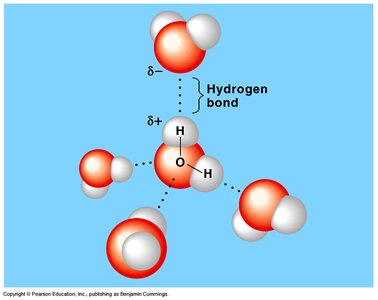
Water is a polar molecule, meaning it has regions of partial positive and negative charge due to the unequal sharing of electrons between hydrogen and oxygen atoms. This polarity allows water molecules to form hydrogen bonds with each other, where the slightly negative oxygen atom of one molecule is attracted to the slightly positive hydrogen atom of another. Each water molecule can form hydrogen bonds with up to four neighbors, creating a dynamic network of interactions.
Polarity: Oxygen is more electronegative than hydrogen, resulting in a partial negative charge (δ-) near the oxygen and a partial positive charge (δ+) near the hydrogens.
Hydrogen Bond: A weak attraction between the hydrogen atom of one water molecule and the oxygen atom of another.
Example: Hydrogen bonding is responsible for many of water's unique properties, such as high cohesion and surface tension.
Cohesion, Adhesion, and Surface Tension
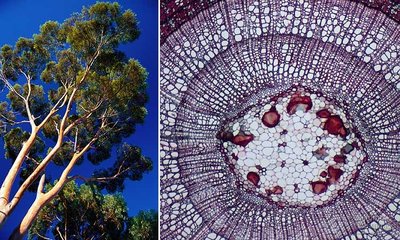
Hydrogen bonds hold water molecules together, a phenomenon known as cohesion. This property allows water to move as a continuous column in plant vessels. Adhesion is the clinging of water molecules to other substances, such as the walls of plant vessels, which also aids in water transport. Surface tension is the measure of how difficult it is to stretch or break the surface of a liquid, and water's surface tension is unusually high due to cohesion.
Cohesion: Responsible for the transport of water against gravity in plants.
Adhesion: Helps water stick to cell walls, aiding in capillary action.
Surface Tension: Allows small insects to walk on water surfaces.
Water Moderates Temperatures on Earth
Water has a high specific heat, meaning it can absorb or release a large amount of heat with only a slight change in its own temperature. This property helps stabilize Earth's climate and organisms' internal environments. Heat is the total kinetic energy of molecules, while temperature measures the average kinetic energy. The calorie is a unit of heat, defined as the amount of heat needed to raise 1 gram of water by 1°C. Specific heat is the amount of heat required to change 1 gram of a substance by 1°C.
Heat of Vaporization: The quantity of heat a liquid must absorb for 1 gram to be converted to gas. Water's high heat of vaporization moderates Earth's climate.
Evaporative Cooling: As water evaporates, the surface cools, helping organisms regulate temperature (e.g., sweating).
Floating of Ice on Liquid Water
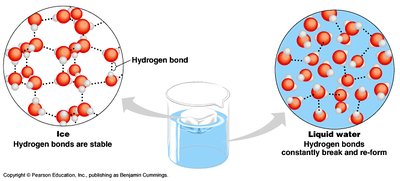
Water is less dense as a solid than as a liquid, which is unusual for most substances. This is because hydrogen bonds in ice keep water molecules further apart than in liquid water, where bonds are constantly breaking and reforming. As a result, ice floats, insulating bodies of water and protecting aquatic life in winter.
Stable Hydrogen Bonds in Ice: Molecules are locked in a crystalline structure.
Liquid Water: Hydrogen bonds are transient, allowing molecules to be closer together.
Biological Importance: If ice sank, lakes and oceans would freeze solid, making life impossible in many environments.
Water as the Solvent of Life
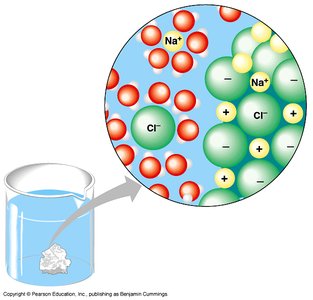
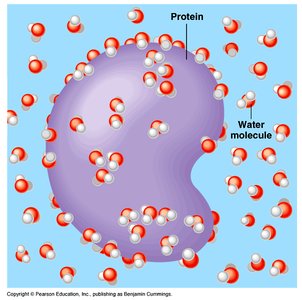
Water is an excellent solvent due to its polarity, allowing it to dissolve many substances. A solution is a homogeneous mixture of two or more substances. The solvent is the dissolving agent, and the solute is the substance dissolved. In an aqueous solution, water is the solvent. Water can dissolve ionic compounds (like salt) and polar molecules (like proteins and sugars).
Hydrophilic Substances: Have an affinity for water (e.g., salts, sugars).
Hydrophobic Substances: Repel water (e.g., oils, fats).
Acids, Bases, and pH
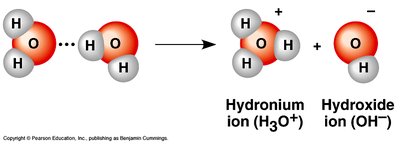
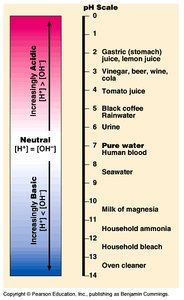
Water can dissociate into hydronium (H3O+) and hydroxide (OH-) ions. An acid increases the hydrogen ion concentration in a solution, while a base reduces it. The product of [H+] and [OH-] in any aqueous solution at 25°C is always $10^{-14}$. The pH scale is used to express the concentration of hydrogen ions, where $\mathrm{pH} = -\log [\mathrm{H}^+]$ and $[\mathrm{H}^+] = 10^{-\mathrm{pH}}$.
Acid Example: HCl → H+ + Cl-
Base Example: NaOH → Na+ + OH-
pH Scale: Ranges from 0 (most acidic) to 14 (most basic), with 7 being neutral.
Buffers and pH Regulation
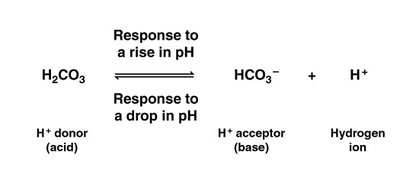
Buffers are substances that minimize changes in pH by accepting or donating hydrogen ions as needed. They typically consist of a weak acid and its corresponding base. Buffers are crucial for maintaining stable pH in biological systems, such as blood.
Example: The bicarbonate buffer system in blood: $\mathrm{H}_2\mathrm{CO}_3 \rightleftharpoons \mathrm{HCO}_3^- + \mathrm{H}^+$
Function: Resists changes in pH when acids or bases are added.
Acid Precipitation and Environmental Impact
Acid precipitation refers to rain, snow, or fog with a pH lower than 5.6, caused by atmospheric pollutants like sulfur dioxide and nitrogen oxides. Acid precipitation can damage forests, aquatic ecosystems, and man-made structures, threatening environmental health and biodiversity.
Sources: Burning fossil fuels releases sulfur and nitrogen compounds.
Effects: Acidifies lakes and soils, harms plants and aquatic life.