Back
Chapter 3: Water – Properties and Biological Significance
Study Guide - Smart Notes
 Tailored notes based on your materials, expanded with key definitions, examples, and context.
Water: Structure and Hydrogen Bonding
Polarity and Hydrogen Bonds
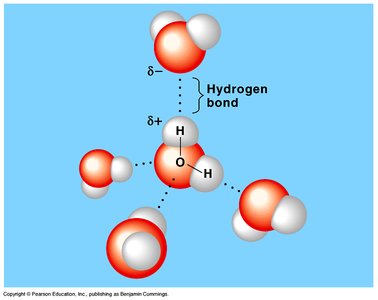
Water molecules are polar, meaning they have regions with partial positive and partial negative charges. This polarity arises because oxygen is more electronegative than hydrogen, causing electrons to spend more time near the oxygen atom. The slightly negative regions of one water molecule are attracted to the slightly positive regions of another, forming hydrogen bonds. Each water molecule can form hydrogen bonds with up to four neighbors, which is fundamental to water's unique properties.
Polarity: Water has a bent shape, with oxygen at one end and hydrogen atoms at the other, resulting in a dipole moment.
Hydrogen Bonding: The attraction between the hydrogen atom of one water molecule and the oxygen atom of another.
Biological Importance: Hydrogen bonds are responsible for many of water's properties, such as cohesion, adhesion, and high specific heat.
Example: Water's ability to dissolve many substances is due to its polarity and hydrogen bonding.
Cohesion, Adhesion, and Surface Tension
Interactions Between Water Molecules
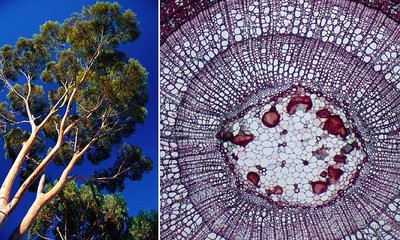
Cohesion refers to the tendency of water molecules to stick together due to hydrogen bonding. Adhesion is the clinging of water molecules to other substances, such as the walls of plant vessels. Surface tension is the measure of how difficult it is to stretch or break the surface of a liquid, and it is higher in water than in most other liquids due to cohesion.
Cohesion: Enables water to move upward in plants against gravity.
Adhesion: Helps water adhere to cell walls, facilitating transport.
Surface Tension: Allows small insects to walk on water and supports the formation of droplets.
Example: Water transport in tall trees relies on both cohesion and adhesion.
Water's Role in Temperature Regulation
Heat, Temperature, and Specific Heat
Water moderates Earth's temperatures by absorbing heat from warmer air and releasing it to cooler air. The kinetic energy of atoms and molecules is measured as heat and temperature. Heat is the total kinetic energy, while temperature is the average kinetic energy. Water has a high specific heat, meaning it can absorb or release large amounts of heat with only a slight change in its own temperature.
Calorie: The amount of heat required to raise 1 gram of water by 1°C.
Specific Heat: Water's specific heat is 1 cal/g/°C, which is higher than most substances.
Heat of Vaporization: The heat required to convert 1 gram of liquid water to gas.
Evaporative Cooling: As water evaporates, the surface cools, helping organisms regulate temperature.
Example: Oceans stabilize coastal climates due to water's high specific heat.
Density and Floating Ice
Solid vs. Liquid Water
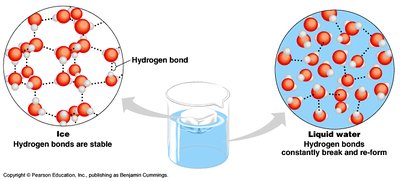
Water is less dense as a solid than as a liquid, which is unusual among substances. In ice, hydrogen bonds are stable and keep water molecules further apart, making ice less dense. In liquid water, hydrogen bonds constantly break and reform, allowing molecules to be closer together. This property ensures that ice floats, preventing bodies of water from freezing solid and supporting aquatic life.
Hydrogen Bonds in Ice: Stable, forming a crystalline structure.
Hydrogen Bonds in Liquid: Transient, allowing closer packing of molecules.
Biological Importance: Floating ice insulates water below, protecting aquatic organisms.
Example: Lakes and oceans remain liquid beneath ice during winter.
Water as the Solvent of Life
Solutions, Solvents, and Solutes
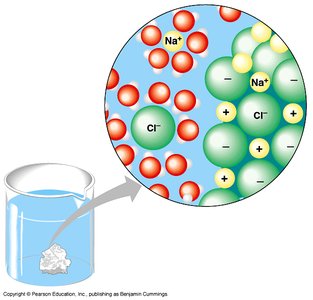
A solution is a homogeneous mixture of two or more substances. The solvent is the dissolving agent, and the solute is the substance dissolved. In aqueous solutions, water is the solvent. Water's polarity allows it to dissolve a wide range of substances, making it essential for biological processes.
Hydrophilic Substances: Have an affinity for water and dissolve easily.
Hydrophobic Substances: Repel water and do not dissolve.
Example: Salt (NaCl) dissolves in water due to interaction with water's polar molecules.
Hydrophilic and Hydrophobic Interactions
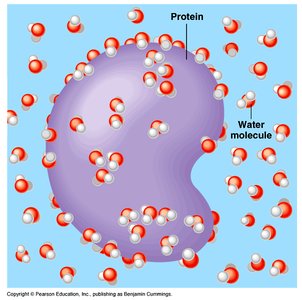
Hydrophilic substances interact with water molecules, often forming hydrogen bonds. Hydrophobic substances, such as oils, do not mix with water. These interactions are crucial for biological structures, such as cell membranes and protein folding.
Hydrophilic Example: Proteins and sugars dissolve in water.
Hydrophobic Example: Lipids form membranes by avoiding water.
Acids, Bases, and pH
pH Scale and Ion Concentrations
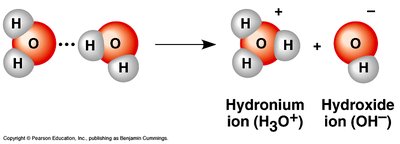
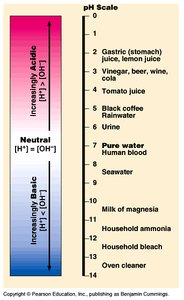
Acids increase the concentration of hydrogen ions (H+) in a solution, while bases decrease it. The product of H+ and OH- concentrations in any solution is constant at . The pH scale expresses the concentration of H+ ions, with lower values being more acidic and higher values more basic.
Acid Example: Hydrochloric acid (HCl) dissociates to release H+.
Base Example: Sodium hydroxide (NaOH) releases OH- ions.
Key Equations:
Buffers and pH Regulation
Buffer Systems
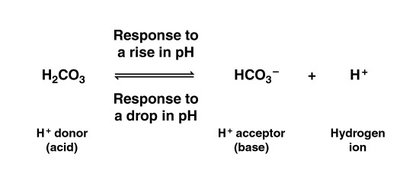
Buffers resist changes in pH when acids or bases are added to a solution. They typically consist of a weak acid and its corresponding base. Buffers are essential for maintaining stable pH in biological systems, such as blood.
Example: The bicarbonate buffer system in blood maintains pH within a narrow range.
Buffer Reaction:
Acid Precipitation and Environmental Impact
Acid Rain
Acid precipitation occurs when rain, snow, or fog has a pH lower than 5.6, often due to pollutants such as sulfur dioxide and nitrogen oxides. Acid rain threatens the fitness of the environment by damaging forests, lakes, and aquatic life.
Environmental Impact: Acid rain can lead to the loss of biodiversity and disrupt ecosystem function.
Example: Acidified lakes may lose fish populations and forest health declines.