 Back
Chapter 30: An Introduction to Animals – Structure, Diversity, and Evolution
Study Guide - Smart Notes
 Tailored notes based on your materials, expanded with key definitions, examples, and context.
Introduction to Animals
Overview of Animal Diversity
Animals are a highly diverse group of eukaryotic organisms, with estimates of 3 to 10 million species on Earth. Only about 1.4 million species have been formally described, and scientists are actively working to discover and catalog more before they go extinct. Animals range from familiar forms to those quite different from humans.
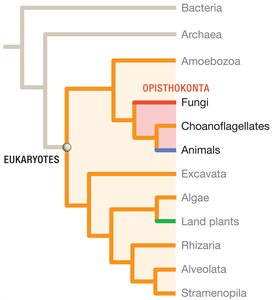
Animals originated from single-celled eukaryotes within the lineage Opisthokonta.
The closest living relatives to animals are choanoflagellates, sharing a common ancestor about 900 million years ago.
What Is an Animal?
Key Traits of Animals
Animals are defined by several key characteristics:
Multicellularity: Animals are multicellular, lacking cell walls but possessing an extensive extracellular matrix (ECM).
Heterotrophy: Animals obtain carbon compounds from other organisms, typically by ingestion rather than absorption.
Motility: Animals move under their own power at some stage of their life cycle.
Biologists currently recognize 30–35 major animal phyla, though this number is subject to change as new data emerges.
Major Animal Phyla
Animal phyla are grouped based on body plan and evolutionary relationships. The following table summarizes major animal phyla, their common names, and approximate numbers of described species:
Group/Phylum | Common Name/Example | Described Species |
|---|---|---|
Placozoa | Placozoans | 1 |
Ctenophora | Comb jellies | 190 |
Porifera | Sponges | 8,500 |
Cnidaria | Jellyfish, corals, anemones | 11,500 |
Platyhelminthes | Flatworms | 20,000 |
Mollusca | Mollusks (clams, snails, octopuses) | 85,000 |
Annelida | Segmented worms | 16,800 |
Nematoda | Roundworms | 25,000 |
Arthropoda | Arthropods (insects, spiders, crustaceans) | 1,200,000 |
Echinodermata | Sea stars, sea urchins | 7,000 |
Chordata | Chordates (vertebrates, tunicates, lancelets) | 65,000 |
Key Innovations in Animal Evolution
Sources of Evidence
Biologists use several types of data to study animal evolution:
Fossils: Provide direct evidence of ancient animals, their appearance, and habitats.
Comparative Morphology: Distinguishes shared traits and synapomorphies, helping define body plans and evolutionary relationships.
Comparative Development (Evo-Devo): Examines gene expression and morphological changes during development, revealing genetic and developmental homologies or convergent evolution.
Comparative Genomics: Compares gene and genome similarities to infer phylogenetic relationships and evolutionary history.
Origin of Multicellularity
All animals are a monophyletic group, sharing a single multicellular ancestor. Evidence from fossils, morphology, development, and genomics supports this. The prevailing hypothesis is that sponges are the most ancient animal lineage.

Origin of Embryonic Tissue Layers and Muscle
Sponges possess the genetic toolkit for cell adhesion but lack complex tissues. The evolution of tissues led to two major groups:
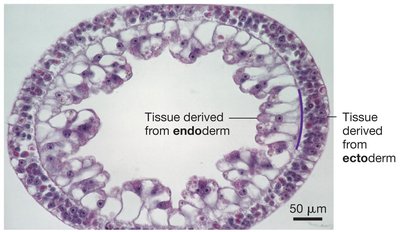
Diploblasts: Animals with two germ layers (ectoderm and endoderm), e.g., Ctenophora and Cnidaria.
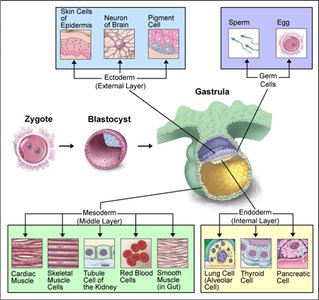
Triploblasts: Animals with three germ layers (ectoderm, mesoderm, endoderm).
Origin and Diversification of Tissues
Germ layers give rise to distinct tissues and organs:
Ectoderm: Forms skin and nervous system.
Endoderm: Forms the lining of the digestive tract.
Mesoderm: Forms muscles, circulatory system, and internal organs.
Body Symmetry, Cephalization, and Nervous System
Types of Symmetry
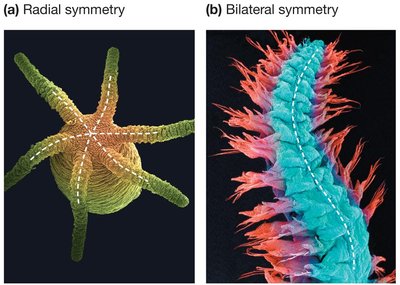
Body symmetry is a key aspect of animal body plans:
Radial symmetry: Multiple planes of symmetry (e.g., cnidarians, ctenophores).
Bilateral symmetry: Single plane of symmetry, associated with long, narrow bodies (e.g., most other animals).
Cephalization and Nervous System Evolution
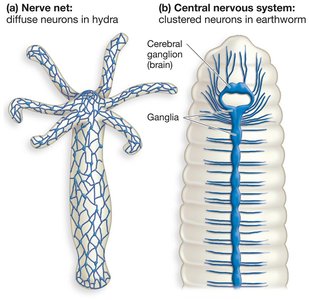
Cephalization is the evolution of a head region where sensory organs and the brain are concentrated. Bilaterians have diverse nervous systems, from nerve nets to centralized nervous systems (CNS) with ganglia and brains.
Origin of the Coelom
Body Cavities in Animals
The basic bilaterian body plan is a tube within a tube, with a gut (inner tube), body wall (outer tube), and mesoderm in between. The coelom is a fluid-filled cavity between the tubes, providing space for organ movement and nutrient circulation.
Coelomates: Coelom completely lined with mesoderm.
Acoelomates: No coelom (e.g., flatworms).
Pseudocoelomates: Coelom partially lined with mesoderm (e.g., roundworms, rotifers).
Protostomes and Deuterostomes
Developmental Differences
Bilaterian animals are divided into two groups based on embryonic development:
Protostomes: Mouth develops before anus.
Deuterostomes: Anus develops before mouth.
Segmentation
Evolution and Function of Segmentation
Segmentation is the division of the body into repeated segments, seen in annelids, arthropods, and vertebrates. It enables specialization and diversification through changes in gene expression (e.g., Hox genes).
Themes in Animal Diversification
Factors Driving Diversification
Higher oxygen levels: Enabled evolution of large, active animals.
Evolution of predation: Drove adaptations for escape and defense.
New niches: Created by animal diversification itself.
Genetic tool kit evolution: Allowed for increased morphological diversity.
Sensory Organs
Diversity of Sensory Abilities
Cephalization led to the concentration of sensory organs in the head. Animals have evolved a wide range of sensory abilities, including sight, hearing, taste, smell, touch, and specialized senses such as detection of magnetic fields, electric fields, and barometric pressure.
Sense | Example |
|---|---|
Sight | Flies use compound eyes to find food and mates |
Hearing | Bats use hearing to locate prey |
Taste/Smell | Moths detect chemical signals with antennae |
Touch | Sea anemones detect prey by touch |
Other senses | Pit vipers sense heat, sea turtles sense magnetic fields, sharks detect electric fields, birds sense barometric pressure, comb jellies sense gravity |
Feeding Strategies and Ecological Roles
What Animals Eat
Detritivores: Feed on dead organic matter (e.g., millipedes).
Herbivores: Feed on plants or algae (e.g., pandas).
Carnivores: Feed on other animals (e.g., owls).
Omnivores: Eat both plants and animals (e.g., humans).
How Animals Feed
Animals use four general feeding strategies:
Suspension feeders: Filter particles from water or air (e.g., barnacles, baleen whales).
Deposit feeders: Ingest organic material from substrates (e.g., earthworms, sea cucumbers).
Fluid feeders: Suck or mop up liquids (e.g., butterflies, vampire bats).
Mass feeders: Ingest chunks of food (e.g., lions, snails).
Movement and Locomotion
Types of Skeletons
Animal movement is powered by muscle and supported by three types of skeletons:
Hydrostatic skeletons: Support from fluid-filled body cavities (e.g., worms).
Endoskeletons: Internal rigid structures (e.g., vertebrate bones).
Exoskeletons: External rigid structures (e.g., arthropod exoskeletons).
Diversity of Limbs
Limbs have evolved in various forms, including lobe-like limbs, jointed limbs, parapodia, tube feet, and tentacles. Genetic studies (e.g., the Distal-less gene) show homology in limb development across animal phyla.
Reproduction and Life Cycles
Modes of Reproduction
Asexual reproduction: Offspring are genetic clones (e.g., budding, fission, parthenogenesis in rotifers).
Sexual reproduction: Involves meiosis and fusion of gametes, leading to genetic diversity.
Fertilization and Embryonic Development
Internal fertilization: Sperm is transferred inside the female's body.
External fertilization: Eggs and sperm are released into the environment, common in aquatic species.
Animals are also classified by where embryos develop:
Viviparous: Embryos develop inside the mother, nourished directly (e.g., most mammals).
Oviparous: Eggs are laid outside the body, embryos nourished by yolk (e.g., most insects, birds).
Ovoviviparous: Eggs retained inside the mother, embryos nourished by yolk, young are born live (e.g., some fish, reptiles).
Life Cycles and Metamorphosis
Most animals have diploid-dominant life cycles. Metamorphosis is a dramatic change from larval to adult form, often involving different habitats and diets for larvae and adults. This reduces competition and can aid dispersal.
