 Back
BackBio 100 Lec Chapter 4 Study Guide
Study Guide - Smart Notes
 Tailored notes based on your materials, expanded with key definitions, examples, and context.
Bio 100 Lec Chapter 4 Study Guide
Carbon and the Molecular Diversity of Life
Organic Chemistry and the Origin of Life
Organic chemistry is fundamental to understanding biological systems, as it focuses on compounds containing carbon. The diversity of organic molecules forms the basis of life, and their properties are governed by chemical laws.
Organic chemistry: The study of compounds containing carbon, regardless of their origin.
Organic compounds: Range from simple molecules (e.g., methane) to colossal ones (e.g., proteins, DNA).
Relevance: Biological systems obey chemical laws, making chemistry central to life sciences.
Experimental Evidence: Origin of Organic Molecules
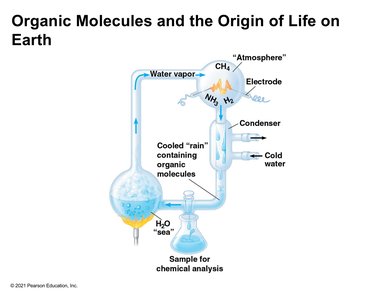
The Miller-Urey experiment demonstrated that organic molecules could be synthesized under conditions simulating early Earth, without the presence of life. This experiment refuted the idea that organic molecules could only be formed within living organisms.
Experimental setup: Simulated early Earth's atmosphere (water vapor, hydrogen, methane, ammonia), electrical discharge to mimic lightning, cooling to produce "rain" containing organic molecules.
Key finding: Complex organic molecules were produced in a closed, lifeless system.
Critical thinking: The experiment shows possibility, not certainty, of life's origin from non-living sources. Scientific experiments require careful analysis and are subject to revision.
Carbon's Properties and Molecular Diversity
Valence Electrons and Bond Formation
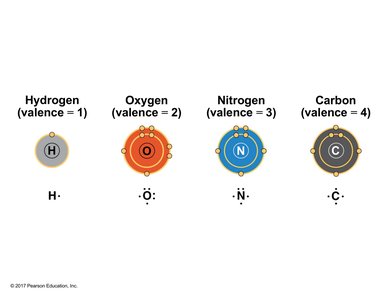
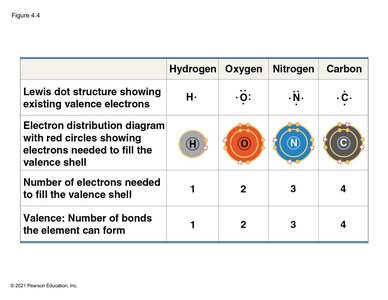
Carbon's ability to form four covalent bonds makes it uniquely suited to create diverse molecules. The behavior of atoms is determined by their valence electrons, which dictate bonding capacity.
Valence electrons: Outermost electrons involved in bonding.
Carbon: Has four valence electrons, forms four bonds.
Other elements: Hydrogen (1 bond), Oxygen (2 bonds), Nitrogen (3 bonds).
Element | Valence Electrons | Bonds Formed |
|---|---|---|
Hydrogen | 1 | 1 |
Oxygen | 2 | 2 |
Nitrogen | 3 | 3 |
Carbon | 4 | 4 |
Diversity of Carbon-Based Molecules
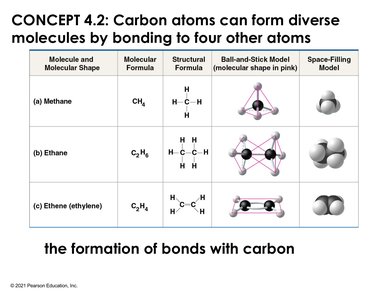
Carbon atoms can bond with themselves and other elements, resulting in a wide variety of molecular shapes and structures. This diversity is essential for the complexity of biological molecules.
Methane (CH4): Simple carbon-hydrogen molecule.
Ethane (C2H6): Two carbons bonded together.
Ethene (C2H4): Contains a double bond between carbons.
Structural diversity: Carbon's bonding allows for various molecular shapes (linear, branched, rings).
Molecule | Molecular Formula | Structural Formula | Ball-and-Stick Model | Space-Filling Model |
|---|---|---|---|---|
Methane | CH4 | H–C–H | 3D tetrahedral | Compact sphere |
Ethane | C2H6 | H–C–C–H | 3D linear | Elongated sphere |
Ethene | C2H4 | H2C=CH2 | Planar | Flat sphere |
Types of Carbon Skeletons
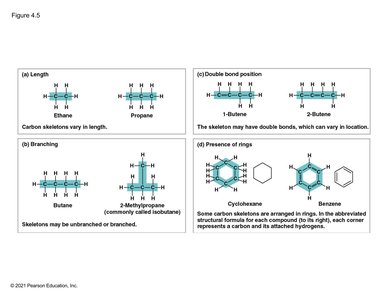
Carbon skeletons can vary in length, branching, double bond position, and ring structure, contributing to molecular diversity and function.
Length: Number of carbon atoms in a chain (e.g., ethane vs. propane).
Branching: Linear vs. branched chains (e.g., butane vs. 2-methylpropane).
Double bond position: Location of double bonds affects properties (e.g., 1-butene vs. 2-butene).
Rings: Presence of rings (e.g., cyclohexane, benzene) adds structural complexity.
Hydrocarbons and Energy Storage
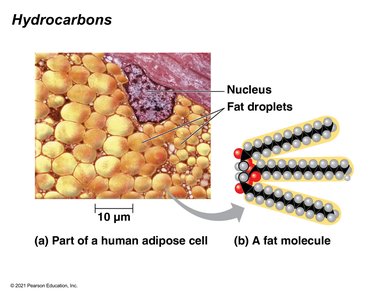
Hydrocarbons are molecules consisting entirely of carbon and hydrogen. They are important for energy storage in biological systems, such as fat molecules in adipose cells.
Hydrocarbons: Nonpolar molecules, store energy efficiently.
Fat molecules: Contain hydrocarbon tails, diversity in length and double bond position.
Biological relevance: Energy acquisition and storage, structural diversity in fats.
Isomers: Structural and Functional Diversity
Types of Isomers
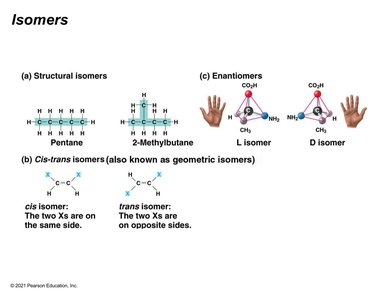
Isomers are molecules with the same molecular formula but different structures, leading to differences in properties and biological function.
Structural isomers: Differ in covalent arrangement (e.g., pentane vs. 2-methylbutane).
Cis-trans (geometric) isomers: Differ in spatial arrangement around a double bond (cis: same side, trans: opposite sides).
Enantiomers: Mirror-image isomers, differ in spatial arrangement of groups attached to carbon.
Enantiomers and Clinical Relevance
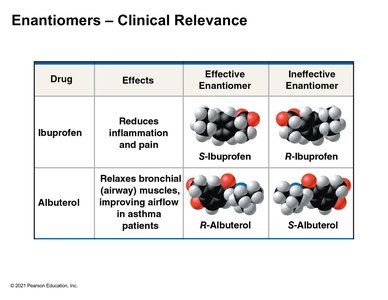
Enantiomers can have dramatically different biological effects. In pharmaceuticals, one enantiomer may be effective while the other is not, due to differences in molecular interactions.
Ibuprofen: S-enantiomer is effective for pain relief; R-enantiomer is ineffective.
Albuterol: R-enantiomer relaxes airway muscles; S-enantiomer is ineffective.
Specificity: Spatial arrangement affects binding and efficacy in biological systems.
Drug | Effect | Effective Enantiomer | Ineffective Enantiomer |
|---|---|---|---|
Ibuprofen | Reduces inflammation and pain | S-Ibuprofen | R-Ibuprofen |
Albuterol | Relaxes bronchial muscles | R-Albuterol | S-Albuterol |
Functional Groups and Chemical Properties
Functional Groups in Biological Molecules
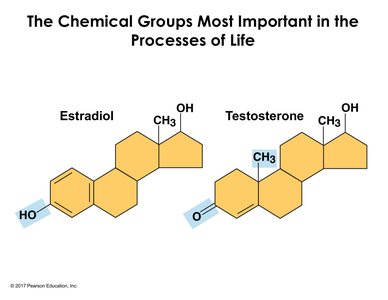
Functional groups are specific chemical groups attached to carbon skeletons, conferring distinct properties and reactivity to organic molecules. Small changes in functional groups can have significant biological effects.
Estradiol vs. Testosterone: Both have similar carbon skeletons, but differ in functional groups, leading to different biological effects.
Functional group diversity: Impacts molecular function and physiological behavior.
Seven Key Functional Groups
Several functional groups are commonly found in biological molecules, each conferring specific properties:
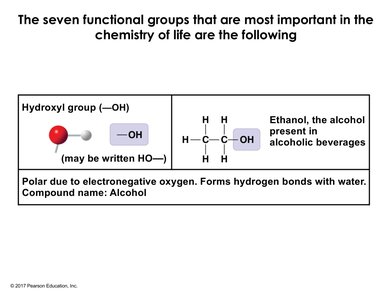
Hydroxyl group (–OH): Polar, forms hydrogen bonds, increases solubility in water. Example: Ethanol.
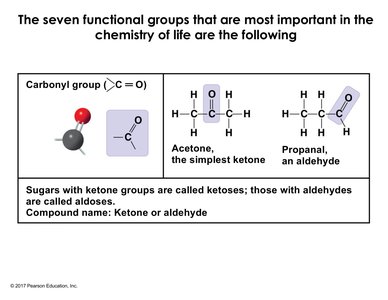
Carbonyl group (C=O): Polar, reactive, found in aldehydes and ketones. Example: Acetone, propanal.
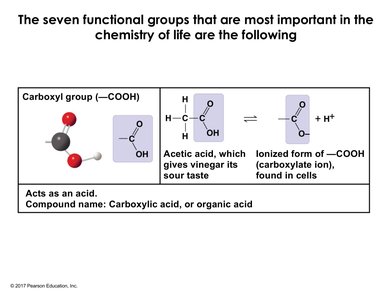
Carboxyl group (–COOH): Acidic, donates protons, found in amino acids. Example: Acetic acid.
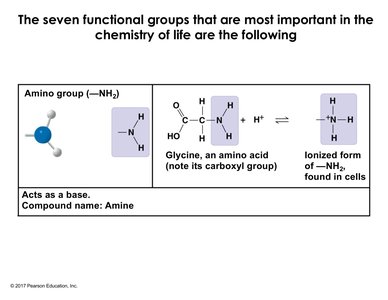
Amino group (–NH2): Basic, accepts protons, found in amino acids. Example: Glycine.
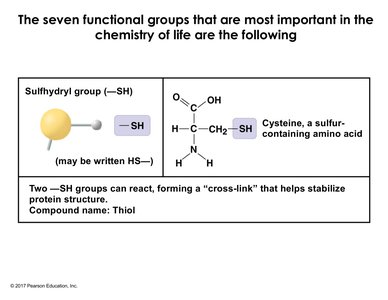
Sulfhydryl group (–SH): Forms disulfide bridges, stabilizes protein structure. Example: Cysteine.
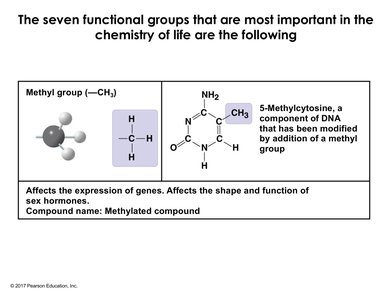
Methyl group (–CH3): Nonpolar, affects gene expression and molecular shape. Example: 5-methylcytosine.
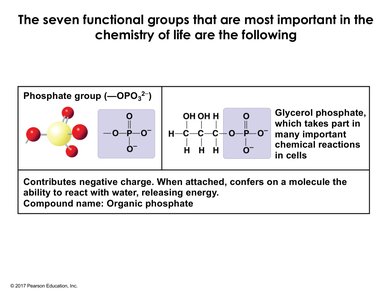
Phosphate group (–OPO32–): Contributes negative charge, enables energy transfer. Example: Glycerol phosphate.
ATP: Energy Transfer in Cells
ATP Structure and Function
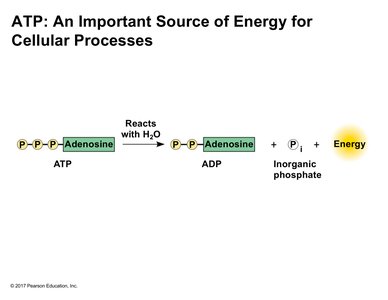
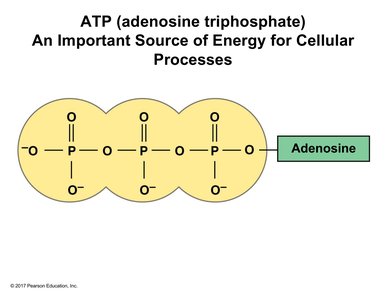
ATP (adenosine triphosphate) is a key molecule for energy transfer in cells. It consists of adenosine attached to three phosphate groups. Hydrolysis of ATP releases energy by removing a phosphate group, forming ADP (adenosine diphosphate) and inorganic phosphate.
ATP hydrolysis:
Phosphate group: Responsible for energy release and transfer.
Biological importance: ATP powers cellular processes, including metabolism, transport, and signaling.
Additional info: These notes expand upon the lecture and slide content, providing definitions, examples, and context for key concepts in carbon chemistry and molecular diversity relevant to introductory biology.
